The good news: a direct, FAA-PMA approved replacement exists. Manufactured by Ni-Cad Systems, Inc.—a Hayward, California-based Part 145 repair facility with over 50 years of exclusive focus on aircraft battery systems—this certified alternative delivers full traceability, meets or exceeds OEM specifications, and ships promptly to keep your aircraft flying.
This article covers what the C734-01-030 is, why FAA-PMA approval is non-negotiable for battery components, what documentation you'll receive, and how to access fast delivery including AOG (Aircraft on Ground) support when every hour of downtime counts.
TLDR: Key Takeaways
- Ni-Cad Systems manufactures an FAA-PMA approved replacement for the Page Aerospace C734-01-030
- FAA-PMA parts carry identical legal airworthiness standing as OEM components under 14 CFR Part 21
- Every replacement ships with full traceability including FAA Form 8130-3 airworthiness approval tag
- 24/7 AOG support at +1 510 501 9391 — rental batteries available to keep aircraft in service during turnaround
- Ni-Cad Systems holds 30+ FAA-PMA approvals and has serviced 47,000+ units since 1974
What Is the Page Aerospace C734-01-030?
The Page Aerospace C734-01-030 is an emergency power supply battery pack designed specifically for Dassault Falcon business jets. This component provides backup power to emergency lighting systems—a safety-critical function that ensures illumination for evacuation routes, exit signs, and critical areas during main electrical system failures or emergency landings.
That backup function spans several Falcon platforms: the Falcon 50, Falcon 900, Falcon 900EX, Falcon 2000, and Falcon 2000EX. As a complete battery assembly, it stores and delivers electrical power through the aircraft's emergency power distribution network, activating automatically when the main system fails.
Why operators seek second-source alternatives:
- OEM discontinuation of legacy components as platforms age — the global fleet average reached 16.3 years in 2025
- Supply chain bottlenecks that cost the global airline industry an estimated $11 billion in 2025, with $3.1 billion attributed to maintenance costs alone
- AOG events running $10,000 to $150,000 per hour depending on aircraft type and route
- Single-source dependency on OEM pricing with no competitive alternative

Each of these pressures is exactly why the FAA-PMA framework exists: to give operators a certified, competitive alternative to OEM-only supply chains across commercial, corporate, and military aviation.
Why FAA-PMA Approval Is Non-Negotiable for This Part
What FAA-PMA Actually Means
Under 14 CFR Part 21 Subpart K, a Parts Manufacturer Approval (PMA) is a combined design and production approval issued by the FAA. It legally authorizes a manufacturer to produce replacement articles for installation on type-certificated aircraft. PMA parts carry the same airworthiness standing as OEM components—they're not alternatives or substitutes, but fully approved equivalents.
The Rigor Behind PMA Approval
The FAA doesn't rubber-stamp PMA applications. Manufacturers must prove compliance through one of two pathways:
- Identicality — the design is identical to the OEM article in every respect, with or without a licensing agreement
- Test and Computation — reverse engineering, comparative analysis, and validation testing confirm the part meets or exceeds original airworthiness standards
Both pathways require review by FAA engineers or a Designated Engineering Representative (DER), independent technical reviewers authorized by the FAA to evaluate design data and recommend approval only after thorough validation.
Why This Matters for Battery Components
Aircraft battery systems are safety-significant components under 14 CFR § 25.1353. Ni-Cd battery installations must:
- Maintain safe cell temperatures and pressures
- Prevent accumulation of explosive or toxic gases
- Feature automatic systems to control charging rates
- Disconnect the battery during over-temperature conditions or failures
A failure in emergency power supply systems can affect engine start capability, emergency systems, and critical avionics. For that reason, part provenance and approval status are subject to the same scrutiny as the component itself.
The Severe Risks of Unapproved Parts
The FAA actively investigates and prosecutes cases involving Suspected Unapproved Parts (SUPs). In 2019, the agency proposed a $203,100 civil penalty against GEE-BEE Aeroproducts for manufacturing and selling unapproved parts without required authorizations. Unapproved alternatives—surplus parts with unknown history, counterfeit hardware, components lacking traceability—pose catastrophic risks:
- Aircraft grounding by FAA inspectors
- Voided maintenance records
- Exposure to enforcement actions and civil penalties
- Unvalidated design that may fail in flight-critical situations
That's precisely why sourcing matters as much as the part number itself.
In-House Engineering Authority
Ni-Cad Systems' Vice President, Stephen Andrues, holds FAA Designated Engineering Representative (DER) credentials alongside his A&P mechanic and pilot certificates. The technical authority behind the company's 30+ PMA approvals is built into the organization, not contracted out. Buyers have direct access to the same engineering expertise that validated the part they're installing.
Ni-Cad Systems' Certified Replacement: Who's Behind It and Why It Matters
Ni-Cad Systems, Inc. is the source of the FAA-PMA approved replacement for the C734-01-030. Founded in 1974 and based in Hayward, California, this Part 145 repair facility has maintained exclusive focus on aircraft battery and power supply systems for over 50 years.
Portfolio depth and specialization:
- 30+ FAA-PMA approvals across NiCd batteries, temperature sensors, and modification kits
- 47,000+ units serviced since 1974—a concrete indicator of production volume, quality consistency, and field-proven reliability
- Single-category depth — aircraft battery systems are the only thing on the table, not a side offering from a general parts distributor
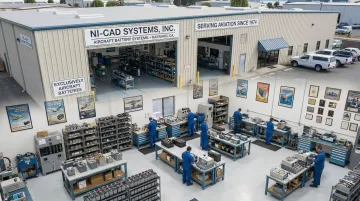
According to IMARC Group, the global commercial aircraft PMA market reached $11.4 billion in 2024 and is projected to grow to $15.6 billion by 2033. Within this expanding market, 74% of airlines now use PMA parts to mitigate supply chain challenges, prioritizing cost savings and availability equally.
What sets Ni-Cad Systems apart within this market is its position as both PMA holder and Part 145 repair station. That dual role means full visibility and accountability across design, manufacture, and service—no handoffs to brokers who lack manufacturing oversight, no gaps in the traceability chain.
Ni-Cad Systems serves corporate aviation, airlines, and military operators—customer segments that run structured procurement programs and hold suppliers to strict quality standards. For parts sourcing managers in those environments, that operational history is a faster path to approval than any spec sheet.
Traceability and Documentation: What Comes With Every Part
In aviation, traceability is proof of airworthiness. Every component installed on a type-certificated aircraft requires an unbroken documentation chain from manufacture to installation.
Every C734-01-030 replacement from Ni-Cad Systems ships with a complete documentation package:
- FAA Form 8130-3 — Airworthiness Approval Tag issued by an authorized Release Certifying Employee (RCE), confirming origin and conformity to approved design data
- Certificate of Conformance — Signed verification of compliance with all applicable specifications
- Test data sheets — Capacity and performance results from production validation testing
- PMA reference documentation — Ties the part directly to its FAA approval, including lot/batch control and inspection sign-offs at critical production stages
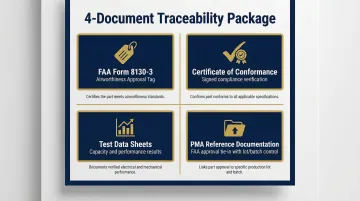
This package satisfies incoming inspection requirements under AC 20-62E, supports logbook entries per 14 CFR Part 43, and holds up under FAA audits, airline quality reviews, and military compliance checks.
Because Ni-Cad Systems is both the manufacturer and the Part 145 facility, documentation originates at the source—there are no intermediaries creating gaps, no brokers with incomplete records, no questions about origin or conformity.
Availability, Lead Times, and AOG Support
Current availability: The C734-01-030 replacement is in stock and ready for prompt shipment. For current inventory levels and lead times, contact Ni-Cad Systems at +1 510 785 9391.
AOG support when downtime isn't an option:
Aircraft on Ground situations represent one of aviation's most severe financial disruptions. With hourly costs ranging from $10,000 to $150,000 depending on aircraft type and route, every minute counts.
Ni-Cad Systems offers dedicated AOG support including:
- +1 510 501 9391 — 24/7 emergency line staffed by battery technicians, not a call center
- Rental battery program — Loaner units keep your Falcon flying while your primary battery is being serviced or a replacement is in transit
- Expedited order processing — Priority handling for AOG-status requests
The rental program eliminates the grounding risk entirely. While your permanent replacement is being prepared, a loaner battery keeps the aircraft operational — no downtime, no deferred revenue.
How to order:
- Phone: +1 510 785 9391 (Monday–Friday 8:00–6:00 PST, Saturday by appointment)
- Email: Sales@NiCadSystems.com
- 24/7 AOG line: +1 510 501 9391
Every call reaches a technician with hands-on NiCd battery experience — the same team that holds 30+ FAA-PMA approvals and has serviced over 47,000 units since 1974.
Frequently Asked Questions
What exactly is the Page Aerospace C734-01-030, and what aircraft does it support?
The C734-01-030 is an emergency power supply battery pack for Dassault Falcon business jets, including the Falcon 50, 900, 900EX, 2000, and 2000EX. It provides backup power to emergency lighting systems during main electrical failures.
Is a FAA-PMA replacement part legally equivalent to the original Page Aerospace part?
Yes. Under 14 CFR Part 21 Subpart K, FAA-PMA parts are legally approved for installation on type-certificated aircraft and carry identical airworthiness standing as OEM components. Design and production standards must meet or exceed the original — that's a condition of PMA approval, not a marketing claim.
What documentation will I receive with the replacement C734-01-030?
You'll receive FAA Form 8130-3 airworthiness approval tag, Certificate of Conformance, test data sheets, and PMA reference documentation—everything required for incoming inspection, logbook entries, and regulatory compliance.
How quickly can Ni-Cad Systems ship the replacement part?
Units are stocked for same-day or next-day shipment in most cases. For current lead times and expedited AOG options, contact Ni-Cad Systems at +1 510 785 9391 or their 24/7 emergency line at +1 510 501 9391.
Can Ni-Cad Systems also repair or overhaul my existing C734-01-030 unit?
Yes. As a Part 145 repair station, Ni-Cad Systems offers repair and overhaul services including capacity testing and deep-cycle testing. Ni-Cad Systems provides rental batteries so you can maintain operations while your unit is in service.
How do I know a surplus or unapproved part is not a safe substitute for the C734-01-030?
Unapproved parts lack FAA design validation, have no traceability to an approved manufacturer, and expose operators to severe enforcement risks. The FAA has imposed civil penalties exceeding $200,000 for unapproved parts violations — a risk no operator or MRO should accept.