Introduction
Picture this: your aircraft is on the ground, a VARTA battery receptacle has corroded beyond serviceable limits, and your maintenance team is watching the clock. Every hour of delay costs thousands of dollars in lost revenue, crew downtime, and schedule disruption. Reaching for an unapproved or undocumented replacement part isn't just a shortcut — it's a regulatory violation that can extend your AOG event significantly if discovered during post-maintenance inspection.
FAA regulations under 14 CFR 21.9 strictly prohibit installation of replacement parts not produced under a Type Certificate, FAA-PMA, or other approved pathway. Installing an unapproved receptacle (even one that appears physically identical) can ground your aircraft pending airworthiness review and expose your operation to regulatory penalties.
This post covers what VARTA aircraft battery receptacles are, why they fail predictably due to potassium hydroxide corrosion, what FAA certification and traceability actually require, and how to source a compliant replacement that clears inspection, ships with full traceability documentation, and gets your aircraft back in service.
Key Takeaways
- Battery receptacles degrade due to KOH electrolyte corrosion, mechanical wear, and thermal cycling—replacement is routine but regulation-sensitive
- FAA regulations require replacement parts from approved sources (OEM or FAA-PMA) with proper release documentation (FAA Form 8130-3)
- Traceability means a documented chain of custody: batch records, part numbers, and test data to satisfy airworthiness requirements
- AOG situations require speed and compliance together—a Part 145 facility with PMA-approved stock delivers both
- Verify PMA eligibility using the FAA's Dynamic Regulatory System database before installation
What Is a VARTA Aircraft Battery Receptacle and Why Does It Fail?
The battery receptacle on VARTA NiCd aircraft batteries is the electrical connector assembly that interfaces the battery with the aircraft's power bus. It carries high-amperage loads during normal operations, engine start sequences, and emergency power delivery. Maintaining a low-resistance, secure connection is non-negotiable across corporate jets, turboprops, regional airliners, and military aircraft.
Understanding how this component fails helps technicians catch problems before they become AOG events.
Primary Failure Modes
VARTA NiCd batteries use potassium hydroxide (KOH) as their electrolyte—a highly caustic alkaline solution that is corrosive to metals and tissue. According to FAA Advisory Circular AC 43-4B (2018), any KOH leakage will cause corrosion. The AC mandates that NiCd battery compartments be cleaned with ammonia or boric acid solutions to neutralize the alkali, dried thoroughly, and painted with alkali-resistant varnish.
The four most common failure vectors:
- KOH attacks metal contacts, creating pitting and discoloration at connection surfaces
- Repeated connect/disconnect cycles wear down contact surfaces over time
- High-current events during start or emergency delivery cause cumulative thermal stress
- Thermal cycling gradually cracks or deforms plastic housing materials
Visual and Functional Indicators of End-of-Life
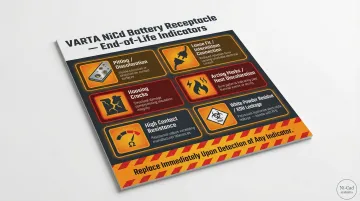
OEM Component Maintenance Manuals (CMMs) for NiCd batteries require technicians to inspect battery power connectors for specific failure indicators:
- Pitting or discoloration on contact surfaces
- Physical cracks in the housing
- Contact resistance above specified limits (typically 0.375 ± 0.005 inches for pin diameter)
- Loose fit or intermittent electrical connection
- Arcing marks or heat discoloration — typically from disconnecting under load
- White powder residue (potassium carbonate), a direct sign of electrolyte leakage
Receptacle Replacement vs. Full Battery Replacement
Receptacle replacement is often a standalone, cost-effective repair when battery cells remain within serviceable limits. A qualified technician at a Part 145 facility must make this determination through capacity testing and visual inspection. Replacing only the receptacle—rather than the entire battery assembly—saves significant cost when the cells still meet performance specifications.
VARTA batteries serve diverse platforms including Cessna 425/441/500/550 series, Falcon 900/2000, Citation 560XL and Citation X, Canadair CL600, and military helicopters. Each application requires the receptacle to meet precise fit, form, and function specifications of the original design.
FAA Certification Requirements for Battery Receptacle Replacement
Any replacement part installed on a type-certificated aircraft must be an "approved part" under 14 CFR 21.9. This means the part must originate from the OEM (under the original Type Certificate or Supplemental Type Certificate) or from an FAA-PMA holder. PMA is a legal authorization issued by the FAA, allowing a manufacturer to produce and sell a specific replacement part for a specific aircraft application. It is not a quality mark.
What FAA-PMA Approval Involves
For a battery receptacle to receive FAA-PMA approval under 14 CFR 21.303, the manufacturer must demonstrate that the part meets or exceeds the original's design and performance specifications. This requires:
- Materials testing and validation
- Electrical performance qualification (contact resistance, current-carrying capacity)
- Environmental qualification (corrosion resistance, thermal cycling, vibration)
- FAA engineering review and approval (not self-declaration)
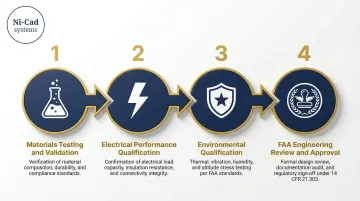
FAA Order 8110.42D (Change 2, 2023) mandates that PMA applicants maintain a quality system, pass conformity inspections, and provide a Continued Operational Safety (COS) plan.
The Role of Part 145 Repair Stations
Meeting PMA requirements covers the part — but the work itself requires separate authorization. Only an FAA-approved repair station can legally perform removal and installation of an airworthy battery assembly. Under 14 CFR 145.201, a repair station may perform maintenance and approve for return to service any article for which it is rated. The work must be documented on a maintenance release that conforms to FAA standards.
Required Release Documentation
FAA Form 8130-3 (Airworthiness Approval Tag) must accompany the replaced assembly back to service. According to FAA Order 8130.21J (2025), this form certifies that:
- Work was performed by an authorized person
- At an approved facility
- Using approved parts and methods
- The article is airworthy with respect to the work performed
The 8130-3 does not constitute installation approval on its own. The installer must still verify the part's eligibility for the specific aircraft application before return to service.
Common Compliance Pitfall
Using surplus, unapproved, or undocumented replacement receptacles—even if physically identical—constitutes installation of an unapproved part. This can result in:
- Aircraft grounded pending airworthiness review
- Regulatory penalties for the operator
- Potential certificate action against the technician
- Extended AOG duration while sourcing compliant parts
Understanding Traceability: Documentation That Keeps You Compliant
Traceability means you can trace a part from its current installation back through its entire manufacturing and maintenance history — batch number, material certifications, test records, prior installations, and release documentation.
That history matters. During an airworthiness directive, service bulletin response, or accident investigation, traceability is what proves a part was approved for the application and installed correctly.
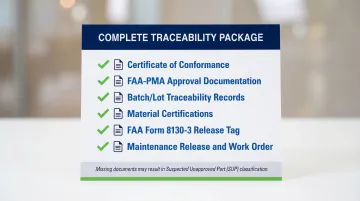
Complete Traceability Package Components
A replacement battery receptacle's traceability package should include:
- Certificate of Conformance (C of C)
- FAA-PMA approval documentation referencing the specific part number and aircraft application
- Batch/lot traceability records
- Material certifications
- FAA Form 8130-3 release tag from the installing repair station
- Maintenance release entry and work order documentation
The Risk of Traceability Gaps
When any of those documents are missing or can't be verified against a known source, the part may be classified as a "Suspected Unapproved Part" (SUP) during an audit or inspection. FAA Advisory Circular AC 21-29D (Change 1, 2018) provides strict guidance on detecting and reporting SUPs.
During receiving inspection, AC 21-29D requires technicians to:
- Verify packaging integrity
- Check for tampering (altered serial numbers, new paint over old)
- Evaluate visible irregularities (pitting, unusual wear)
- Demand positive forms of identification (8130-3, EASA Form 1, FAA-PMA markings)
If a part lacks documentation or shows signs of tampering or damage, it must be segregated and reported using FAA Form 8120-11 (Suspected Unapproved Parts Report).
Digital and Physical Recordkeeping
Maintenance organizations should retain traceability records for replaced battery components for the aircraft's operational life plus applicable regulatory retention periods. 14 CFR 145.219 requires repair stations to keep records for at least two years from the date of Return to Service.
AC 120-78B (2024) permits and encourages electronic recordkeeping, including digital signatures and electronic manuals. Many operators' digital maintenance tracking systems require 8130-3 tags and C of C documents to be uploaded at installation.
AOG Readiness: When Compliance and Speed Must Move Together
An Aircraft on Ground (AOG) event is one of the most severe financial disruptions an operator can face. Industry estimates from Boeing, Aviation Week, and IATA place the cost of a grounded aircraft between $10,000 and $150,000 per hour, depending on aircraft size, route, and passenger demand.
Those figures compound fast when you factor in actual downtime. A 2016 study on Boeing 777 AOG events found an average out-of-service time of nearly 23 hours — with almost 10 of those hours spent purely waiting for parts. A 2025 joint report by IATA and Oliver Wyman confirms the problem is getting worse: supply chain constraints are directly driving both AOG frequency and duration.
The Compliance vs. Speed Tension
Maintenance teams face intense pressure to return aircraft to service quickly. However, installing unapproved or inadequately documented parts can extend the AOG event — turning a 4-hour fix into a multi-day grounding if a ramp inspection or regulatory review flags the paperwork. Speed matters, but only compliant parts keep the aircraft flying once it leaves the gate.
What AOG-Ready Replacement Sources Look Like
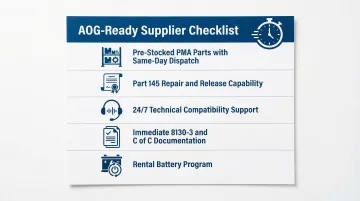
A truly AOG-ready supplier provides:
- FAA-PMA approved receptacles pre-stocked with full traceability documentation, ready for same-day or next-day dispatch
- Part 145 repair and release capability available on short notice
- 24/7 technical support to confirm part compatibility for specific battery and aircraft configurations
- 8130-3 tags and Certificates of Conformance ready for immediate upload to maintenance tracking systems
- Rental battery programs to keep aircraft operational while the receptacle is replaced
Choosing the Right FAA-Certified Replacement Source
When evaluating a supplier for VARTA battery receptacle replacement, maintenance organizations should verify:
Regulatory credentials:
- FAA-PMA holder status for the specific receptacle part number
- Active Part 145 certification (verify using the FAA Facility Dashboard)
- PMA eligibility confirmed via the FAA Dynamic Regulatory System
Operational capabilities:
- Demonstrated traceability practices (AC 21-29D compliance)
- AOG support capability (24/7 availability, expedited shipping)
- Relevant experience with NiCd aircraft battery systems
- Rental battery programs to minimize downtime
Documentation standards:
- Accreditation under AC 00-56B (Voluntary Industry Distributor Accreditation Program)
- Digital recordkeeping capability (AC 120-78B)
- Complete traceability packages with every shipment
Why Second-Source PMA Suppliers Are Strategically Sound
FAA-PMA parts are legally eligible alternatives to OEM parts. AC 20-62E (Change 1, 2018) explicitly lists PMA parts under "FAA-Approved Parts," confirming they are produced under an FAA-approved system and conform to FAA-approved data. PMA suppliers often offer:
- Faster availability than OEM backorders
- Competitive pricing that meets the same FAA compliance standards
- FAA engineering approval backing (not a compromise)
- Equivalent airworthiness status for regulatory purposes
Ni-Cad Systems meets all of these criteria — and has the operational history to back it up.
Ni-Cad Systems: Specialized AOG-Ready Provider
Ni-Cad Systems operates as a Part 145 FAA-approved repair facility with over 50 years of NiCd aircraft battery service experience. The company holds 30+ FAA-PMA approvals for battery system components, including low-impedance receptacles compatible with VARTA, SAFT, Marathon, and G.E. battery systems.
Key capabilities:
- Immediate AOG support with 24/7 technical assistance (+1 510 501 9391)
- Pre-stocked PMA-approved receptacles for rapid dispatch
- Rental battery programs to minimize aircraft downtime
- Complete traceability documentation with every shipment
- Over 47,000 units serviced since 1974
Stephen Andrues, Vice President/General Manager, serves as an FAA Designated Engineering Representative (DER) with 40 years of NiCd battery experience, providing technical depth for complex applications. For AOG situations where documentation delays are as costly as parts delays, that combination matters.
Frequently Asked Questions
How much does it cost to change battery connectors?
Pricing depends on battery type, receptacle design, and labor rates at the Part 145 facility performing the work. Sourcing from a PMA-approved facility like Ni-Cad Systems ensures the cost covers compliant parts and release documentation. Request a quote directly based on your specific aircraft application.
What is FAA-PMA approval and why does it matter for aircraft battery components?
FAA-PMA (Parts Manufacturer Approval) is federal authorization allowing a manufacturer to produce a specific replacement part for certificated aircraft. Using a non-PMA part on a type-certificated aircraft is a regulatory violation under 14 CFR 21.9, regardless of physical fit or appearance.
Can I replace just the receptacle on a VARTA aircraft battery, or does the whole battery need replacement?
Receptacle replacement is often a standalone, cost-effective repair when battery cells remain within serviceable limits. This determination must be made by a qualified technician at a Part 145 facility through capacity testing and visual inspection.
What documentation should accompany a replaced battery receptacle?
Key documents include FAA Form 8130-3 from the installing repair station, Certificate of Conformance from the parts manufacturer, and FAA-PMA approval documentation traceable to the specific part number and aircraft application. Retain these records per 14 CFR 145.219 and 91.417.
What is an AOG event and how does it affect battery replacement turnaround time?
AOG (Aircraft on Ground) means an aircraft is grounded due to a maintenance issue. AOG situations require suppliers with pre-stocked, already-documented parts and the ability to perform and release repairs without delay—often within hours rather than days.
How do I verify that a replacement battery receptacle is FAA-approved?
Confirm the supplier holds an active FAA-PMA for the specific part number and aircraft application using the FAA's Dynamic Regulatory System database. Before accepting the part, request the full traceability package (8130-3, C of C) and verify physical markings include "FAA-PMA," manufacturer name, and part number per 14 CFR 45.15.