Introduction
When an Avtech temperature sensor fails on a Citation jet, the consequences extend far beyond a simple maintenance write-up. These safety-critical components govern the entire NiCad battery charging cycle—when they malfunction, operators face incomplete charge cycles, cockpit annunciators, and potential thermal runaway. Unscheduled Aircraft on Ground (AOG) events that follow can cost $50,000 to $150,000+ per day.
For maintenance technicians, A&P mechanics, and flight department managers, catching a failing sensor early is the difference between a scheduled swap and an AOG crisis.
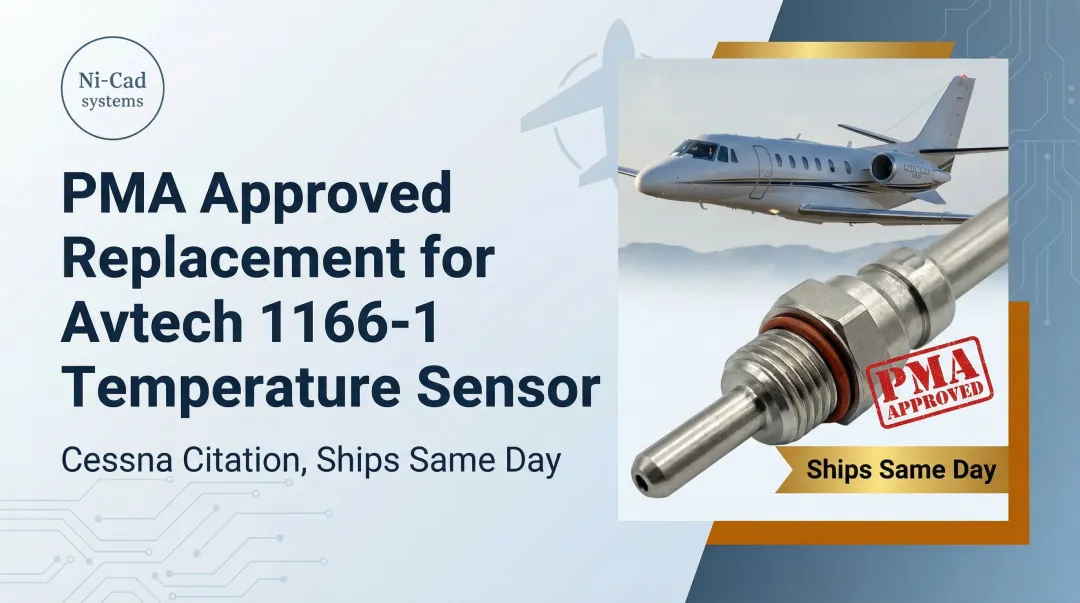
This article covers the specific symptoms of Avtech sensor degradation, root causes, replacement costs, and FAA-PMA certified alternatives—including fast-turn AOG support from Ni-Cad Systems.
Key Takeaways
- Avtech temperature sensors regulate NiCad battery charging on Citation jets; failure disrupts the charge cycle and triggers fault codes or thermal warnings
- Key failure signs: charger fault codes, incomplete charge cycles, erratic temperature readings, and nuisance battery warnings in the cockpit
- A failed sensor left in service risks thermal runaway, battery damage, and unplanned AOG events — expenses that dwarf the cost of a replacement sensor
- FAA-PMA approved second-source sensors offer legally compliant, cost-effective alternatives to expensive OEM parts
- Ni-Cad Systems holds FAA-PMA approvals for Citation battery temperature sensors and ships AOG orders with same-day turnaround
What the Avtech Temperature Sensor Does on a Citation Jet
The Sensor's Safety-Critical Function
Avtech temperature sensors monitor battery pack temperature during the charge cycle, feeding real-time data to the charger so it can regulate charge rate, terminate charging at the correct point, and prevent overcharging or thermal runaway in NiCad batteries.
FAA Advisory Circular AC 43.13-1B requires a temperature or current monitoring system on every NiCad battery installation — no exceptions.
The sensor works through a Negative Temperature Coefficient (NTC) thermistor that exhibits a predictable decrease in resistance as temperature rises. This resistance change signals the battery charging card to modulate or terminate charge current before the battery temperature exceeds critical limits. Without accurate temperature data, the charger cannot safely manage the charge cycle.
Physical Location and System Integration
The Avtech temperature sensor mounts physically on or adjacent to the battery pack and connects via wiring harness to the charger/controller. Its signal directly governs whether the charger proceeds, throttles back, or shuts down. If valid temperature data is absent, the charging system will fault rather than continue. The sensor's input is so critical that the charging system will fault rather than proceed without valid temperature data.
Citation Variants Using Avtech Sensors
Avtech temperature sensors are used across multiple Citation variants, including:
- Citation 500 series (Citation I)
- Citation 550 series (Citation II, S/II)
- Citation 560 series (Citation V, Ultra, Encore)
- Citation 560XL (Excel/XLS)
- Citation X (750)
- Various CJ-series aircraft depending on battery configuration
Common Avtech part numbers include 1131-1 and 1529-1 (battery temperature monitors) and 1229-1 (cockpit temperature indicator). Specific part numbers vary by airframe and battery configuration, so verify against your aircraft's Illustrated Parts Catalog (IPC) before ordering.
Warning Signs of Avtech Temperature Sensor Failure
Charger Fault Codes
Most Citation battery chargers display fault or error codes when sensor input falls outside expected parameters. Common fault indications include:
- Open circuit faults – Sensor resistance reads infinite, indicating a broken lead wire or failed thermistor element
- Sensor fault codes – Charger detects out-of-range resistance values that don't correspond to any valid temperature
- Over-temp warnings – False high-temperature readings trigger protective shutdown even when the battery is cool
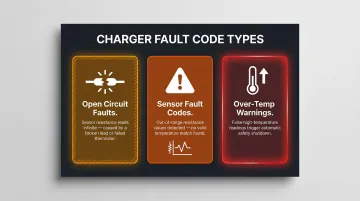
A charger fault code points to the sensor first — rule it out before assuming the charger unit has failed.
Incomplete or Aborted Charge Cycles
A sensor reading incorrectly high temperature causes the charger to terminate prematurely, leaving the battery undercharged. Technicians notice:
- Charge cycle ends too quickly (minutes instead of hours)
- Charger never reaches "complete" or "ready" state
- Battery voltage remains below expected fully-charged level
- Repeated charge attempts produce the same premature termination
The battery appears to accept a charge but never reaches full capacity. That gap directly cuts available power for engine start and emergency backup.
Erratic or Frozen Temperature Display
A sensor with intermittent continuity or degraded thermistor element produces readings that jump unpredictably or stay fixed at a single value regardless of actual battery temperature. Watch for:
- Temperature display jumping between extreme values
- Reading stays locked at one number throughout the entire charge cycle
- Display shows ambient temperature when the battery should be warm from charging
- Temperature indication doesn't change when heat is applied during testing
Either pattern — erratic jumps or a frozen reading — means the sensor can no longer be trusted. Replace it before the next charge cycle.
Cockpit Battery or Charging System Annunciator
On Citation aircraft where the sensor signal feeds aircraft systems (not just the charger), a failed sensor can illuminate battery warning lights or cause annunciator messages. The red "BATT O'TEMP" light illuminates steadily when battery temperature exceeds 145°F and flashes when temperature exceeds 160°F. A degraded thermistor with resistance drift triggers false warnings that force aborted takeoffs or unplanned landings.
These false warnings create operational disruptions and may trigger a maintenance write-up or MEL action, grounding the aircraft until the fault is resolved.
Resistance/Continuity Check Failure During Scheduled Maintenance
Many Aircraft Maintenance Manual (AMM) procedures include a sensor resistance check at specific temperatures. During functional testing:
- A sensor reading outside published limits must be replaced before return to service
- Functional tests must verify all sensor functions remain within ±10% of specified values
- Industry guidance requires annual functional tests of the temperature sensor assembly — not just when a fault appears
A functional NTC thermistor produces a smooth, steady resistance change as heat is applied. Zero ohms, infinite resistance, or no change at all when heated — any of these confirms the sensor has failed.
Root Causes: Why These Sensors Fail
Age and Thermal Cycling Fatigue
NiCad battery sensors endure repeated heat cycles during every charge. Over time, the thermistor element and internal connections degrade, causing drift in resistance values.
High-frequency engine vibration combined with rapid temperature changes creates mechanical shock and strain. The result: fatigue cracking of the sensor's encapsulant or lead terminations.
On high-cycle corporate fleets, sensors may show degradation well before the aircraft reaches major inspection intervals. Operators flying multiple legs per day expose sensors to significantly more thermal cycles than low-utilization aircraft.
Wiring Harness and Connector Corrosion
Moisture ingress at the battery compartment connector causes pin corrosion or intermittent open circuits that mimic sensor failure. The harsh chemical environment inside a NiCad battery box accelerates this process: shorted thermistors or receptacles are frequently traced to potassium hydroxide (KOH) electrolyte intrusion.
Look for white powdery residue (KOH) at battery receptacles and sensor harnesses during every battery capacity check. Copper migration at the glass-PVC interface during repeated thermal cycling is a well-documented failure mechanism in glass-coated chip-type NTC thermistors.
Critical diagnostic step: Perform a continuity and resistance check at the sensor connector per the AMM to isolate whether the fault is at the sensor element or in the wiring. If resistance reads correctly at the sensor terminals but the charger still faults, the harness or connector is the more likely culprit.
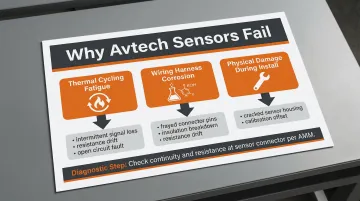
Physical Damage During Battery Removal/Installation
Sensors are vulnerable to inadvertent bending, pinching, or connector over-insertion during routine battery swaps—often a shop-floor cause of failure unrelated to the sensor's actual service life. Technicians rushing through battery changes may:
- Over-torque sensor mounting hardware
- Pinch sensor leads between battery and receptacle
- Damage connector pins during mating
- Bend thermistor probe when positioning battery
Always inspect sensor condition during battery removal and installation, and handle leads carefully to prevent mechanical damage.
Cost Implications: AOG Time, Repair vs. Replacement
The High Cost of Aircraft on Ground
An unscheduled AOG on a corporate Citation generates significant direct costs per day. According to industry analysis, average AOG costs for business aviation range from $50,000 to $150,000+ per day, including replacement charter, crew standby, and passenger disruption. A failed temperature sensor—while a small part—can ground the aircraft if no spare is on hand.
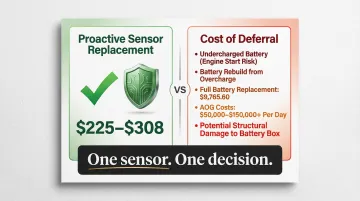
Real consequence: Deferring replacement of a $225-$308 temperature sensor can trigger AOG costs exceeding $50,000 per day.
OEM Sensor Pricing and Availability
Original Avtech sensors (part numbers 1131-1, 1529-1) are increasingly available only in "used" or "as-removed" condition, with current market pricing ranging from $225 to $308 for used units. Relying on used sensors with unknown thermal cycling histories introduces operational risk.
OEM lead times can extend days to weeks if parts are not in distributor stock—a critical concern for AOG situations where every hour counts. For operators with an aircraft on the ground, that wait is not an option.
FAA-PMA Alternative Pricing Advantage
That sourcing gap is where FAA-PMA approved alternatives become practical. Second-source sensors from suppliers such as Ni-Cad Systems cost less than used OEM units while meeting the same regulatory standard. Under 14 CFR Part 43, PMA parts are legally identical to OEM for installation purposes—there is no regulatory distinction between installing a PMA sensor and an OEM sensor.
Ni-Cad Systems offers 24/7 AOG support at +1 510 501-9391, providing immediate technical assistance and fast-turn capability for operators who cannot afford extended downtime. Their FAA Part 145 approved facility and history dating back to 1974 mean technicians can diagnose, supply, and support the replacement without delay.
Total Cost of Deferral
Deferring sensor replacement risks compounding costs. A degraded sensor leads to:
- Shortened battery service life from undercharging, increasing the risk of engine start failure
- Heat damage to cells from overcharging, which can escalate to a full battery rebuild
- Thermal runaway, requiring battery replacement at $9,765.60 and potential structural damage to the battery box
FAA Service Difficulty Reports document incidents where battery thermal runaway resulted in 6 ruptured cells, damage to 11 others, and damage to the battery box itself. The financial and safety consequences of sensor failure far exceed the cost of proactive replacement.
Certified Replacement Options: OEM vs. FAA-PMA Sensors
OEM Avtech Replacement Sensors
The original Avtech part remains the baseline option, traceable to the OEM design approval. Some operators' MEL or maintenance program language may require OEM parts. Buyers should:
- Verify specific part number against aircraft IPC
- Confirm part condition (new vs. used/as-removed)
- Check lead time and availability
- Obtain proper 8130-3 documentation
OEM sensors provide direct form-fit-function replacement with established traceability, but supply constraints and higher costs make them less attractive for many operators.
FAA-PMA Approved Second-Source Sensors
FAA Parts Manufacturer Approval (PMA) means the FAA has independently reviewed and approved the replacement part's design and manufacturing process under 14 CFR Part 21 Subpart K. An applicant for PMA must demonstrate that the design meets airworthiness requirements via test reports and computations, or by showing identicality to a type-certificated part.
Key regulatory facts:
- PMA parts are legally airworthy substitutes under 14 CFR Part 43
- They carry their own PMA data plate and 8130-3 paperwork for installation traceability
- Once installed, PMA and OEM parts are treated identically under the regulations
- PMA parts are routinely used across commercial, corporate, and military aviation
Ni-Cad Systems as a Certified Source
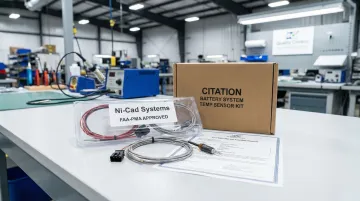
Ni-Cad Systems (Hayward, CA) is a Part 145 FAA-approved repair facility holding 30+ FAA-PMA approvals, including second-source temperature sensors for applicable Citation battery systems. The company's differentiators include:
- 50+ years of NiCad battery expertise (founded 1974, over 47,000 units serviced)
- Immediate AOG support with 24/7 technical assistance at +1 510 785-9391
- Fast-turn capability with rental batteries available to minimize downtime
- Engineering depth with over 100 years of combined team experience, including FAA Designated Engineering Representative (DER) credentials
Ni-Cad Systems manufactures FAA-PMA approved temperature sensors compatible with Citation models including 500, 550, S550, 560, and 650 series aircraft. Their sensors are designed for SAFT nickel cadmium battery systems commonly found in Citation fleets.
How to Verify Compatibility Before Ordering
Before ordering any replacement sensor, maintenance personnel should:
- Locate the exact Avtech part number in your aircraft's current IPC
- Verify the PMA sensor covers your specific aircraft make, model, and series against the PMA holder's approval data
- Confirm the part ships with a proper 8130-3 airworthiness release certificate
- Call Ni-Cad Systems at +1 510 785-9391 — their team can cross-reference IPC numbers to confirm compatibility before you order
Installation and Documentation Considerations
Sensor replacement must be performed by appropriately rated personnel:
- Work must be performed by an A&P mechanic or Part 145 repair station per 14 CFR 43.3 and 43.7
- Log the installation per 14 CFR 43.9, including work performed, date, and PMA part number
- Confirm the article is permanently marked with "FAA-PMA," part number, and manufacturer identification per 14 CFR 45.15
- Tag the removed part appropriately if returning it for failure analysis
Complete records protect the aircraft's airworthiness history and support any future regulatory audit.
Frequently Asked Questions
What happens when your temperature sensor goes bad?
A failed temperature sensor disrupts the battery charger's ability to regulate the charge cycle. It may abort charging early, allow overcharging, or trigger fault codes—all of which affect battery health and can ground the aircraft until the sensor is replaced.
Can I legally install an FAA-PMA temperature sensor instead of the original Avtech part?
Yes. FAA-PMA approved parts are legally airworthy substitutes under 14 CFR Part 43 and are routinely used across commercial, corporate, and military aviation. The key requirement is that the PMA approval covers your specific aircraft make/model application.
How often should Avtech temperature sensors on Citation jets be inspected or replaced?
Inspection intervals are governed by the aircraft manufacturer's AMM and your approved maintenance program. A resistance/continuity check is typically part of battery removal and installation procedures, and sensors should be replaced any time readings fall outside published limits or during annual functional tests.
Will a faulty temperature sensor cause my Citation to go AOG?
A confirmed sensor failure typically requires maintenance action before further flight since it compromises battery system airworthiness. Check your MEL for any applicable deferral provisions, but many operators elect immediate replacement to avoid battery damage risk and potential thermal runaway.
How do I distinguish a failed temperature sensor from a wiring harness problem?
Perform a continuity and resistance check at the sensor connector per the AMM. If resistance reads correctly at the sensor terminals but the charger still faults, the harness or connector is the more likely culprit. Look for white powdery KOH residue indicating electrolyte intrusion.
Which Citation jet models are most commonly affected by Avtech temperature sensor failures?
Avtech sensors are used across multiple Citation variants including Citation I, II, V, Ultra, Encore, Excel/XLS, and Citation X, depending on battery and charger configuration. PMA approval coverage varies by model — confirm compatibility before ordering.
Need immediate AOG support for a Citation temperature sensor failure? For emergency AOG situations, reach Ni-Cad Systems' 24/7 technical support at +1 510 501-9391. For business-hours parts inquiries and compatibility verification, call +1 510 785-9391. With 30+ FAA-PMA approvals and over 50 years servicing NiCd aircraft batteries, Ni-Cad Systems provides fast, certified replacements that keep Citation operators airworthy and on schedule.