This article examines the role of the G4 emergency battery, why OEM Securaplane has become a pain point for operators, and how FAA-PMA second-source parts provide a compliant, practical path forward without sacrificing airworthiness or insurance standing.
Key Takeaways
- The G4 emergency battery powers essential flight instruments and lighting if the main electrical system fails—required under FAR Part 25
- OEM Securaplane units face long lead times, high costs, and limited service support, creating AOG risk
- FAA-PMA approved replacements are legally airworthy alternatives requiring no STC — direct replacements with no additional certification
- Verify your source holds Part 145 certification and PMA approvals specific to NiCd emergency battery systems — Ni-Cad Systems carries 30+ FAA-PMA approvals and has serviced over 47,000 units
What the Gulfstream G4 Emergency Battery Actually Does — and Why It Cannot Fail
The Emergency Power Supply Unit Explained
The Emergency Power Supply Unit (EPSU) on the Gulfstream G4 platform (GIV, G400, G450) is a self-contained nickel-cadmium battery pack that provides backup power to essential avionics, flight instruments (attitude indicator, turn coordinator), and emergency lighting if both generators and the main battery system fail.
Unlike the main aircraft battery, the EPSU is a dedicated backup unit with its own maintenance requirements and replacement intervals. Operators and technicians sometimes conflate the two — they serve distinct functions and cannot substitute for each other.
Regulatory Basis: FAR Part 25 Requirements
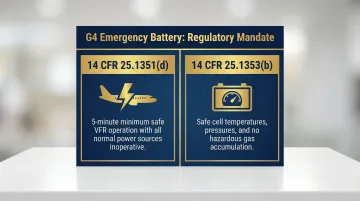
The EPSU isn't optional equipment. Two FAR Part 25 regulations define the baseline:
- 14 CFR 25.1351(d): Transport category aircraft must sustain safe VFR operations for at least five minutes with all normal electrical power sources inoperative
- 14 CFR 25.1353(b): Storage batteries must maintain safe cell temperatures and pressures, with no accumulation of explosive or toxic gases in hazardous quantities
Capacity Testing and Serviceability
The emergency battery must demonstrate a minimum of 70–80% of rated capacity on periodic tests. According to the Gulfstream Aircraft Maintenance Manual (AMM) Chapter 05-10-00, the Securaplane Emergency Battery Pack (Part Number 100-0302-03) has a mandatory discard and replacement interval of 4 years (48 months) from the date of aircraft installation. Failure to pass a capacity check grounds the aircraft until a serviceable unit is installed.
AOG Implications
A failed capacity check has immediate dispatch consequences. Under 14 CFR 91.213, the aircraft cannot legally depart until a serviceable replacement is installed.
The Gulfstream MMEL for the GIV-X/G450 (Revision 11) lists the IRU Back Up Battery (EPSU) under ATA 24 with Repair Category A or B dispatch limitations — requiring correction within 1 flight-day and restricting operations to Day VMC conditions. For IFR corporate operations, that means the aircraft is grounded. Sourcing speed and rental unit availability aren't just conveniences; they determine how long the aircraft stays on the ground.
Why G4 Operators Are Moving Away from OEM Securaplane
Corporate Ownership and OEM Background
Securaplane Technologies Inc., based in Tucson, AZ, was acquired by Meggitt PLC in 2011 and subsequently became part of Parker-Hannifin Corporation following Parker's $7.2 billion acquisition of Meggitt in September 2022. Parker-Hannifin's official SEC Form 10-K filings for fiscal years 2024 and 2025 explicitly list Securaplane Technologies, Inc. as a wholly-owned subsidiary.
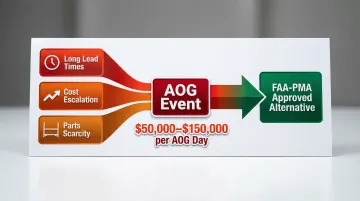
Securaplane was the default solution for decades — but supply chain pressure, cost escalation, and parts scarcity have forced operators to reconsider. The G4 fleet spans approximately 694 active aircraft, including 363 G450/G350 and 331 GIV-SP/G400 aircraft, and the sourcing challenges affect the entire fleet.
Lead Time and Parts Availability Issues
The aviation supply chain is experiencing severe constraints. XS Aviation reports that parts scarcity remains the single biggest factor prolonging AOG events, with OEM production constraints forcing operators to wait days or weeks for critical components. For G4 operators, multi-week or multi-month turnarounds for Securaplane EPSU overhaul or replacement translate directly into AOG days or the need for expensive rental units.
Cost Escalation
OEM Securaplane EPSU overhaul and replacement costs have climbed steadily, hitting fleet battery budgets hard for operators managing multiple G4-series aircraft. For multi-aircraft fleets, the financial impact compounds quickly:
- Higher per-unit overhaul costs as the G4 fleet ages
- Extended downtime adding indirect costs on top of direct repair spend
- Rental unit expenses when AOG wait times stretch beyond a few days
- Mandatory 4-year replacement cycles creating predictable but unavoidable budget pressure
FAA-PMA approved alternatives offer equivalent airworthiness at lower cost — making them a financially and regulatorily sound choice.
Obsolescence and Component Availability
Some Securaplane EPSU models have been subject to limited component availability, making overhaul more complex and expensive over time as the G4 fleet ages. The 4-year mandatory replacement interval adds to the pressure—operators must budget for fleet-wide EPSU replacements on a strict calendar interval regardless of cycle count, and any delays in sourcing can cascade into fleet-wide availability issues.
The Cumulative Operational Risk
When lead time, cost, and parts availability issues compound, operators face a direct choice: absorb OEM costs and downtime, or qualify an FAA-PMA approved alternative. Choosing an FAA-PMA approved replacement is both legal and financially sound. With AOG costs ranging from $50,000 to $150,000 per day — factoring in direct repair costs, expedited shipping, and lost utilization — waiting on backordered OEM batteries represents unacceptable financial exposure.
Understanding FAA-PMA Approval for Emergency Battery Replacements
What is FAA-PMA?
FAA-PMA (Parts Manufacturer Approval) is an FAA authorization that allows an alternative manufacturer to produce a direct replacement aviation part, provided they demonstrate the replacement meets the same form, fit, function, and airworthiness standards as the OEM part. 14 CFR Part 21, Subpart K prescribes the procedural requirements for issuing PMAs.
PMA vs. STC: Understanding the Compliance Pathway
A PMA-approved emergency battery replacement for the G4 installs as a direct replacement—no Supplemental Type Certificate (STC) required. 14 CFR 21.113 requires an STC only when introducing a "major change in type design." A direct NiCd-to-NiCd EPSU replacement matching OEM form, fit, and function qualifies as a minor change eligible for PMA. Upgrading to lithium chemistry, by contrast, triggers STC requirements.
FAA Order 8110.42D (Change 2, October 2023) outlines two primary PMA approval pathways:
- Identicality: Applicant proves the part is identical in all respects to the TC holder's part
- Test and Computation: Applicant uses comparative analysis, reverse engineering, and testing to prove the part meets airworthiness standards
Airworthiness Equivalence
PMA parts must pass the same FAA scrutiny as OEM parts. Operators can log PMA emergency batteries on aircraft records exactly as they would an OEM unit. FAA Special Airworthiness Information Bulletin (SAIB) NE-08-40 confirms this in three key points:
- TC/PC holder, PMA, and STC parts are fully interchangeable within the certificated product
- OEMs cannot invalidate a PMA installation — the FAA, not the OEM, governs airworthiness
- PMA parts do not alter FAA-approved life limits
Using a PMA part does not void airworthiness or compromise insurance standing. Aviation insurers underwrite liability based on FAA approval status — and PMA parts carry it.
Documentation: FAA Form 8130-3
FAA Order 8130.21J (September 2025) governs the completion of FAA Form 8130-3, the Authorized Release Certificate. For new PMA parts, this tag constitutes a statement from the FAA that the article conforms to its approved design and is in a condition for safe operation. The 8130-3 tag serves as official proof of conformity and condition for safe operation, enabling seamless integration into Part 145 maintenance records and legal dispatch.
Ni-Cad Systems as a Qualified Second-Source Provider
Ni-Cad Systems brings a combination of credentials that few PMA battery suppliers can match:
- 30+ FAA-PMA approvals covering nickel-cadmium batteries and emergency power supplies
- Part 145 certified — can both manufacture PMA replacement units and overhaul existing units under one roof
- 47,000+ units serviced across corporate, airline, and military aviation since 1974
- In-house DER authority — VP/GM Stephen Andrues holds FAA Designated Engineering Representative status, supporting PMA approval processes directly
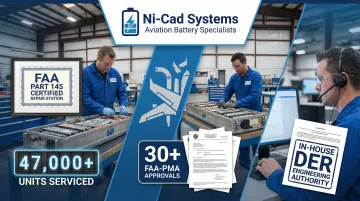
That last point matters. Having a DER on staff means Ni-Cad Systems can navigate approval processes internally rather than outsourcing engineering sign-off — a structural advantage when operators need a supplier they can rely on for both parts and documentation.
G4 Emergency Battery Replacement Intervals and Warning Signs
Which Battery is Used in Gulfstream G4 Emergency Lights?
The G4 uses a Securaplane-designed Emergency Power Supply Unit (EPSU) — a nickel-cadmium battery pack dedicated to powering emergency lighting and essential flight instruments if the primary electrical system fails. The most common Securaplane models for the G4 fleet are the XL246-S (Part Number 100-0201-01) for the G-IV/G-IVSP and the XL249 (Part Number 100-0302-0X) for the G350/G450. FAA-PMA approved second-source packs using the same NiCd chemistry serve as direct substitutes for both models.
How Often Should Gulfstream G4 Emergency Lighting Batteries Be Replaced?
Replacement is driven by capacity test results, not a fixed calendar interval alone. Three conditions drive a mandatory replacement:
- Capacity below threshold — annual or flight-hour checks must confirm the battery holds 70–80% of rated capacity (per the aircraft's Airworthiness Limitations); anything below that requires immediate replacement
- Hard discard interval — the Gulfstream AMM mandates replacement at 48 months regardless of capacity test results
- Any failed capacity test — no deferral permitted under airworthiness requirements
Key Warning Signs of Impending Failure
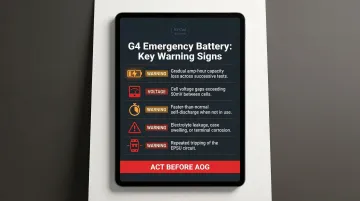
Don't wait for complete failure to act. Track these warning signs across consecutive capacity tests:
- Gradual amp-hour capacity loss across successive tests
- Cell voltage gaps exceeding 50mV between the strongest and weakest cells
- Faster-than-normal self-discharge when the battery is not in use
- Electrolyte leakage, case swelling, or terminal corrosion
- Repeated tripping of the EPSU circuit on the aircraft
The Importance of Longitudinal Test Records
A repair station that maintains detailed test records across service intervals can spot capacity degradation trends early — giving operators a genuine window to plan replacement before an AOG event forces the issue.
Choosing the Right Second-Source Emergency Battery Provider
Four Critical Evaluation Criteria
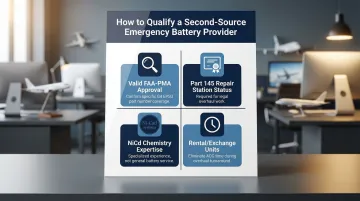
Operators should use these criteria to evaluate a second-source emergency battery provider:
- Valid FAA-PMA approval specifically covering the G4 EPSU part numbers in question
- Part 145 FAA-approved repair station status for overhaul work
- Demonstrated nickel-cadmium battery chemistry experience — not just general battery service
- Availability of rental/exchange units to eliminate AOG time during overhaul turnaround
How Ni-Cad Systems Measures Up
Ni-Cad Systems meets all four criteria — here's the specifics:
- Founded in 1974 — over 50 years specializing exclusively in nickel-cadmium aircraft battery service
- 30+ FAA-PMA approvals covering emergency power supplies and battery systems
- Part 145 FAA certification enabling in-house overhaul and repair
- Rental battery program for AOG support, with 24/7 technical assistance
- In-house FAA DER credentials — Stephen Andrues holds Designated Engineering Representative status, giving the company direct engineering authority over PMA approvals and technical evaluations
Few PMA battery suppliers hold both Part 145 repair station status and an in-house DER — that pairing cuts approval timelines and keeps technical decisions in one place.
Practical Recommendations for Operators
Before committing to a second-source provider:
- Confirm rental unit availability — ensure the provider can supply a rental unit while your aircraft's own EPSU is on overhaul
- Verify specific PMA part number approval — confirm the PMA approval covers your aircraft serial number range
- Request a copy of the FAA repair station certificate — validate Part 145 certification and applicable ratings
- Ask about longitudinal test records — determine whether the provider tracks capacity data over successive overhaul cycles for trending
Contact Ni-Cad Systems at +1 510 785-9391 for sales and general inquiries, or +1 510 501-9391 for 24/7 AOG support.
Frequently Asked Questions
Which battery is used in Gulfstream G4 emergency lights?
The G4 uses a Securaplane-designed Emergency Power Supply Unit (EPSU), which is a nickel-cadmium battery pack dedicated to powering emergency lighting and essential flight instruments if the primary electrical system fails. FAA-PMA approved replacements using the same NiCd chemistry are available as direct substitutes.
How often should Gulfstream G4 emergency lighting batteries be replaced?
Replacement is driven by capacity test results, not a fixed calendar interval alone. Annual or flight-hour-based checks verify the battery holds a minimum percentage of rated capacity (as defined in the aircraft's Airworthiness Limitations) — any unit falling below that threshold must be replaced immediately. The Gulfstream AMM also sets a hard 48-month (4-year) discard limit regardless of test results.
Is an FAA-PMA replacement emergency battery airworthy on the Gulfstream G4?
Yes. FAA-PMA approved emergency battery replacements are fully airworthy—they are produced under direct FAA oversight and must meet the same form, fit, function, and performance standards as the OEM Securaplane part. No STC is required for a like-for-like PMA replacement.
What are the most common causes of G4 emergency battery failure?
The main failure modes are individual cell capacity degradation over charge/discharge cycles, cell voltage reversal due to cell imbalance, and electrolyte loss—all characteristics of aging NiCd battery packs. These failure modes make periodic capacity testing and proactive replacement essential to avoid AOG events.
Can I keep my aircraft flying while the emergency battery is at an overhaul shop?
No. The EPSU is a required system under FAR Part 25, so a serviceable unit must be installed before legal departure. Ni-Cad Systems offers rental and exchange units specifically to prevent AOG while your battery is being serviced.