Introduction
Aircraft battery receptacles are a critical but often-overlooked maintenance item. When they corrode, crack, or fail, they compromise the entire battery system's reliability and airworthiness — creating urgent AOG (Aircraft on Ground) risk for operators and MROs. A single AOG event can cost between $50,000 and $150,000 per day, with three-day groundings escalating to over $600,000 in lost revenue, passenger compensation, and emergency logistics costs.
This guide is written for aviation maintenance professionals, MRO facilities, corporate flight departments, airlines, and military operators sourcing certified replacement receptacles for SAFT, Marathon, VARTA, and GE battery systems.
We'll cover what battery receptacles are, why FAA certification matters for replacements, a brand-by-brand breakdown, and how wholesale procurement from a qualified PMA-approved supplier reduces compliance burden and total cost.
What Is an Aircraft Battery Receptacle — and Why Does It Need Replacing?
An aircraft battery receptacle is the structural housing, tray, or enclosure that secures the battery cells in the aircraft. It includes terminal hardware, connector interfaces, and vent provisions—it is a distinct, certifiable aircraft part under 14 CFR Part 21, not simply packaging.
The receptacle plays a critical functional role in the aircraft electrical system:
- Maintains proper cell alignment and mechanical security
- Manages heat dissipation from battery charging cycles
- Provides electrical connections to the airframe via terminals and quick-disconnect plugs
- Contains vented gases or electrolyte in the event of a cell anomaly
Causes of Receptacle Degradation
Battery receptacles operate in harsh environments and degrade through multiple failure modes:
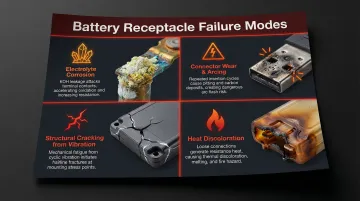
Electrolyte Corrosion:
- Potassium hydroxide (KOH) electrolyte from NiCd cells causes severe corrosion on terminal surfaces and cell links
- Corroded terminals introduce electrical resistance and compromise battery performance — even on otherwise well-maintained batteries
Connector Wear and Arcing:
- Quick-disconnect plugs subjected to removal under load develop pitted contact pins
- Arcing creates localized heating and carbon buildup on terminal surfaces
- FAA AC 43.13-1B specifically warns against "corrosion, pitting, arcing, and burns" on battery terminals
Structural Cracking from Vibration:
- Continuous airframe vibration fatigues receptacle mounting points
- Thermal cycling from charging and environmental temperature changes compounds stress
- Cracks can compromise structural integrity and allow electrolyte migration to surrounding airframe
Heat Discoloration:
- High charging currents and loose connections create localized overheating
- Discolored terminals indicate thermal damage that reduces electrical conductivity
- Degraded plastic housings and vent provisions are common results — both of which affect airworthiness compliance
Maintenance manuals and regulatory guidance under 14 CFR Part 43 require periodic assessment of receptacle condition, not just the cells. A degraded receptacle can compromise battery performance, introduce resistance into the electrical system, and—if corrosive gases or fluids escape—create compliance failures under airworthiness regulations.
Two FAA Airworthiness Directives illustrate how these failures escalate:
- AD 98-20-17 / AD 2005-13-18 (McDonnell Douglas DC-9/MD-80): SAFT NiCd terminal screws sheared under normal torque, risking internal shorting and potential battery explosion
- AD 99-21-11 (Bombardier CL-600): Charger input connector damage created a short circuit and electrical fire risk
When a receptacle reaches this condition, replacement with a certified part is the only compliant path forward.
FAA Certification Requirements for Replacement Battery Receptacles
14 CFR Part 21 Requirements
Any replacement part installed on a type-certificated aircraft must be produced under an approved method:
- OEM Production Approval Holder (PAH) part
- Parts Manufacturer Approval (PMA)
- Standard part via the aircraft's maintenance manual
Using unapproved parts can render the aircraft unairworthy.
What Is FAA-PMA?
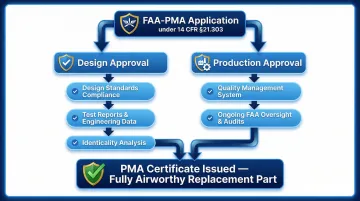
FAA-PMA (Parts Manufacturer Approval) is a dual approval granted by the FAA that authorizes a non-OEM manufacturer to produce a specific replacement part. Under 14 CFR §21.303, the approval requires:
Design Approval:
- The part meets the original design standards
- Demonstrated through test reports, computations, or identicality analysis (confirming the part is identical to the approved design)
Production Approval:
- Consistent manufacturing quality via established quality systems
- Ongoing FAA oversight of production processes
Regulatory Standing of PMA Parts
PMA parts are:
- Fully airworthy under FAA regulations
- Legally interchangeable with OEM parts on certificated aircraft
- Accepted by airlines, MRO facilities, and military operators under FAA oversight
- Not "aftermarket" in the unapproved sense — they carry the same regulatory weight as OEM parts
A 2025 Aviation Week/Naveo survey found that 94% of aftermarket executives cited long OEM lead times as driving PMA adoption, with 62% successfully negotiating with lessors to allow PMA parts on leased equipment.
PMA vs. STC
For maintenance personnel sourcing receptacles, the distinction between these two approval types determines what paperwork — and what steps — apply at installation.
| PMA | STC | |
|---|---|---|
| Purpose | Direct replacement for an existing approved part | Modifies the original aircraft design |
| Design change? | No — maintains original aircraft design | Yes — introduces a major design change |
| Approval required | Design and production approval | Full type certificate amendment process |
| Installation | No STC required if approved for the specific application | Required before installation |
PMA parts can be installed without an STC as long as they're approved for the specific aircraft application.
Battery Replacement Guidance
Per AC 20-184 principles and 14 CFR 23/25/27/29.1353, replacement components—including receptacles—must be approved for the specific aircraft application. Part 145 repair stations and airline maintenance organizations must verify PMA approval documentation before procurement.
Replacement Receptacles for SAFT, Marathon, VARTA, and GE Battery Systems
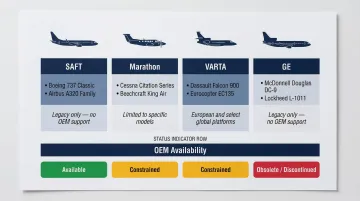
These four OEM brands dominate the certified aviation NiCd battery market, installed across commercial transport, corporate, rotorcraft, and military aircraft platforms—creating ongoing demand for certified replacement receptacles.
SAFT
SAFT is a major global NiCd battery supplier with a broad commercial installed base, including ULM® (Ultra Low Maintenance) batteries using plastic bonded electrode (PBE) technology. Aircraft applications include:
- Airbus A320/A330/A380 families
- Boeing 737/747 series
- Gulfstream G500/G550/G650
Aging SAFT battery systems require periodic receptacle replacement during cell replacement or overhaul cycles. PMA-approved receptacles reduce dependence on OEM supply chains and cut lead-time delays.
Marathon
Marathon (including legacy Marathon Power Technologies) produces the M3 Micro Maintenance and SuperPower battery lines, widely used across general aviation and corporate fleets. Procurement delays for OEM Marathon receptacles create AOG exposure — making certified second-source receptacles especially valuable for this brand. Aircraft applications include:
- Cessna 425, 441, 500, 550, S550, 552, 560, 650
- Citation 560XL and Citation X (750)
- Canadair CL600
- Learjet 55
VARTA
VARTA is a European NiCd aviation battery supplier with a 130+ year history and a significant installed base in rotorcraft and fixed-wing platforms, including the F20/F11 series. OEM parts availability can be constrained for U.S.-registered operators. FAA-PMA approved replacement receptacles give U.S. operators a direct path to compliance when OEM parts are unavailable. Aircraft applications include:
- Airbus Helicopters (Eurocopter)
- ATR regional aircraft
- Dassault Falcon jets
GE
GE produced aviation NiCd batteries from the 1970s through the 1990s — no longer in production — leaving a wide installed base across legacy commercial and military fleets with no OEM support path.
Original GE components face severe obsolescence and sourcing constraints. The breadth of those legacy installations makes certified receptacle availability critical. Operators need to identify PMA second-source receptacles before an AOG event forces the issue.
Aircraft applications include:
- Legacy commercial transport platforms
- U.S. military aircraft
These four brands represent the bulk of certified NiCd battery installations still in active service. Where OEM receptacle supply is slow, obsolete, or constrained, FAA-PMA approved second-source parts are the practical solution for maintaining airworthiness without extended AOG exposure.
FAA-PMA Certified 2nd-Source Receptacles vs. OEM Parts
Design Equivalency
The FAA-PMA approval process requires the 2nd-source manufacturer to demonstrate that the replacement receptacle meets the same design and performance standards as the OEM part. PMA-approved receptacles carry full regulatory standing — not a workaround, but a documented equivalent that satisfies the same airworthiness standard.
PMA approval requires:
- Electrical performance testing (contact resistance, current capacity)
- Mechanical testing (vibration, structural integrity)
- Material compatibility analysis
- Environmental testing (temperature, humidity, corrosion resistance)
Practical Procurement Advantages
PMA receptacles address the three procurement pain points MROs encounter most often with OEM parts:
- Shorter lead times — PMA suppliers aren't competing for capacity with new aircraft production schedules, so availability is less constrained
- Better stock depth — PMA manufacturers typically carry stronger inventory; industry observers note current stock levels running above historical norms as operators buffer against ongoing supply chain unpredictability
- Cost advantages — PMA pricing generally comes in below OEM, which matters for fleet operators managing maintenance across multiple aircraft types
Regulatory Acceptance
PMA parts are accepted by:
- FAA-approved repair stations (Part 145 facilities)
- Airline-operated aircraft under 14 CFR Part 121
- Military MRO contexts under applicable oversight
- International operators via dual-release 8130-3 tags for EASA compliance
Documentation Requirements: PMA parts should be accompanied at installation by FAA Form 8130-3 (Authorized Release Certificate), which documents airworthiness approval status and traceability. Note that FAA Order 8130.21H clarifies Form 8130-3 does not, by itself, constitute installation eligibility — that must be verified via the PMA supplement or Illustrated Parts Catalog (IPC). The form does, however, provide critical traceability documentation for Part 145 repair stations.
Why Source Wholesale Replacement Receptacles from a Certified Aviation Supplier
Wholesale Procurement Advantages
For MRO facilities and fleet operators, wholesale sourcing delivers:
- Reduced per-unit costs and predictable budget planning for scheduled maintenance
- Continuous certified stock to avoid emergency expedited shipping charges
- Single-vendor relationship that cuts per-transaction paperwork and streamlines receiving inspection
- On-hand availability that prevents costly AOG groundings and supports unscheduled maintenance
Ni-Cad Systems: Certified Aviation Battery Expertise
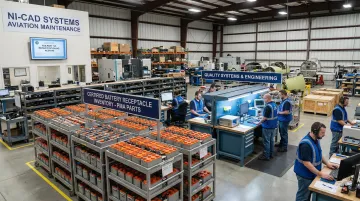
Ni-Cad Systems, Inc. is a Part 145 FAA-approved repair facility with 30+ FAA-PMA approvals and over 50 years of aviation battery expertise. The company offers certified 2nd-source replacement receptacles for SAFT, Marathon, VARTA, and GE battery systems.
Key capabilities include:
- PMA-approved low-impedance receptacles compatible with all four major NiCd battery brands
- Butt type and stud type mounting configurations for Marathon systems
- Rental batteries available to keep aircraft flying during turnaround
- 24/7 AOG support at +1 510 501-9391 for emergency situations
- Pre-purchase technical consultation to confirm part applicability
As both a PMA holder and Part 145 repair facility, Ni-Cad Systems understands the maintenance context. The team confirms installation eligibility, supplies parts with proper documentation, and streamlines receiving inspection and airworthiness record-keeping for buyers.
Aircraft Coverage: Ni-Cad Systems' receptacles support applications across:
- Corporate aviation (Cessna, Falcon, Gulfstream, Citation, Learjet)
- Commercial transport (DC-9, DC-10, L-1011, BAe 146)
- Regional aircraft (Saab 340, Canadair CL600)
- Rotorcraft and military platforms
With over 47,000 units serviced since 1974 and a team carrying over 100 years of combined engineering experience, Ni-Cad Systems delivers wholesale supply backed by the documentation and technical depth MRO buyers require.
Contact Information:
- Technical Support: +1 510 785-9391 (Monday-Friday, 8:00 AM - 6:00 PM)
- 24/7 AOG Support: +1 510 501-9391
- Email: Sales@NiCadSystems.com
Frequently Asked Questions
What are the FAA battery restrictions?
The FAA requires aircraft batteries and replacement components to meet airworthiness standards under 14 CFR Parts 21 and 43. Replacement parts must be produced under an approved method such as PMA and must be appropriate for the specific aircraft application.
What are OEM parts in aviation?
OEM (Original Equipment Manufacturer) parts are produced by the company that originally designed and certified the component. They must be produced under an FAA Production Approval and serve as the benchmark against which PMA replacement parts are evaluated for equivalency.
What is an aircraft battery receptacle?
A battery receptacle is the FAA-certifiable structural and electrical housing that secures and connects the battery within the aircraft. It is a distinct aircraft part, separate from the cells, and is subject to its own inspection, maintenance, and replacement requirements under 14 CFR Part 43.
What does FAA-PMA mean for replacement aviation parts?
FAA-PMA (Parts Manufacturer Approval) is a dual design and production approval allowing a non-OEM manufacturer to produce certified replacement parts. PMA parts are fully airworthy and legally interchangeable with OEM parts on type-certificated aircraft under 14 CFR §21.303.
Can FAA-PMA certified parts replace OEM battery receptacles on my aircraft?
Yes. FAA-PMA approved replacement receptacles are fully authorized for installation on certificated aircraft in place of OEM parts, provided the PMA covers the specific aircraft application. Request FAA Form 8130-3 with the part at installation to confirm airworthiness approval status.
How do I order wholesale replacement battery receptacles for SAFT, Marathon, VARTA, or GE batteries?
Contact an FAA-PMA approved supplier directly with your aircraft type, battery part number, and quantity needs. Ni-Cad Systems can confirm applicability, provide pricing, and support AOG requirements with fast turnaround — call +1 510 785 9391 or email Sales@NiCadSystems.com.