Introduction
SAFT aviation batteries power emergency systems across commercial, corporate, and military fleets. Operators track capacity and service intervals carefully—but the battery receptacle is often the last thing anyone thinks about until it fails.
When a receptacle degrades mid-overhaul or during routine inspection, the result is immediate: the battery can't be certified for return to service, and without an approved replacement on hand, the aircraft stays grounded.
For Part 145 MRO shops, that scenario triggers two problems at once:
- Compliance: Sourcing an FAA-PMA approved receptacle replacement — "looks-like, fits-like" parts without proper approval documentation are a regulatory violation, not an acceptable workaround
- Speed: Getting the part before AOG costs spiral — unplanned groundings can run $50,000 to $150,000 per day
What follows covers where to find FAA-certified SAFT receptacle replacements and how to keep them stocked so your shop never holds up a return-to-service.
Key Takeaways
- SAFT battery receptacles wear through normal service cycles and must be replaced with FAA-approved parts to maintain airworthiness
- FAA-PMA approval is the legal standard—second-source parts are airworthy only with an FAA Form 8130-3 and full PMA traceability
- Part 145 shops must follow approved maintenance data and maintain complete traceability when replacing receptacles
- Ni-Cad Systems ships in-stock receptacles same day, cutting AOG risk with 24/7 technical support
What Is a SAFT Battery Receptacle and Why Does It Wear Out?
A battery receptacle on a SAFT aviation nickel-cadmium (NiCd) battery assembly serves as both the mechanical mounting interface and the high-current electrical junction between the battery and the aircraft's power bus. It's a load-bearing component in every sense. When the receptacle degrades, the battery cannot deliver power reliably, regardless of cell condition.
Primary Failure Modes
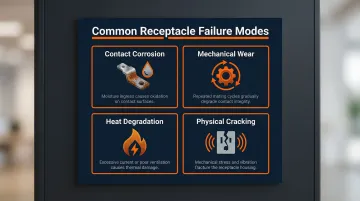
Receptacle wear is an expected outcome of normal service life. The most common failure modes include:
- Contact corrosion from exposure to moisture, cleaning solvents, and environmental contaminants
- Mechanical wear from repeated mating cycles during battery installation and removal
- Heat degradation caused by high-current charge and discharge cycles that stress terminal connections
- Physical cracking or deformation from airframe vibration and thermal expansion cycles
The FAA has documented these risks in multiple Airworthiness Directives. AD 2005-13-18, which supersedes AD 98-20-17, explicitly addresses SAFT NiCd batteries (P/N 021929-000 and 021904-000), noting that "battery screws shearing off while under normal torque loads" can cause "internal shorting, arcing, and loss of emergency battery power." The directive mandates replacement of terminal hardware to prevent catastrophic failure.
When Receptacle Issues Surface
Most shops discover receptacle problems during:
- Scheduled battery capacity checks where connection resistance readings spike
- Overhaul intervals when the battery is disassembled on the bench
- Visual inspections during Part 145 battery service that reveal corrosion or cracking
- Post-incident diagnostics following intermittent power loss or charging faults
By the time the issue is flagged, the battery is already on the bench and turnaround pressure is immediate. Without an approved replacement receptacle on hand, the entire return-to-service process stalls.
FAA-PMA Compliance: What It Means for Receptacle Replacements
What Is FAA-PMA Approval?
FAA Parts Manufacturer Approval (PMA) is the agency's authorization for a manufacturer to produce and sell a specific replacement part for type-certificated aircraft, engines, or appliances. Under 14 CFR § 21.9, any replacement part installed on a certified aircraft must be produced under a type certificate or an FAA production approval—PMA is that production approval.
Critical distinction: A part that "looks like" or "fits like" the OEM component is not airworthy unless it carries FAA-PMA approval. Physical fit is irrelevant without regulatory validation.
How PMA Differs from Unapproved Parts
When the FAA issues a PMA, it validates that the replacement part meets or exceeds the original design's:
- Performance specifications
- Material composition and strength
- Safety margins and failure modes
- Environmental and operational tolerances
This is what makes a PMA part legally installable. A non-PMA part, even one that is dimensionally identical, lacks this validation and creates an airworthiness violation under 14 CFR § 43.13.
Required Documentation: FAA Form 8130-3
Every PMA part must ship with an FAA Form 8130-3 Authorized Release Certificate. According to FAA Advisory Circular 43-9D, this document serves as the maintenance release for components and must include:
- Part number and description
- PMA approval reference (the specific FAA authorization)
- Manufacturer name and production approval number
- Certification that the part meets applicable airworthiness standards
Receiving inspection requirement: Part 145 shops must verify the 8130-3 accompanies every PMA part and retain it in the maintenance record. Missing documentation is a red flag during FAA audits.
Liability and Enforcement
Using non-PMA parts in a Part 145 environment exposes the shop to:
- FAA enforcement actions including fines and certificate suspension
- Civil liability if the part contributes to an incident or accident
- Loss of customer trust and potential contract termination
For quality managers and directors of maintenance, the math is simple: proper PMA parts cost far less than the fines, liability exposure, and certificate risk that come with unapproved alternatives.
Ni-Cad Systems: 30+ FAA-PMA Approvals
Ni-Cad Systems holds over 30 FAA-PMA approvals, including for SAFT battery receptacle replacements. Each part ships with complete 8130-3 documentation and is manufactured in its FAA Part 145 approved facility in Hayward, California. Every order includes full traceability documentation, and parts are available to ship same-day for AOG situations.
Part 145 Repair Station Requirements for Battery Receptacle Work
Approved Data and Approved Parts
Under 14 CFR § 145.109, certificated repair stations must perform all work using approved data—manufacturer maintenance manuals, FAA-approved Instructions for Continued Airworthiness (ICA), or equivalent technical documentation. Battery receptacle replacement is not exempt from this requirement, even when the rest of the battery assembly is serviceable.
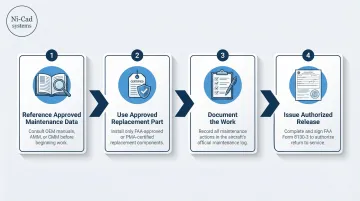
The process a Part 145 shop must follow:
- Reference approved maintenance data (e.g., SAFT Component Maintenance Manual)
- Use an approved replacement part (OEM or FAA-PMA)
- Document the work with part number, approval basis, and traceability
- Issue an authorized release (FAA Form 8130-3 or equivalent) before returning the battery to service
Quality Control Documentation
14 CFR § 145.211 requires repair stations to maintain a quality control system that includes receiving inspections for incoming materials. For PMA receptacles, this means:
- Physical inspection for damage and proper "FAA-PMA" marking per 14 CFR § 45.15
- Documentation verification that the 8130-3 matches the part received
- Work order recording of the PMA part number and approval reference
- Record retention for at least two years per 14 CFR § 145.219
FAA inspectors will look for this paper trail during audits. Missing documentation can trigger findings and corrective action requirements — and that exposure starts at receiving inspection, not at sign-off.
Non-Part 145 Facilities: When to Outsource
If a flight department's own maintenance crew needs to replace a battery receptacle, they face a regulatory decision. Under 14 CFR § 43.7, only specific persons are authorized to approve components for return to service:
- Certificated repair stations (Part 145)
- Certificated mechanics with appropriate ratings
- Manufacturers under production certificates
When battery receptacle work requires approved data, specialized tooling, or traceability documentation your facility cannot produce in-house, a Part 145 shop is the compliant path forward. The shop's certificate covers both the technical work and the return-to-service release — closing the regulatory loop that a non-certificated facility cannot.
OEM vs. FAA-PMA Second-Source Receptacles: What MROs Need to Know
Practical Differences
When sourcing a SAFT battery receptacle, MROs can choose between:
- OEM parts directly from SAFT – Original manufacturer supply chain
- FAA-PMA approved second-source replacements – Validated alternatives from approved manufacturers
Key differences:
| Factor | OEM (SAFT) | FAA-PMA Second-Source |
|---|---|---|
| Legal status | Approved for installation | Approved for installation (legally equivalent) |
| Lead time | Often weeks or months | Same-day to next-day (if stocked domestically) |
| Price | OEM pricing | Typically 20-35% lower |
| Documentation | OEM release certificate | FAA Form 8130-3 with PMA reference |
Addressing Quality Concerns
Some MRO shops hesitate to use second-source parts due to perceived quality differences. That hesitation doesn't hold up against the regulatory record. FAA-PMA approval under 14 CFR Part 21 Subpart K requires the manufacturer to demonstrate that the replacement part meets the same performance and materials specifications as the OEM design — including rigorous testing, design validation, and ongoing production oversight.
A properly approved PMA part is legally and functionally equivalent to the OEM component for installation purposes. "Second-source" describes the supply chain origin, not the quality standard.
Supply Chain Reality
Once you're confident in the quality equivalence, the supply chain case for PMA parts becomes straightforward. The Oliver Wyman 2025 MRO survey found that 80% of respondents cited piece-part availability as their top supply chain issue. OEM lead times can stretch to 250+ days for niche components like battery receptacles. Domestic PMA suppliers stocking these parts can ship same-day or next-day — a difference that directly affects shop throughput and aircraft-on-ground resolution time.
Why In-Stock Availability Is Critical for AOG Situations
The AOG Cost Equation
When a battery cannot be certified for return to service because a replacement receptacle is back-ordered, the aircraft is grounded. The financial impact is immediate and severe. According to Air Cargo Week, "loss of revenue from a grounded aircraft can reach $10,000 to $150,000 or more per day, depending on the aircraft size and route."
The cumulative cost breakdown:
| Duration | Estimated Cost Range |
|---|---|
| 1 day AOG | $50,000 – $150,000 |
| 2–3 days AOG | $150,000 – $600,000 |
| 3+ days AOG | $600,000+, potentially over $2 million |
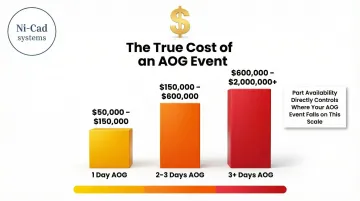
IATA projects that supply chain challenges will cost the airline industry more than $11 billion in 2025. Every hour a shop waits for a back-ordered part adds to that total.
The Domestic Inventory Advantage
Sourcing from a supplier that maintains in-stock inventory of FAA-PMA approved SAFT receptacles delivers measurable operational advantages:
- Same-day or next-day shipping from domestic facilities
- No international import delays or customs clearance
- 8130-3 documentation ships with every part
- Faster battery turnaround that meets customer SLAs
For Part 145 shops competing on speed and reliability, having a domestic PMA supplier in your approved vendor list is a strategic advantage.
Ni-Cad Systems: In-Stock AOG Support
Ni-Cad Systems maintains inventory of FAA-PMA approved SAFT receptacle replacements at their Hayward, California facility. Their 24/7 AOG technical support line (+1 510-501-9391) provides immediate assistance for grounded aircraft situations. Their rental battery program keeps operators flying while the primary battery is in for service, reducing the financial exposure of unplanned maintenance.
Frequently Asked Questions
What exactly is a SAFT battery receptacle, and is it a line-replaceable item?
The receptacle is the electrical and mechanical connector interface on a SAFT aircraft battery assembly. While it is replaceable during battery overhaul or repair by a Part 145 facility using approved parts and data, it is not typically a line-replaceable item swapped on the ramp—replacement requires bench work and proper documentation.
Does replacing a SAFT battery receptacle require an FAA-PMA approved part?
Yes. Any replacement part installed on a type-certificated aircraft battery must be either an OEM part or an FAA-PMA approved alternative. Using an unapproved part—even if it physically fits—is an airworthiness violation under FAA regulations and exposes the shop to enforcement action.
Can a Part 145 repair station use a second-source receptacle on a SAFT battery?
Yes, provided the receptacle carries FAA-PMA approval. The Part 145 station must follow approved maintenance data, document the part's approval basis and traceability in the work order, and verify the 8130-3 certificate accompanies the part.
How long does it typically take to receive SAFT battery receptacle replacements from an in-stock domestic supplier?
In-stock domestic suppliers can typically ship same-day or next-day, compared to OEM lead times that can stretch weeks or months. For AOG situations, that gap often separates a one-day fix from a week-long grounding.
What documentation should accompany an FAA-PMA approved SAFT receptacle replacement?
Each PMA-approved part must include an FAA Form 8130-3 Authorized Release Certificate identifying the part number, PMA approval reference, and manufacturer. This document must be retained in the maintenance record as proof of airworthiness approval.
Which SAFT battery models have receptacle replacements available under FAA-PMA approval?
Ni-Cad Systems holds FAA-PMA approvals for receptacles compatible with multiple SAFT battery families. For a current list of covered models and part numbers, contact Ni-Cad Systems at +1 510-785-9391 or review their PMA approval documentation.
Ready to eliminate AOG delays caused by back-ordered SAFT battery receptacles? Contact Ni-Cad Systems at +1 510 785 9391 or visit their facility at 25216 Cypress Ave, Hayward, CA 94544. For AOG support, their 24/7 technical line is +1 510 501 9391.