Introduction
Aircraft battery reliability directly impacts flight safety and operational efficiency. A weak battery can leave you stranded on the ramp or, worse, compromise emergency power when you need it most.
The FAA requires aircraft batteries to provide at least 30 minutes of essential power during complete electrical system failure—a safety margin that depends entirely on battery health.
In the general aviation battery market, two brands dominate: Gill and Concorde. Gill holds the legacy position as OEM equipment in countless aircraft, while Concorde has captured approximately 48% of the sealed battery market through superior AGM technology.
Choosing between these brands affects starting reliability, emergency power capacity, maintenance costs, and long-term value. This comparison examines the performance data, technology differences, and practical considerations that should drive your decision.
Key Takeaways
- Gill batteries serve as OEM equipment in many aircraft with proven flooded-cell performance and 24-month warranties
- Concorde sealed AGM batteries deliver 20-30% higher capacity and 7.6% early failure rates versus 30% for Gill sealed models
- Sealed AGM technology eliminates maintenance hassles while Concorde demonstrates superior cold-weather cranking
- Choose based on flooded vs sealed preference, capacity needs, operating climate, and cost-per-amp-hour value
Gill vs Concorde: Quick Comparison
Technology Options
Gill: Offers both flooded and sealed batteries.
Flooded models provide proven performance with traditional maintenance requirements. Sealed models use VRLA technology but independent testing shows 30% early failure rates within 24 months.
Concorde: Manufactures both flooded and sealed AGM batteries with proprietary PolyGuard separator technology.
Sealed RG-series batteries demonstrate just 7.6% early failure rates and superior resistance to overcharge abuse.
Amp-Hour Capacity
Beyond technology differences, capacity directly impacts mission flexibility and reserve power availability.
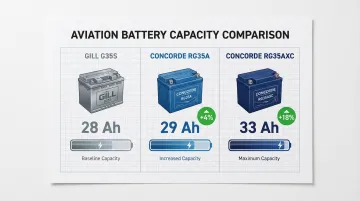
Gill: Generally lower published amp-hour ratings for equivalent-size batteries. The G35S provides 28 Ah capacity in the popular 12-volt size.
Concorde: Typically delivers 20-30% higher capacity in same-size cases.
The RG35A offers 29 Ah, while the RG35AXC extra-capacity model provides 33 Ah—representing 18% more capacity than Gill's equivalent in the same footprint.
Warranty Coverage
Warranty terms reflect manufacturer confidence in reliability and help operators plan replacement budgets.
Gill: 24 months for 12-volt batteries, 12 months for 24-volt batteries (conditions apply).
Concorde: 24 months for both 12-volt and 24-volt reciprocating engine applications. Sealed batteries can go 2 years before first capacity test under certain operating conditions.
Installation Requirements
Gill: Original equipment in many aircraft from Cessna, Piper, Beechcraft, and other manufacturers. Found in equipment lists, requiring no STC for original replacements.
Concorde: Installed under STC for most applications. May require minor modifications such as battery box lid trimming or handle adjustment, but comprehensive STC coverage exists for virtually all popular aircraft.
For operators evaluating installation complexity, FAA Part 145 certified facilities like Ni-Cad Systems can assist with battery transitions and provide capacity testing to validate performance after installation.
Cost and Value
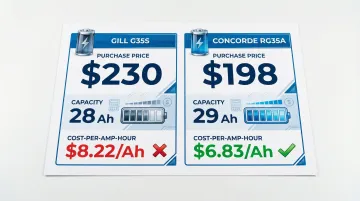
Gill: Lower upfront purchase price but reduced amp-hour capacity. Calculate cost per amp-hour for accurate value comparison.
Concorde: Slightly higher initial cost offset by greater capacity and longer service life. Independent analysis shows $6.83 per amp-hour versus $8.22 for Gill when normalized for actual capacity.
What is a Gill Aircraft Battery?
Gill batteries have served the aviation industry since before 1974, earning their place as the OEM standard for general aviation aircraft. The brand became synonymous with aircraft batteries through decades of factory installations in Cessna, Piper, Beechcraft, Mooney, and numerous other manufacturers' aircraft.
The core advantage of Gill batteries lies in their widespread acceptance and availability:
- Most A&P mechanics know these batteries intimately
- FBOs stock them regularly across the country
- No STC paperwork required when replacing original equipment with equivalent Gill models
- Familiar specifications reduce installation questions
This widespread familiarity simplifies maintenance and reduces downtime.
Gill manufactures two primary battery types:
Flooded (wet cell) batteries: Traditional lead-acid batteries requiring periodic water maintenance and specific gravity checks. These "pink" batteries (named for their distinctive color) offer proven performance at lower initial cost.
7000 Series sealed batteries: Valve-Regulated Lead-Acid (VRLA) batteries using AGM technology designed to compete with Concorde's sealed offerings. These eliminate water maintenance but have shown reliability concerns in independent testing.
Gill publishes cold cranking amp (CCA) ratings and 30-minute emergency ratings using standards familiar to anyone who's purchased automotive batteries. This makes specifications easy to interpret and compare.
These familiar ratings help operators make informed decisions based on their specific mission requirements.
Use Cases and Applications
Gill batteries fit operations where OEM equipment is preferred or required.
Flight schools operating large fleets of identical aircraft often standardize on Gill to maintain consistency with original equipment lists. Aircraft owners who prioritize avoiding STC paperwork typically choose Gill replacements for their familiar, readily-available components.
Key applications include:
- Cessna 172/182 series (most common training and personal aircraft)
- Piper Cherokee/Archer/Arrow series (popular flight school aircraft)
- Beechcraft Bonanza/Baron series (high-performance singles and twins)
- Most certified general aviation aircraft manufactured before 2000
Gill maintains strong positioning in the traditional general aviation market where flooded batteries remain acceptable and operators value the simplicity of OEM replacement parts.
What is a Concorde Aircraft Battery?
Concorde Battery Corporation, founded in 1977 and headquartered in West Covina, California, pioneered sealed AGM technology for aircraft applications.
The company now holds approximately 48% of the sealed aviation battery market, building this position through superior performance rather than OEM relationships.
Concorde's core advantages center on their AGM technology and engineering focus:
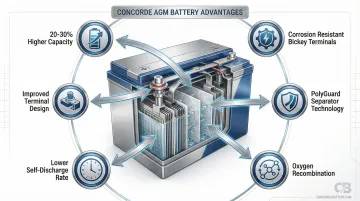
- Concorde batteries deliver 20-30% more amp-hours than competing batteries in the same physical dimensions, providing greater emergency power reserves
- Their RG (Recombinant Gas) series uses fiberglass mat separators that absorb electrolyte and enable oxygen recombination, preventing water loss entirely
- The PolyGuard microporous polyethylene separator adds shock and vibration protection beyond standard AGM designs
- Sealed batteries self-discharge at approximately one-third the rate of flooded cells, maintaining charge during infrequent flying schedules
- Redesigned terminals with conical washers and torque-wrench-compatible lugs prevent the loose connections that cause starting failures
Concorde achieved market penetration through comprehensive STC coverage for most popular aircraft models, making installation legally straightforward despite not being original equipment. This broad compatibility makes Concorde batteries practical for a wide range of operational scenarios.
Use Cases and Applications
Concorde batteries excel in demanding operational environments:
Cold-weather operations: The RG35AXC delivers 440 cold cranking amps compared to approximately 250 CCA for equivalent Gill models, providing significantly faster engine turnover in cold temperatures.
Infrequent flying schedules: The lower self-discharge rate keeps batteries healthier during extended periods between flights, reducing the need for maintenance charging.
Maximum emergency capacity requirements: Extra-capacity models provide up to 47% more amp-hours than standard batteries, extending emergency power duration.
Reduced maintenance priorities: Corporate flight departments and fleet operators prioritizing reduced maintenance labor costs benefit from eliminated water maintenance and extended capacity test intervals.
A corporate flight department operating a mixed fleet in northern climates reported switching their entire fleet to Concorde RG-series batteries after experiencing improved cold-weather starting reliability and reduced maintenance hours.
The fleet documented extended replacement intervals from an average of 3 years with flooded batteries to 5+ years with properly maintained Concorde sealed batteries, representing significant operational cost savings despite higher initial purchase prices.
Gill vs Concorde: Which is Better for Your Aircraft?
Choosing between Gill and Concorde isn't about finding a universal winner. The right battery depends on your aircraft's specific needs, operating conditions, and maintenance approach.
Key Decision Factors
Installation requirements: Do you prefer OEM equipment without STC paperwork, or are you comfortable with STC installations that may require minor modifications?
Battery technology preference: Are you willing to maintain proper charging system voltage for sealed batteries, or do you prefer the forgiveness of flooded cells?
Operating environment: Do you fly in cold climates requiring maximum cranking power, or in warm regions with frequent flights?
Capacity requirements: Do you need maximum emergency power reserves, or is standard capacity sufficient?
Total cost of ownership: Are you optimizing for lowest initial cost or best long-term value per amp-hour?
Based on these factors, here's how to match each brand to your operational profile.
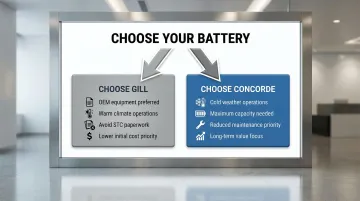
Choose Gill If:
- Your aircraft lists Gill as original equipment and avoiding STC paperwork is a priority
- A 12-volt system with 24-month warranty coverage matters to you
- Current battery performance and capacity meet your needs
- Warm climates with frequent flying define your operations
- Charging system voltage runs high (above 14.9V) and flooded batteries' tolerance for charging variations appeals to you
- Initial purchase price drives your decision
Choose Concorde Sealed Batteries If:
- Cold climates require maximum cranking power for your operations
- Infrequent flying makes lower self-discharge rates valuable
- Maximum amp-hour capacity and emergency power duration are priorities
- Eliminating battery water maintenance entirely appeals to you
- A 24-volt system benefits from Concorde's superior warranty versus Gill 24V models
- Well-maintained charging systems consistently stay below 14.9V/29.4V
- Long-term value outweighs initial cost in your calculations
Cost-Per-Amp-Hour Value Analysis
Calculate true value by comparing cost per amp-hour:
| Battery Model | Price | Capacity | Cost per Amp-Hour |
|---|---|---|---|
| Gill G35S | $230 | 28 Ah | $8.22/Ah |
| Concorde RG35A | $198 | 29 Ah | $6.83/Ah |
(Prices reflect historical comparisons for illustration—verify current pricing with suppliers)
This calculation reveals that despite similar or comparable sticker prices, Concorde batteries often deliver better value per unit of actual capacity.
Flooded vs Sealed Decision
Choose flooded batteries if:
- Your charging system consistently runs above 14.9V (12V system) or 29.4V (24V system)
- Your voltage regulator maintenance is inconsistent
- You don't mind periodic water additions and specific gravity checks
- You want maximum forgiveness for charging system variations
Choose sealed AGM batteries if:
- Your charging system is properly maintained below 14.9V/29.4V
- You want to eliminate maintenance and corrosion issues
- You need best cold-weather performance
- You fly infrequently and need lower self-discharge
- You want maximum capacity in the same footprint
Professional Servicing Considerations: Maximizing Battery Life Regardless of Brand
Professional Servicing Considerations: Maximizing Battery Life Regardless of Brand
Battery longevity depends more on proper maintenance than brand selection. Independent testing demonstrates that well-maintained batteries of either brand can last 5-10 years, while poorly maintained batteries fail in 2-3 years—a difference that dwarfs brand-specific performance variations.
Critical Maintenance Practices
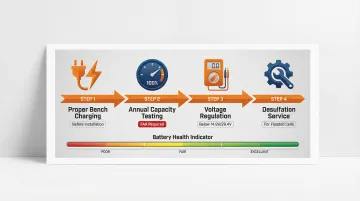
Professional maintenance programs focus on four key practices:
- Proper bench charging before installation – Fully charge and capacity-test new batteries to establish baseline performance
- Annual capacity testing – FAA regulations (FAR 91.403) require periodic testing to ensure batteries maintain at least 80% of rated capacity
- Appropriate charging system voltage – Sealed batteries need charging voltage below 14.9V (12V systems) or 29.4V (24V systems) to prevent permanent damage
- Desulfation for flooded batteries – Professional desulfation services can recover capacity in batteries showing early decline
Professional Service Value
Specialized aviation battery service providers offer expertise that extends battery lifespan regardless of brand choice. Professional servicing typically includes:
- Comprehensive capacity testing using aviation-specific equipment
- Deep-cycle testing for emergency batteries
- Proper storage charging for spare batteries
- Rental batteries to minimize aircraft downtime during service
- Expert diagnosis of charging system issues before they damage batteries
Facilities like Ni-Cad Systems—which has serviced over 47,000 units across 50 years—offer capacity testing, fast turnaround, and rental batteries for both Gill and Concorde batteries. Their FAA Part 145 certification ensures the specialized knowledge required to maximize battery lifespan through proper maintenance.
Professional servicing can double or triple battery lifespan while ensuring FAA compliance. This investment pays for itself many times over through reduced replacement costs and eliminated AOG incidents.
Conclusion
The Gill versus Concorde decision isn't about finding a universally "better" battery—it's about matching battery characteristics to your operating requirements. Gill excels as familiar OEM equipment with strong flooded-cell performance and straightforward replacement procedures. Concorde sealed AGM batteries offer superior capacity, demonstrated reliability (7.6% vs 30% early failure rates), and exceptional cold-weather performance.
For most operators, Concorde sealed AGM batteries provide the best combination of reliability, capacity, and reduced maintenance burden. The slightly higher initial cost translates to better cost-per-amp-hour value and potentially thousands of dollars saved through reduced downtime and extended replacement intervals.
However, this advantage requires proper charging system maintenance—sealed batteries demand voltage regulation below 14.9V/29.4V.
Beyond the brand decision, professional battery servicing delivers the greatest impact on longevity and reliability. FAA-certified facilities like Ni-Cad Systems provide the expertise to maximize either battery type's performance through:
- Comprehensive capacity testing that identifies issues before in-flight failures
- Proper deep-cycle testing and charging protocols
- Expert maintenance that can double or triple service life
With over 47,000 units serviced since 1974, professional testing and maintenance often matters more than the nameplate on the case.
Frequently Asked Questions
How long do Gill aircraft batteries last?
Gill flooded cells typically last 3-5 years with proper maintenance, while sealed batteries average 2-4 years. Independent testing shows Gill sealed models have 30% early failure rates compared to Concorde's 7.6%.
What is the difference between Gill and Concorde aircraft batteries?
Gill serves as OEM equipment requiring no STC, while Concorde requires STC installation. Concorde delivers 20-30% higher capacity and superior cycle endurance, while Gill offers widespread FBO availability.
What is a Gill aircraft battery?
Gill is an established aviation battery brand that became OEM standard for Cessna, Piper, and Beechcraft aircraft. Available in flooded and sealed configurations, Gill batteries require no STC for original equipment replacements.
Where are Concorde aircraft batteries made?
Concorde batteries are manufactured in the United States at facilities in West Covina, California (headquarters) and Austell, Georgia. The company has focused exclusively on aviation-specific sealed AGM technology since its founding in 1977.
What is the cost difference between Gill and Concorde batteries?
Gill batteries often have higher sticker prices but lower capacity. A Gill G35S at $230 for 28 Ah costs $8.22 per amp-hour, while a Concorde RG35A at $198 for 29 Ah costs $6.83 per amp-hour—better value overall.
Do sealed AGM batteries really require no maintenance?
Sealed AGM batteries eliminate water addition but aren't maintenance-free. They require proper charging voltage (under 14.9V/29.4V), periodic FAA capacity testing, and storage charging for inactive aircraft.