
Introduction
You arrive for a critical flight only to discover your aircraft battery is dead. The culprit? Improper storage over the past few months that caused irreversible sulfation damage.
Aircraft batteries suffer from accelerated self-discharge, sulfation damage, and premature capacity loss when stored or maintained incorrectly. These problems lead to unexpected downtime and potential safety hazards during critical flight phases.
The stakes are high. Allowing a lead-acid battery's voltage to drop below minimum thresholds causes permanent sulfation, while improper storage temperatures can drastically reduce usable life.
This guide covers optimal storage conditions, maintenance schedules, voltage monitoring protocols, common mistakes to avoid, and FAA compliance considerations that keep your aircraft batteries airworthy and ready.
Key Takeaways
- Store below 68°F (20°C) to extend shelf life by 40%+ versus warm storage
- Check voltage every 2-4 months; recharge if below 12.5V (12V) or 25.0V (24V)
- NiCd, lead-acid, and lithium batteries each require specific storage protocols and maintenance intervals
- Preventive maintenance costs far less than premature replacement or in-flight failures
- FAA requires documented maintenance and capacity testing for airworthiness
Why Proper Storage and Maintenance of Aircraft Batteries Is Critical
Proper battery care isn't just about extending service life—it's fundamental to flight safety, operational reliability, and cost control. Neglecting storage and maintenance protocols leads to measurable performance degradation and increased operational risk.
Impact on Battery Performance and Capacity Retention
Self-discharge rates vary dramatically with temperature and directly affect available capacity. Research shows that at 30°C (86°F), a battery reaches 50% state-of-charge in just 9 months, compared to 15 months at 20°C (68°F). This means self-discharge rates roughly double for every 10°C (18°F) increase in temperature.
The chemistry is straightforward: higher temperatures accelerate the electrochemical reactions that cause self-discharge, depleting stored energy even when the battery sits unused.
For lead-acid batteries, this discharge allows sulfation to progress unchecked, while NiCd batteries experience capacity fade through internal resistance increases.
Effect on Battery Lifespan and Replacement Cycles
Field data indicates that maintaining batteries at temperatures below 20°C and recharging before voltage drops by 0.5V can extend lead-acid battery life by approximately 0.4 years on a 5-year baseline. This represents roughly an 8% lifespan extension through proper storage alone.
Sulfation is the primary cause of lead-acid battery degradation. When a battery discharges, lead sulfate crystals form on the plates. During recharge, these normally convert back to active material.
However, if the battery remains discharged, these crystals harden into a stable form that cannot be reconverted by standard charging. Once voltage drops below critical thresholds (12.5V for 12V batteries, 25.0V for 24V batteries), sulfation can become irreversible, permanently reducing capacity regardless of subsequent charging attempts.
Role in Flight Safety and FAA Compliance Requirements
Beyond the economic impact of shortened battery life, proper storage directly affects flight safety and regulatory compliance. The FAA mandates specific maintenance actions to ensure airworthiness. 14 CFR Part 43 Appendix D explicitly lists "Batteries" as an item requiring inspection for "improper installation and improper charge" during annual and 100-hour inspections.
Advisory Circular 43.13-1B establishes that a battery is only considered airworthy if it possesses at least 80% of its rated 1-hour (C1) capacity. Batteries that fail to meet this threshold must be removed from service, regardless of their physical appearance or voltage readings.
Battery failure during critical flight phases poses serious safety risks across multiple scenarios:
- Engine start: Weak batteries may provide insufficient cranking power, particularly in cold weather
- Emergency power systems: Capacity degradation can leave aircraft without backup electrical power when it's most needed
- Avionics operation: Voltage instability can disrupt essential navigation and communication systems
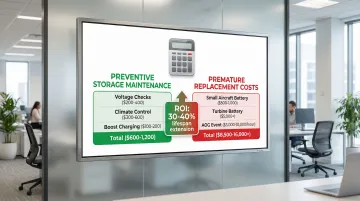
Cost Comparison: Preventive Storage Maintenance vs Premature Replacement
Aircraft battery replacement costs vary significantly by type and application:
- Small piston aircraft batteries: $500–$1,000
- Turbine aircraft batteries: $5,000+
- AOG (Aircraft on Ground) event: Thousands per hour in lost revenue and schedule disruption
Preventive storage maintenance requires minimal investment:
- Periodic voltage checks (technician time plus basic test equipment)
- Climate-controlled storage space
- Occasional boost charging
When compared against premature replacement and operational disruptions, the ROI is substantial. Implementing proper storage protocols that extend battery life by even 30-40% delivers significant savings over a fleet's operational lifetime.
Optimal Storage Conditions for Aircraft Batteries
Storage environment is the single most important factor in preserving battery capacity and lifespan. Temperature, humidity, and physical storage conditions all play critical roles in determining how long a battery maintains its rated capacity.
Temperature Requirements
Store batteries below 68°F (20°C). Cooler temperatures provide increasingly better results by slowing the electrochemical reactions responsible for self-discharge.
At 20°C, a battery reaches 50% state-of-charge in approximately 15 months, while at 30°C this drops to just 9 months—nearly a 40% reduction in shelf life.
Temperature impact on capacity retention:
| Storage Temperature | Time to 50% SoC | Relative Performance |
|---|---|---|
| 10°C (50°F) | >18 months | Excellent |
| 20°C (68°F) | ~15 months | Good (baseline) |
| 30°C (86°F) | ~9 months | Poor |
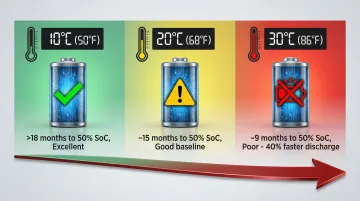
This temperature data debunks a common storage myth. The old warning about storing batteries on concrete floors is outdated—modern battery cases seal and insulate against any discharge through concrete. Temperature is the only environmental factor affecting self-discharge rates, making the surface material beneath the battery irrelevant.
Practical guidance:
- Use climate-controlled storage rooms maintained below 68°F
- Consider refrigerated units for long-term storage of spare batteries
- Insulated containers can help moderate temperature swings in uncontrolled environments
- Never store batteries in direct sunlight or near heat sources
Humidity and Ventilation
Maintain 40-60% relative humidity to prevent both corrosion and electrolyte evaporation.
Excessive humidity promotes corrosion on terminals and metal components. Extremely low humidity can accelerate electrolyte evaporation in vented lead-acid batteries.
While hydrogen generation is minimal during open-circuit storage, proper ventilation remains important during any maintenance charging operations.
Warning signs of improper humidity:
- White powder or blue-green corrosion on terminals
- Case deterioration or discoloration
- Condensation on battery surfaces
- Electrolyte level changes in flooded lead-acid batteries
Storage Position and Physical Considerations
Proper orientation: Most aircraft batteries should be stored upright in their normal operating position. Certain NiCd models have specific orientation requirements—always consult the manufacturer's Component Maintenance Manual (CMM).
Terminal protection: Prevent short circuits by:
- Installing terminal caps or covers
- Applying insulating tape over exposed terminals
- Ensuring batteries are spaced to prevent terminal contact
- Never stacking batteries without protective barriers
Spacing requirements: Allow at least 2-3 inches between stored batteries to permit air circulation and prevent thermal buildup. Batteries generate small amounts of heat even during storage, and adequate spacing prevents localized hot spots that accelerate degradation.
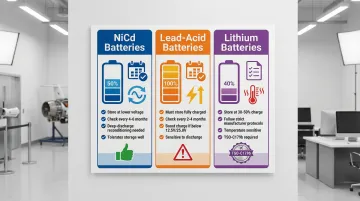
Battery Type-Specific Storage Requirements
NiCd batteries are more tolerant of storage than lead-acid types:
- Can be stored at lower voltage levels without damage
- Require periodic deep-discharge reconditioning to prevent memory effect
- Check voltage every 4-6 months in cool storage
Lead-acid batteries (sealed and flooded) demand full-charge storage:
- Must be stored at full charge (12.5V minimum for 12V, 25.0V minimum for 24V)
- Check voltage every 2 months in warm storage, 4 months in cool storage
- Flooded types require electrolyte level checks
- Boost charge immediately if voltage drops below minimum thresholds
Lithium batteries require specialized handling:
- Follow manufacturer-specific protocols due to safety considerations
- Typically stored at 30-50% state-of-charge (not full charge like lead-acid)
- More sensitive to temperature extremes
- Must comply with FAA TSO-C179b for aviation applications
- Never store lithium batteries that show physical damage or swelling
Types of Aircraft Battery Maintenance
Effective battery maintenance combines scheduled preventive care with condition-based monitoring. Understanding these maintenance categories helps operators allocate resources efficiently and prevent failures.
Routine/Preventive Maintenance
Scheduled maintenance prevents problems before they occur and costs significantly less than reactive repairs.
Key activities include:
- Measure open-circuit voltage every 2-4 months depending on storage temperature
- Check for physical damage, corrosion, leakage, case swelling, or terminal deterioration
- Remove corrosion from terminals and apply protective compounds to prevent future buildup
- Record all inspections, voltage readings, and maintenance actions for FAA compliance and warranty claims
Cost is minimal—primarily technician time plus basic test equipment (digital multimeter, cleaning supplies, protective compounds). Most inspections run $50-100 in labor.
FAA regulations require maintenance records for airworthiness. Use battery maintenance log sheets or digital tracking systems to record storage dates, voltage readings, boost charges, and capacity test results.
Corrective/Reactive Maintenance
Triggered when routine monitoring reveals problems that require immediate action.
Common triggers include:
- Open-circuit voltage below minimum thresholds (12.5V for 12V batteries, 25.0V for 24V batteries)
- Visible corrosion or physical damage
- Electrolyte leakage or low levels
- Case swelling or deformation
Required procedures:
- Use constant potential chargers to restore voltage to acceptable levels
- Perform capacity testing when voltage drops below minimum thresholds or battery has been stored beyond recommended periods
- Check and adjust electrolyte levels in flooded lead-acid batteries
- Clean, tighten, or replace damaged terminals
Allowing low-voltage conditions to persist speeds up sulfation in lead-acid batteries. Once sulfation hardens, it may be irreversible—capacity testing often reveals permanent damage requiring battery replacement.
Costs run $200-500 depending on services required. Capacity testing alone costs $150-300, while boost charging adds $50-100.
Condition-Based Maintenance
Advanced approach using monitoring systems to track battery health trends over time.
Key components include:
- Battery management systems that continuously monitor voltage and temperature
- Data logging to track self-discharge rates and identify abnormal patterns
- Predictive algorithms that forecast when maintenance will be required
- Integration with aircraft maintenance tracking systems for automated alerts
Benefits include:
- Maintenance scheduled based on actual battery condition rather than calendar intervals
- Early detection of developing problems before they cause failures
- Reduced unnecessary maintenance on batteries in good condition
- Better resource allocation and maintenance planning
Initial investment in monitoring equipment runs $500-2,000 per battery. This is offset by reduced maintenance frequency, fewer premature replacements, and prevention of AOG events. ROI is achieved within 2-3 years for active fleets.

Major Overhaul/Professional Service
Required when batteries reach capacity limits or show signs of serious degradation.
Overhauls are needed when:
- Capacity drops below 80% of rated (FAA airworthiness threshold)
- Physical damage to case or terminals
- Age limits specified by manufacturer or aircraft ICA
- Repeated capacity test failures after boost charging
Professional services include:
- Cell replacement in NiCd batteries
- Plate reconditioning
- Case refurbishment
- Complete capacity verification and certification
Ni-Cad Systems operates an FAA Part 145 approved repair facility specializing in NiCd battery overhauls with over 40 years of experience.
The company offers rental batteries to minimize aircraft downtime and holds 30+ FAA-PMA approvals for replacement parts, providing certified alternatives to OEM components.
Costs vary by battery type and service required, ranging from $200-2,000+ depending on complexity. Professional overhaul often costs 50-70% less than new battery replacement while restoring batteries to airworthy condition.
How to Check If Your Aircraft Battery Needs Maintenance
Early detection of battery problems prevents in-flight failures and reduces maintenance costs. These indicators signal when maintenance or further testing is required.
Open-Circuit Voltage (OCV) Measurements
OCV is the primary indicator of state-of-charge for lead-acid batteries and provides valuable information for NiCd batteries as well.
Voltage thresholds for lead-acid batteries:
| Battery Type | Fully Charged | Acceptable | Needs Boost Charge | Needs Capacity Test |
|---|---|---|---|---|
| 12 Volt | ≥12.8V | 12.5-12.8V | <12.5V | <12.0V |
| 24 Volt | ≥25.6V | 25.0-25.6V | <25.0V | <24.0V |
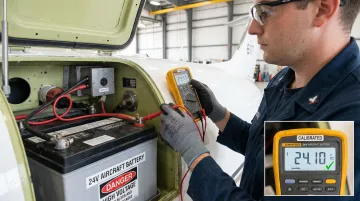
Proper OCV measurement technique:
- Battery must rest for 2-4 hours after charging to allow surface charge to dissipate
- Use calibrated digital multimeter (±0.5% accuracy minimum)
- Measure directly at battery terminals, not through aircraft wiring
- Record temperature—voltage readings vary slightly with temperature
- Compare against manufacturer specifications in CMM
Physical Inspection Indicators
While voltage measurements provide critical data, visual inspection reveals problems that electrical testing cannot detect.
Critical warning signs:
- Case swelling or bulging: Indicates overcharging, internal shorts, or thermal runaway
- Electrolyte leakage: Visible fluid around terminals or case seams (acid appears wet, alkaline may crystallize)
- Terminal corrosion: White powder (lead-acid) or blue-green deposits (NiCd)
- Case cracks or damage: Compromises battery integrity and creates safety hazards
- Discoloration: Heat damage or chemical reactions affecting case material
Unusual characteristics:
- Excessive heat during charging (temperature should remain moderate, not excessive)
- Abnormal odors (sulfur smell indicates overcharging in lead-acid)
- Loose or damaged terminals that compromise electrical connections
- Vent blockage preventing gas release
Any physical damage should disqualify a battery from installation until professional evaluation confirms safety and airworthiness.
Performance and Operational Changes
Changes in battery behavior signal developing problems even when voltage appears normal.
Key indicators:
- Difficult engine starts: Longer cranking times or reduced starter motor speed
- Frequent charging required: Battery doesn't hold charge between flights as historically typical
- Rapid voltage drop: Voltage sags excessively under load or doesn't maintain charge
- Reduced capacity: Shorter emergency power duration during capacity testing
Research shows that voltage drops exceeding 20% during load testing indicate significant capacity loss. For example, a 24V battery that drops below 19.2V during starting likely has capacity below 80% and requires professional capacity testing before continued service.
Aircraft Battery Maintenance Schedule
Maintenance schedules vary significantly based on battery chemistry, storage temperature, and whether the battery is in active use or long-term storage.
General Maintenance Frequency Guidelines
| Maintenance Task | Storage (Cool <68°F) | Storage (Warm >68°F) | Active Use |
|---|---|---|---|
| Visual Inspection | Every 4 months | Every 2 months | Pre-flight daily |
| OCV Check | Every 4 months | Every 2 months | Weekly |
| Boost Charge (if needed) | As required when OCV low | When OCV drops | As required |
| Capacity Test | Annually or per CMM | Annually or per CMM | Per manufacturer CMM |
| Professional Service | As needed based on capacity | As needed based on capacity | Per CMM or when capacity <85% |
For batteries in active service, conduct daily pre-flight checks:
- Visual inspection for damage or leakage
- Terminal security and cleanliness
- Proper installation and connection
- No unusual odors or heat
Always consult the specific Component Maintenance Manual (CMM) for your battery manufacturer (Concorde, Gill, Saft, etc.).
When aircraft Instructions for Continued Airworthiness (ICA) specify different intervals than the battery CMM, the aircraft ICA generally takes precedence for airworthiness compliance.
Battery Type-Specific Schedules
NiCd batteries tolerate storage conditions better than lead-acid types and require less frequent maintenance:
- Voltage checks every 4-6 months in cool storage
- Deep-discharge reconditioning every 12-24 months to prevent memory effect
- Capacity testing per manufacturer specifications (typically annually)
- Professional cell balancing when capacity drops to 85-90%
Lead-acid batteries demand more attention, particularly in warm conditions:
- Voltage checks every 2 months if stored above 68°F, every 4 months if below
- Immediate boost charge if OCV drops below 12.5V/25.0V
- Capacity testing annually or when voltage drops significantly
- Electrolyte level checks (flooded types) every 3-6 months
Lithium batteries require strict adherence to manufacturer protocols due to safety considerations. Store at partial charge (30-50% SoC) rather than full charge, and monitor temperature closely—remove from aircraft if operating outside specified range. All aviation lithium batteries must comply with FAA TSO-C179b requirements. Never use lithium batteries showing physical damage or swelling.
Common Aircraft Battery Storage Mistakes to Avoid
Even experienced maintenance personnel can fall into these traps that compromise battery life and safety.
Storing Batteries at Full Discharge or Allowing Voltage to Drop Too Low
The problem: Deeply discharged lead-acid batteries sulfate rapidly and may not recover even with aggressive charging and capacity testing. Below 12.5V (12V batteries) or 25.0V (24V batteries), sulfation accelerates exponentially.
The solution: Always charge batteries to 100% before storage. Check voltage regularly and boost charge immediately when readings approach minimum thresholds. Never assume a battery will "be fine" until you need it—by then, permanent damage may have occurred.
Ignoring Temperature Control and Storing in Uncontrolled Environments
The problem: Hangar storage without climate control exposes batteries to extreme temperature swings. Summer heat is particularly damaging, accelerating self-discharge and degradation. A battery stored at 86°F (30°C) requires maintenance nearly twice as frequently as one stored at 68°F (20°C).
The solution: Invest in climate-controlled battery storage areas. Even a small insulated room with air conditioning significantly extends lifespan. For spare batteries, consider dedicated battery refrigerators that maintain optimal temperatures year-round.
Failing to Document Storage Dates, Voltage Readings, and Maintenance Actions
The problem: FAA compliance requires maintenance documentation for airworthiness. Without proper records, you cannot demonstrate that batteries have been maintained according to regulations.
Warranty claims also require proof of proper storage and maintenance—without documentation, manufacturers may deny claims for batteries that failed prematurely.
The solution: Implement battery maintenance log sheets or digital tracking systems that capture:
- Storage start date and location
- Initial voltage reading
- All subsequent voltage checks with dates
- Any boost charges performed
- Capacity test results
- Physical inspection findings
- Maintenance actions taken
Digital systems provide automated reminders when maintenance is due, reducing the risk of overlooked inspections.
Conclusion
Proper aircraft battery storage and maintenance directly impacts safety, reliability, and cost control.
The evidence is clear: batteries stored below 68°F with regular voltage monitoring deliver 30-50% longer service life than those subjected to warm storage and neglect.
The right approach balances proactive temperature control, regular voltage monitoring, and strict adherence to manufacturer and FAA requirements. By implementing the storage protocols and maintenance schedules outlined in this guide, you protect your investment and ensure your aircraft batteries deliver reliable performance when you need them most.
For professional battery service, capacity testing, or emergency rental batteries, Ni-Cad Systems' FAA Part 145 approved facility offers comprehensive solutions backed by decades of aviation battery expertise. Their specialized knowledge and fast turnaround times keep aircraft operational, with rental batteries available for immediate AOG support.
A structured storage and maintenance program is your best defense against premature battery failure, unexpected downtime, and the safety risks of degraded battery performance.
Frequently Asked Questions
What are the FAA rules for battery packs?
FAA regulations require batteries to meet at least 80% of their rated capacity to be considered airworthy (AC 43.13-1B). 14 CFR Part 43 Appendix D mandates inspection for "improper installation and improper charge" during annual and 100-hour inspections, and all maintenance must be documented per Part 91 or 135 requirements.
What is the ideal storage temperature for aircraft batteries?
Below 68°F (20°C) is ideal for aircraft battery storage. Cooler temperatures significantly slow self-discharge rates—batteries stored at 20°C reach 50% charge in 15 months versus just 9 months at 30°C. This extends maintenance intervals from 2 months to 4+ months, directly impacting battery lifespan.
How often should I check the voltage of a stored aircraft battery?
Check voltage every 2 months for warm storage (above 68°F) and every 4 months for cool storage (below 68°F). Boost charge immediately if readings drop below 12.5V for 12V batteries or 25.0V for 24V batteries. More frequent checks may be needed in extremely warm conditions or for batteries approaching end of life.
Can I store aircraft batteries on a concrete floor?
Yes—the old warning about concrete floors is a myth. Modern sealed battery cases prevent any discharge through concrete surfaces. Temperature is the only environmental factor affecting self-discharge rates, not the surface material beneath the battery. Focus your attention on maintaining proper storage temperature rather than worrying about floor material.
What happens if I let my aircraft battery voltage drop too low during storage?
Batteries below minimum voltage thresholds (12.5V for 12V, 25.0V for 24V) develop irreversible sulfation. Once sulfation hardens, capacity test failure rates exceed 80%. Even if rechargeable, the battery must undergo capacity testing before installation to verify it meets FAA's 80% capacity requirement.
How long can an aircraft battery be stored before it needs to be replaced?
With proper storage conditions (cool temperature, regular voltage monitoring, and timely boost charging), batteries can typically be stored for 1-2 years or more while maintaining airworthiness. However, manufacturer shelf-life limits apply regardless of voltage readings. Perform capacity testing before installing batteries that have been in storage for extended periods, following manufacturer CMM guidelines for maximum storage duration.