Introduction
When generators fail at 35,000 feet, your aircraft battery becomes the only thing standing between controlled flight and total avionics failure. These aren't automotive batteries with forgiving tolerances—they're precision-engineered devices that must perform reliably across extreme temperature ranges, altitudes, and vibration environments.
Aircraft batteries power everything from engine starts to emergency backup systems. During ground operations, they keep systems running without burning fuel.
Selecting the wrong battery type creates real consequences:
- Premature failures that ground aircraft unexpectedly
- Maintenance costs that exceed budget projections by 40-60%
- Safety risks including thermal runaway in confined spaces
- Operational disruptions that cascade through flight schedules
A battery that works perfectly in a Florida-based Citation may fail repeatedly in an Alaska-based Caravan operating in -40°F conditions.
This guide covers the three main aircraft battery types and how to select the right one:
- Lead-acid batteries: Traditional chemistry with proven reliability
- Nickel-cadmium (NiCd) batteries: Robust performance in extreme conditions
- Lithium-ion batteries: Lightweight but temperature-sensitive
You'll learn the fundamental differences between each type and a practical framework for selection based on aircraft specifications, mission profile, operating environment, and total cost of ownership.
Key Takeaways
- Aircraft batteries serve three critical functions: engine starting, emergency backup power, and ground operations support
- Lead-acid: lowest upfront cost, highest weight, regular maintenance required
- NiCad: proven extreme-temperature reliability, 1,500-2,000 cycle life
- Lithium-ion: 60-70% weight savings, maintenance-free, strict regulatory requirements
- Selection depends on aircraft specs, environment, maintenance capability, and lifecycle costs
What Is an Aircraft Battery?
An aircraft battery is an electrochemical energy storage device that converts chemical energy into electrical energy to power aircraft systems. Unlike the battery in your car, aircraft batteries must meet stringent aviation certification standards including FAA-PMA approval and Technical Standard Order (TSO) compliance.
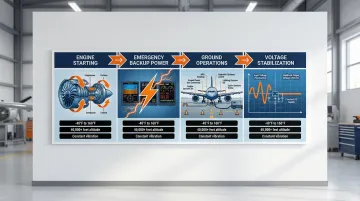
Aircraft batteries serve multiple critical functions that directly impact flight safety:
- Engine and APU starting - Delivering high cranking power to start turbine or piston engines
- Emergency backup power - Providing electricity to essential avionics, instruments, and systems when generators fail
- Ground operations - Powering systems during preflight, maintenance, and ground handling without running engines
- Voltage stabilization - Smoothing electrical loads and protecting sensitive avionics from power fluctuations
These critical functions must operate reliably under extreme conditions that set aircraft batteries apart from automotive applications. They must function reliably from -40°F to 160°F, withstand constant vibration and shock loads, operate at altitudes exceeding 40,000 feet, and maintain performance through hundreds or thousands of charge-discharge cycles.
A typical general aviation battery provides 10-35 amp-hours (Ah) capacity—far less than automotive batteries—but must deliver that power under far more demanding conditions.
Why Aircraft Battery Selection Matters
The right battery choice affects aircraft weight, fuel efficiency, payload capacity, and overall performance—factors that directly impact operating economics.
A 17-pound weight reduction from switching to lithium-ion translates to additional payload, extended range, or improved climb performance. For operators flying 200+ hours annually, these seemingly small improvements compound into measurable fuel savings and operational flexibility.
Improper battery selection creates cascading problems:
- Premature failures requiring unscheduled maintenance
- AOG situations disrupting schedules and stranding passengers
- Safety hazards from thermal runaway and power loss
- Regulatory non-compliance without FAA-PMA or TSO certification
- Increased maintenance burden beyond available resources
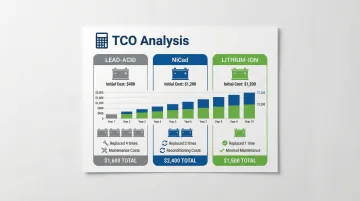
These problems directly impact total cost of ownership, which extends far beyond the purchase price. A $400 lead-acid battery requiring replacement every 2.5 years costs $1,600 over 10 years, plus regular maintenance labor. A $1,200 lithium-ion battery lasting 8+ years costs $1,500 over the same period with zero scheduled maintenance—a lower total cost despite the higher initial investment.
Factor in weight-related fuel savings, reduced maintenance labor, and improved reliability, and the economic case becomes even clearer.
Types of Aircraft Batteries
Aircraft batteries are not one-size-fits-all solutions. Three primary battery types dominate aviation applications, each developed to address specific operational requirements, performance characteristics, and cost constraints. Understanding the fundamental differences in chemistry, construction, performance, and maintenance needs is essential for making informed selection decisions that balance initial cost against long-term value.
Lead-Acid Batteries
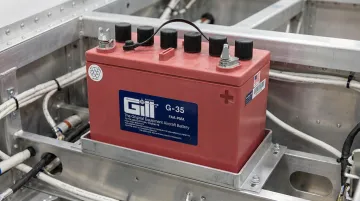
Description: Lead-acid batteries represent the oldest and most established aircraft battery technology, using lead plates immersed in sulfuric acid electrolyte. They're available in two main variants: flooded-cell batteries requiring regular maintenance, and sealed VRLA (Valve-Regulated Lead-Acid) or AGM (Absorbed Glass Mat) batteries that immobilize the electrolyte in glass mat separators.
Key Characteristics:
Lead-acid batteries offer proven reliability backed by decades of aviation use, the lowest initial purchase cost of any battery type, and tolerance to deep discharge cycles that would damage other chemistries. However, they're the heaviest option with relatively low energy density of 30-50 Wh/kg. For example, the Concorde RG-25 (22 Ah, 12V) weighs 22.75 lbs, while the RG-380E/44 (42 Ah, 24V) tips the scales at 89 lbs.
Best Applications:
- Light general aviation aircraft where initial cost is the primary concern
- Older aircraft designs originally certificated with lead-acid batteries
- Operations where maintenance infrastructure for flooded-cell servicing is readily available
- Aircraft with weight-insensitive missions and infrequent operations
Maintenance Requirements:
Flooded-cell batteries require regular electrolyte level checks and distilled water additions every 30-90 days depending on usage and climate. You must check levels after charging (when electrolyte has expanded) and add only distilled or demineralized water to prevent contamination.
Sealed AGM batteries eliminate fluid maintenance but are less tolerant of overcharging, which can cause permanent damage.
The primary enemy of lead-acid batteries is sulfation—the formation of hardened lead sulfate crystals on the plates when batteries remain in a discharged state. Sulfation occurs when batteries are undercharged or stored without periodic topping charges.
Prevention requires maintaining open cell voltage above 2.10V and applying a topping charge every six months during storage.
Limitations:
- Typical service life of only 2.5 to 3 years
- Cycle life of 500-1,000 cycles, significantly lower than alternatives
- Significant weight penalties compared to newer technologies
- Performance degradation in extreme cold—electrolyte can freeze at 19°F when discharged
- High-temperature sensitivity: life expectancy halves for every 15°F above 77°F
- Environmental disposal concerns due to lead content
Nickel-Cadmium (NiCad) Batteries
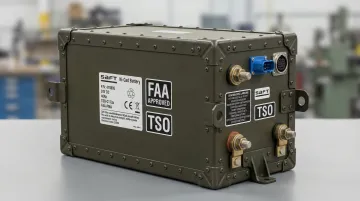
Description: Nickel-cadmium batteries have served as the aviation standard for decades, using nickel hydroxide and cadmium electrodes in an alkaline electrolyte. They're widely used in commercial and military aviation due to proven reliability and exceptional performance characteristics.
Key Characteristics:
NiCad batteries provide excellent performance across wide temperature ranges from -40°F to 160°F, superior cycle life of 1,500-2,000 cycles, ability to deliver high cranking power for turbine starts, and excellent resistance to vibration and shock. They offer higher energy density (50-75 Wh/kg) than lead-acid but remain heavier than lithium-ion options.
Best Applications:
- Turbine aircraft requiring high starting current
- Commercial aviation operations (standard on A320, 737, and similar aircraft)
- Military applications demanding maximum reliability
- Aircraft operating in extreme climates from Arctic to desert environments
- Operations requiring proven track record and established maintenance infrastructure
Maintenance Requirements:
NiCad batteries require periodic capacity checks performed by FAA-approved facilities, specialized charging equipment with proper voltage regulation, and professional servicing by certified technicians.
They're subject to memory effect—a phenomenon where repeated partial discharges cause the battery to "remember" the shorter capacity, reducing effective runtime. Periodic deep cycling or reconditioning is required to prevent memory effect and cell imbalance, typically every 100 hours for certain aircraft types.
FAA Part 145 certified facilities like Ni-Cad Systems offer capacity testing and deep-cycle reconditioning backed by over 40 years of NiCad service experience. Fast turnaround times with rental batteries available minimize aircraft downtime during service intervals.
Limitations:
- Higher initial cost than lead-acid batteries
- Susceptibility to thermal runaway if improperly charged or overcharged
- Cadmium's toxic nature requiring specialized disposal procedures
- Gradual replacement by lithium technologies in some applications
- Weight: A Saft 5317CH-1 (53 Ah, 24V) weighs 95 lbs
Lithium-Ion Batteries
Description: Lithium-ion batteries represent the newest aviation battery technology, using lithium-based chemistry (commonly lithium iron phosphate for aviation applications) to deliver the highest energy density and lowest weight of any aircraft battery type.
Key Characteristics:
Lithium-ion batteries provide exceptional energy density of 90-160 Wh/kg and can weigh 60-70% less than equivalent lead-acid batteries. They require no scheduled maintenance, offer flat discharge curves maintaining voltage under load, and feature integrated Battery Management Systems (BMS) for continuous safety monitoring.
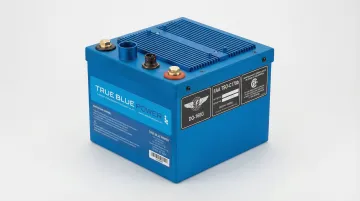
For example, the True Blue Power TB17 weighs just 16 lbs compared to 22.75 lbs for a comparable lead-acid unit—a 30% weight reduction.
Best Applications:
- Business jets and modern general aviation aircraft
- Experimental and Light Sport Aircraft (LSA)
- Weight-sensitive applications where every pound matters
- Electric and hybrid-electric aircraft
- Operations prioritizing reduced maintenance and longer service intervals
- Aircraft with STCs available for lithium-ion installation
Maintenance Requirements:
Certified aviation lithium-ion batteries are typically maintenance-free with on-condition replacement. They require no capacity checks, electrolyte servicing, or water additions. However, they must be monitored by integrated BMS and require strict adherence to charging parameters including temperature-controlled charging. Maintenance intervals extend to 2 years, compared to frequent checks for lead-acid alternatives.
Limitations:
- Highest initial purchase cost: 2-3x lead-acid (e.g., TB17 lists at $8,453)
- Strict requirements to prevent deep discharge below minimum voltage
- Intolerance to overcharging without proper BMS protection
- Need for temperature-controlled charging (many include integrated heaters)
- Regulatory certification complexities due to Boeing 787 battery fire incidents
- Must meet TSO-C179b and RTCA DO-311A standards
- Requires STC for installation in type-certificated aircraft
- Only FAA-approved aviation-grade lithium batteries with proper safety certifications should be used
Despite higher upfront costs, lithium-ion batteries offer 8-year average useful life—roughly four times that of lead-acid—and 50-90% maintenance cost savings, making total cost of ownership competitive or superior to legacy chemistries.
How to Choose the Right Aircraft Battery
The "right" battery depends on a comprehensive evaluation of operational needs, aircraft specifications, regulatory requirements, and total cost of ownership—not simply initial purchase price or latest technology trends. A systematic approach ensures your battery selection aligns with actual mission requirements rather than assumptions or marketing claims.
Aircraft Specifications and Compatibility
Your aircraft maintenance manual contains the critical specifications that narrow your battery options:
- Voltage requirements: 12V or 24V system (never mix)
- Capacity requirements: Minimum amp-hours (Ah) specified for your aircraft
- Physical dimensions: Length, width, height, and terminal configuration
- Mounting orientation: Some batteries require upright installation; others allow any position
- Starting current: Instantaneous Peak Power (IPP) or Cold Cranking Amps (CCA) for turbine engines
- FAA certification: Battery must have FAA-PMA approval or TSO certification for your specific aircraft make and model
Changing battery types (e.g., lead-acid to lithium-ion) may require a Supplemental Type Certificate (STC) to ensure compatibility with charging systems, mounting provisions, and weight-and-balance calculations. Never assume a battery will fit simply because the voltage and capacity match.
Mission Profile and Operational Environment
How you actually operate the aircraft determines which battery chemistry makes the most sense:
Flight frequency:
- Daily operations benefit from lithium-ion's maintenance-free design
- Weekend flying may favor lead-acid's lower initial cost
Starting demands:
- Turbine engines require high cranking power, favoring NiCad or lithium-ion
- Piston engines are less demanding, making lead-acid viable
Climate conditions:
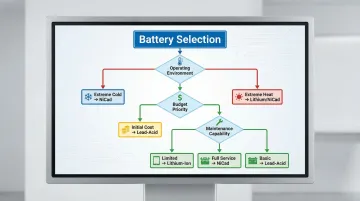
- Extreme cold: NiCad performs best; lead-acid electrolyte can freeze when discharged
- Extreme heat: Halves lead-acid life for every 15°F above 77°F
- Temperature extremes: Lithium-ion with integrated heaters maintains performance to -40°C
Ground power availability:
- Frequent ground operations without external power favor high-capacity batteries
- Regular access to ground power reduces battery demands
Emergency power duration:
- Calculate essential system runtime during generator failure
- Verify battery capacity meets regulatory requirements (typically 30 minutes minimum)
Maintenance Capabilities and Infrastructure
Match battery technology to your actual maintenance capabilities:
- Access to FAA-approved battery service facilities: NiCad batteries require professional reconditioning
- In-house maintenance capabilities: Can your staff perform flooded-cell electrolyte checks?
- Proper charging equipment: Lithium-ion requires temperature-controlled chargers; NiCad needs specialized equipment
- Maintenance schedule flexibility: Lithium-ion's 2-year intervals vs. lead-acid's 30-90 day checks
FAA Part 145 certified facilities offer capacity testing, professional servicing, and rental batteries to minimize downtime during maintenance. If your operation lacks in-house battery expertise, partnering with specialized battery service facilities ensures proper maintenance without building internal capabilities.
Total Cost of Ownership Analysis
Maintenance requirements directly affect long-term costs. Calculate true battery expenses over a realistic ownership period, not just the purchase price.
| Cost Factor | Lead-Acid | NiCad | Lithium-Ion |
|---|---|---|---|
| Initial Price | $300-$600 | $800-$1,500 | $1,200-$8,500 |
| Service Life | 2.5-3 years | 5-7 years | 8-10 years |
| Maintenance Intensity | High (30-90 day checks) | Medium (reconditioning) | Low (2-year checks) |
| 10-Year Replacements | 3-4 units | 1-2 units | 1 unit |
| Maintenance Costs | Electrolyte checks, water, testing | Professional reconditioning, testing | Capacity check every 2 years |
Additional cost factors include disposal fees (especially for NiCad's toxic cadmium), weight-related fuel savings from lighter batteries, reduced downtime from improved reliability, and rental battery costs during service intervals.
Specialized battery service facilities can help develop accurate cost projections based on your specific operational profile and maintenance capabilities.
Regulatory and Certification Requirements
Every aircraft battery must meet specific regulatory requirements before installation:
- FAA-PMA approval or TSO certification for your aircraft type
- Compatibility with aircraft type certificate (check TCDS)
- STC requirements if changing battery types
- Installation by appropriately certified personnel (A&P mechanic or repair station)
- Compliance with 14 CFR 23.1353 or 25.1353 for battery installation standards
- Special conditions for lithium-ion meeting TSO-C179b and RTCA DO-311A
Never install batteries lacking proper aviation certification, even if physically compatible—battery failures can have catastrophic consequences.
Common Battery Selection Mistakes to Avoid
Choosing Based Solely on Purchase Price
Focusing only on initial cost while ignoring service life, maintenance expenses, and reliability results in higher total ownership costs and increased operational disruptions. A $400 battery requiring replacement every 2.5 years costs more over 10 years than a $1,200 battery lasting 8+ years.
Conduct proper lifecycle cost analysis including:
- Purchase price ÷ expected service life = annual cost
- Maintenance labor hours × hourly rate × service frequency
- Disposal fees
- Downtime costs when batteries fail unexpectedly
- Weight-related fuel savings (calculate pounds saved × hours flown × fuel cost impact)
Ignoring Operating Environment and Mission Profile
Selecting a battery without considering usage patterns and climate conditions creates predictable failures. Common mismatches include:
- Choosing lithium-ion for infrequent operations where self-discharge becomes problematic
- Installing lead-acid in extreme cold climates where performance suffers and electrolyte freezes
- Using flooded-cell batteries in aerobatic aircraft where electrolyte spills
- Selecting batteries without adequate capacity for ground operations duration
Match battery characteristics to how you operate, not how you wish you operated.
Overlooking Proper Maintenance and Service Requirements
Selecting a battery type whose maintenance demands exceed available resources or expertise creates ongoing problems:
- Installing flooded-cell batteries without establishing regular electrolyte checking procedures
- Choosing NiCad batteries without access to proper reconditioning equipment
- Failing to use temperature-controlled charging equipment for lithium-ion
- Ignoring capacity testing requirements that ensure continued airworthiness
For operations without in-house battery expertise, partnering with specialized facilities ensures batteries receive proper care throughout their service life.
FAA-approved service providers offer capacity testing, professional reconditioning, and fast turnaround with rental batteries to minimize downtime.
Conclusion
Aircraft batteries are critical components requiring careful selection based on aircraft type, operational requirements, maintenance capabilities, and total cost of ownership. The cheapest battery upfront often becomes the most expensive when you factor in maintenance costs, replacement frequency, and operational disruptions.
The three primary battery types each serve different aviation applications:
- Lead-acid: Lowest initial cost for light aircraft with available maintenance infrastructure
- Nickel-cadmium: Proven reliability for turbine aircraft and extreme environments
- Lithium-ion: Superior weight savings and maintenance-free operation where lifecycle costs matter more than upfront investment
Proper battery selection matters, but so does partnering with the right service provider. FAA Part 145 certified facilities with specialized expertise—like those offering fast turnaround, rental batteries during service, and comprehensive testing capabilities—ensure optimal performance and reliability.
Getting selection right reduces maintenance burden, improves dispatch reliability, and enhances safety margins throughout your battery's service life.
Frequently Asked Questions
What types of batteries are used in aircraft?
Aircraft use three main types: lead-acid (lowest cost, heaviest), nickel-cadmium (commercial aviation standard, excellent temperature range), and lithium-ion (lightest, highest energy density). Selection depends on aircraft type, operating environment, and whether you prioritize initial cost or lifecycle value.
How long do aircraft batteries typically last?
Lead-acid batteries last 2.5-3 years, nickel-cadmium provide 5-7 years or 1,500-2,000 cycles, and lithium-ion deliver 8-10 years or 3,000+ cycles. Actual lifespan depends on maintenance practices, operating conditions (especially temperature extremes), and proper charging procedures.
What maintenance do aircraft batteries require?
Flooded-cell lead-acid batteries need electrolyte checks and distilled water additions every 30-90 days. NiCad batteries require periodic capacity testing and reconditioning to prevent memory effect. Sealed AGM and lithium-ion batteries are maintenance-free but need voltage and BMS monitoring.
Can I replace my aircraft battery with a different type?
Changing battery types typically requires an STC (Supplemental Type Certificate), verification of physical fit and electrical compatibility, possible charging system modifications, and must be approved and installed by an A&P mechanic or repair station. Consult with your aircraft manufacturer or experienced service provider before changing battery chemistry.
How do temperature extremes affect aircraft battery performance?
Extreme cold reduces battery capacity and cranking power, with lead-acid most affected (electrolyte can freeze when discharged). Extreme heat accelerates self-discharge and shortens service life significantly. NiCad batteries perform best across temperature extremes (-40°F to 160°F), while lithium-ion requires temperature-controlled charging but includes integrated heaters for cold-weather operation.
What should I do if my aircraft battery fails unexpectedly?
Replace immediately with an FAA-approved battery of the correct type and capacity. Have your charging system inspected to identify causes like overcharging or voltage regulation problems. Providers like Ni-Cad Systems offer rental batteries and fast turnaround to minimize downtime during replacement and diagnosis.