Key Takeaways
- Proper maintenance prevents costly aircraft downtime and doubles battery life
- Test capacity every 12-18 months—it's the only way to verify airworthiness
- Batteries must maintain 80% of rated capacity to meet FAA requirements
- Correct charging prevents sulfation, the primary cause of battery failure
- Temperature compensation is critical—self-discharge rates double every 10°C rise
Understanding Lead Acid Battery Chemistry and Construction
Aircraft lead acid batteries generate electrical power through a chemical reaction between lead dioxide (positive plate), pure lead (negative plate), and sulfuric acid electrolyte.
Each cell produces approximately 2 volts, with fully charged cells ranging from 2.0 to 2.12 volts.
Voltage Configurations:
- 12V systems: 6 cells in series producing ~12.9V at full charge
- 24V systems: 12 cells in series producing ~25.8V at full charge
Flooded vs. VRLA (Sealed) Designs
Beyond voltage requirements, the construction type determines your maintenance approach.
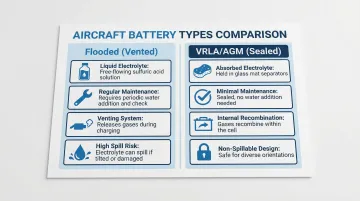
Aviation batteries come in two primary configurations, each with distinct maintenance requirements:
| Feature | Flooded (Vented) | VRLA/AGM (Sealed) |
|---|---|---|
| Electrolyte | Liquid acid requiring periodic water addition | Absorbed in glass mat; no water addition needed |
| Maintenance | Regular specific gravity checks and water replenishment | Minimal; voltage testing only |
| Venting | Requires sump jars and acid-resistant paint due to corrosive fumes | Internal gas recombination; pressure relief valve activates only during overcharge |
| Spill Risk | High; free-flowing electrolyte | Non-spillable; multiple mounting orientations possible |
Critical Battery Terms
Understanding these key terms helps diagnose battery health and performance issues:
Open Circuit Voltage (OCV): Voltage measured when the battery is at rest, not under load or charging. OCV provides a reliable indicator of state of charge after the battery has rested for at least 30 minutes.
Closed Circuit Voltage (CCV): Voltage measured while the battery is under load, such as during engine cranking. Significant voltage drop under load indicates high internal resistance or capacity loss.
Specific Gravity: The density of the electrolyte compared to water, measured with a hydrometer. For flooded batteries, specific gravity directly relates to state of charge—fully charged cells typically read 1.265 or higher.
Sulfation: The formation of lead sulfate crystals on battery plates. Sulfation occurs naturally during discharge but becomes permanent when batteries remain discharged for extended periods (typically over 24 hours), permanently reducing capacity and increasing internal resistance.
Why Maintenance of Aircraft Lead Acid Batteries Is Critical
Aircraft battery maintenance is not optional—it's a regulatory requirement with direct implications for safety, operational reliability, and cost management.
Flight Safety and System Reliability
Lead acid batteries serve two critical functions:
- Provide essential backup power during generator failures
- Supply the high current needed for engine starts
In emergency situations, your battery must power critical avionics, lighting, and communication systems long enough to execute a safe landing. A battery that appears functional during routine starts may fail completely when called upon during an actual emergency.
Battery Lifespan and Replacement Economics
Proper maintenance can extend battery service life from 2-3 years to 4-5 years, depending on application:
- Turbine engine starts: 1-5 years
- Reciprocating engine starts: 3-6 years
- Emergency backup applications: 5-15 years
Aircraft batteries represent a significant investment. Replacement costs range from $500 for small general aviation aircraft to over $3,000 for larger turbine-powered aircraft.
When you factor in labor for removal and installation, testing, and potential AOG charges for expedited shipping, the total cost of reactive battery replacement can easily double.
Preventive Maintenance vs. Reactive Replacement
The economics favor preventive maintenance decisively.
Preventive approach includes:
- Scheduled capacity testing ($150-300)
- Routine inspections (1-2 hours labor)
- Timely water additions
- Batteries remain serviceable for their full design life
Reactive approach costs:
- Expedited shipping with hazardous material surcharges
- Mechanic travel costs
- Aircraft downtime (potentially $500-2,000 per day)
- Loss of scheduled revenue flights
Rental battery programs allow aircraft to remain operational during scheduled maintenance, eliminating downtime while ensuring compliance with testing requirements.
FAA Compliance Requirements
Beyond safety and economics, regulatory compliance drives maintenance requirements. The FAA establishes clear airworthiness standards for aircraft batteries.
Advisory Circular AC 43.13-1B specifies that batteries must maintain at least 80% of rated capacity to remain airworthy. This threshold ensures the battery can support essential electrical loads for the minimum required duration during generator failure.
Part 91 operators must maintain batteries according to manufacturer recommendations, while Part 135 operators face more stringent inspection requirements. All battery maintenance must be properly documented in aircraft logs to maintain airworthiness certification.
Sulfation Prevention
Understanding the chemistry behind battery failure helps explain why maintenance timing matters.
Sulfation is the primary cause of premature battery failure in aviation applications. When batteries remain in a discharged state, soft lead sulfate crystals harden into permanent formations that cannot be reversed through normal charging.
Prevention strategies:
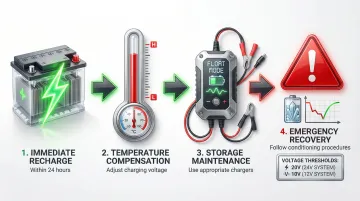
- Recharge batteries immediately after discharge—never leave a discharged battery sitting overnight
- Use temperature-compensated charging to ensure complete charge cycles
- For aircraft in storage, maintain batteries on appropriate trickle chargers
- If battery voltage drops below 20V (24V system) or 10V (12V system), follow manufacturer conditioning charge procedures immediately
Types of Maintenance for Lead Acid Aircraft Batteries
Aircraft battery maintenance follows a tiered approach, from routine visual checks to complete capacity evaluation and replacement. Understanding when each maintenance level is appropriate ensures regulatory compliance while optimizing costs.
Routine Preventive Maintenance
Routine checks between major inspections catch early warning signs before they become serious problems. For aircraft in regular use with properly functioning charging systems, these preventive tasks maintain battery health:
- Visual inspection for case damage, swelling, or corrosion
- Terminal cleaning and torque verification
- Electrolyte level checks (flooded batteries only)
- Open circuit voltage measurement
- Vent system inspection and cleaning
During these inspections, look for white powder on terminals indicating acid leakage, verify secure mounting to prevent vibration damage, and measure OCV to confirm adequate state of charge.
Check vent tubes for blockages that could cause dangerous pressure buildup.
Capacity Testing and Evaluation
Capacity testing is the only definitive method to determine battery airworthiness. Voltage checks alone cannot reveal internal capacity loss.
Capacity tests are required at these intervals:
- Time-based intervals (typically 12-18 months)
- Specific gravity discrepancies between cells exceeding 0.050
- Performance concerns such as slow cranking or rapid voltage drop
The battery undergoes controlled discharge at the C1 rate (one-hour rate) to a specific endpoint voltage of 1.67 volts per cell. The time to reach this endpoint determines actual capacity as a percentage of rated capacity.
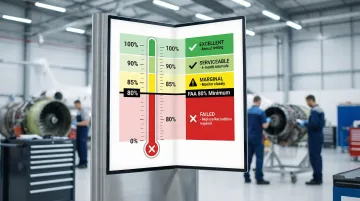
Results fall into four categories:
- Above 90%: Excellent health; continue annual testing
- 85-90%: Serviceable but inspection intervals should be shortened to 6 months
- 80-85%: Marginal; closely monitor and consider replacement
- Below 80%: Failed; must be replaced or reconditioned per FAA requirements
Professional testing services minimize aircraft downtime through this process. Ni-Cad Systems offers capacity testing with rental batteries available, allowing operators to continue flight operations while their primary battery undergoes evaluation.
Corrective Maintenance and Desulfation
Low capacity test results, voltage irregularities between cells, or extended discharge periods trigger corrective action. Each scenario requires specific intervention to restore battery performance.
Conditioning charge cycles using specific voltage and current profiles can sometimes recover capacity in mildly sulfated batteries. If a battery fails capacity testing below 85%, a conditioning charge may restore it. If it fails a second capacity test after reconditioning, replacement is required.
Severely sulfated batteries with hard crystal formations cannot be recovered. Attempting to force-charge heavily sulfated batteries risks thermal runaway and can void manufacturer warranties.
Professional evaluation is essential to determine whether reconditioning is viable or replacement is necessary.
Major Overhaul and Replacement
Replacement becomes necessary under these conditions:
- Failed capacity tests below 80% after reconditioning attempts
- Physical damage including cracked cases or swollen cells
- Cell voltage imbalance exceeding manufacturer specifications
- Reaching manufacturer's calendar life limits (typically 5-7 years regardless of condition)
Replacement batteries must be FAA-approved for the specific aircraft installation, typically meeting TSO-C173 standards. Operators must document all battery replacements with proper logbook entries that include installation details and initial capacity test results.
Professional battery service facilities offer comprehensive solutions including capacity testing, reconditioning when viable, and FAA-approved replacement batteries. Rental battery programs minimize aircraft downtime—operators can continue flight operations while their primary battery undergoes testing or replacement.
How to Check If Your Aircraft Battery Needs Maintenance
Early detection of battery problems prevents in-flight failures and costly AOG situations. These indicators indicate that maintenance or testing may be required.
Voltage and Electrical Performance Changes
Voltage measurements provide the first line of defense in battery monitoring.
After a full charge cycle, 12V batteries should read at least 12.6V and 24V batteries should read at least 25.2V. Lower readings indicate incomplete charging or internal capacity loss.
State of charge voltage reference:
| System | 100% Charge | 75% Charge | 50% Charge |
|---|---|---|---|
| 12V | 12.9V | 12.7V | 12.4V |
| 24V | 25.8V | 25.4V | 24.8V |
Slow cranking despite adequate charging time indicates high internal resistance or insufficient capacity. The battery may have enough voltage but cannot deliver the required current.
Rapid voltage drop under load during engine cranking signals that internal resistance has increased due to sulfation or plate deterioration.
Specific Gravity Discrepancies
For flooded batteries, specific gravity measurements reveal cell-by-cell health that voltage readings cannot detect.
How to measure: Use a temperature-compensated hydrometer to draw electrolyte samples from each cell. Take readings when the battery is fully charged and at rest.
Concerning readings:
- Specific gravity below 1.265 in a fully charged cell indicates sulfation or capacity loss
- Variance greater than 0.050 between cells signals cell imbalance, typically indicating the battery is approaching end of life
VRLA/sealed batteries: Since electrolyte is not accessible, use voltage testing to assess individual cell condition. Significant voltage differences between cells indicate internal problems.
Physical Inspection Findings
Beyond electrical testing, visual inspection reveals physical degradation patterns.
White powder or crusty deposits on terminals indicate electrolyte leakage. Acid vapors corrode terminals and cable connections, increasing resistance and creating potential failure points.
Case deformation: Swollen or bulging battery cases indicate overcharging, internal short circuits, or thermal runaway. Any visible case distortion requires immediate battery removal.
Electrolyte condition: In flooded batteries, discolored electrolyte (brown or gray instead of clear) indicates plate material shedding. Excessive water consumption between inspections suggests overcharging or high operating temperatures.
Operational Anomalies
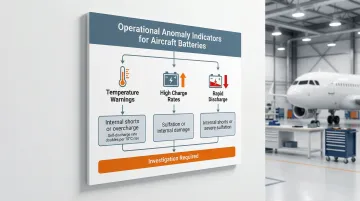
How the battery behaves during normal operations provides diagnostic clues:
- Temperature warnings: Overheating during charging indicates internal short circuits, excessive charge rates, or inadequate ventilation. Self-discharge rates double for every 10°C (18°F) rise in temperature
- Continuous high charge rates: Persistent high charge current means the battery cannot accept a full charge due to sulfation or internal damage
- Failure to maintain charge: Rapid discharge between flights despite proper charging indicates high self-discharge rates from internal shorts or severe sulfation
Time-Based Maintenance Intervals
Even with excellent electrical performance, calendar time drives mandatory inspections.
Most lead acid battery manufacturers specify capacity testing every 12-18 months, with specific intervals varying by battery model and application. Lead acid batteries typically have 5-7 year calendar life limits regardless of measured capacity—chemical degradation occurs over time even with proper maintenance.
Aircraft maintenance programs may specify battery inspections based on flight hours or engine start cycles, particularly for commercial operations.
Aircraft Battery Maintenance Schedule (General Guidelines)
Regular maintenance prevents unexpected battery failures and extends service life. Schedules vary by aircraft type, battery manufacturer, operating environment, and regulatory requirements (Part 91 vs. Part 135).
The following table provides baseline intervals that should be adjusted based on manufacturer recommendations and operating conditions.
| Interval | Maintenance Tasks | Notes |
|---|---|---|
| Preflight/Daily | Visual inspection for damage, leakage, secure mounting; verify battery switch operation | Quick check taking 2-3 minutes |
| Every 50 Hours or Monthly | Check terminal torque and cleanliness; measure OCV; inspect vent system | Typical general aviation interval |
| Every 100 Hours or Quarterly | Flooded batteries—check electrolyte level and specific gravity; all batteries—detailed visual inspection | Add distilled water as needed |
| Annually or 12-18 Months | Capacity test per manufacturer procedures; detailed electrical testing; update maintenance logs | Professional testing recommended |
These baseline intervals apply to standard operating conditions. Adjust your maintenance schedule based on the following factors:
Operating Condition Adjustments
High-temperature environments:
- Temperature significantly accelerates self-discharge and chemical degradation
- Increase capacity testing frequency in hot climates
- Monitor electrolyte levels more closely
Aircraft in storage:
- Batteries self-discharge approximately 4% per month at 25°C
- Use appropriate trickle chargers for aircraft stored longer than 30 days
- Alternatively, remove batteries and store in temperature-controlled environments
Frequent engine starts:
- Training aircraft and those making multiple daily starts experience higher battery stress
- Shorten inspection intervals for high-cycle applications
- Consider professional capacity testing if degradation is suspected
Temperature compensation for charging:
- Below 25°C: Increase voltage by 0.024V/°C (12V) or 0.048V/°C (24V)
- Above 25°C: Decrease voltage by 0.008V/°C (12V) or 0.016V/°C (24V)
- Reference: Concorde temperature compensation guidelines
For annual capacity testing and detailed electrical analysis, FAA-certified facilities like Ni-Cad Systems provide professional testing services with fast turnaround times and rental batteries to minimize aircraft downtime.
Conclusion
Aircraft lead acid battery failures cause costly AOG situations and compromise safety. The right maintenance approach prevents both.
Structured capacity testing schedules, consistent monitoring of key performance indicators, and early problem detection extend battery life significantly while keeping aircraft operational. These practices balance FAA compliance requirements with cost-effectiveness.
Essential maintenance actions include:
- Capacity testing at manufacturer-recommended intervals (typically 12-18 months)
- Monthly voltage and electrolyte level checks
- Immediate investigation of any performance degradation
- Professional reconditioning when capacity drops below 80%
When batteries need service, FAA Part 145 certified facilities like Ni-Cad Systems offer capacity testing, reconditioning, and rental battery programs that minimize downtime. With over 47,000 units serviced since 1974 and same-day AOG support, specialized battery service providers help operators maintain airworthy batteries without operational disruption.
Frequently Asked Questions
What is a lead acid battery in aviation?
Aircraft lead acid batteries are rechargeable power sources using lead dioxide and lead plates in sulfuric acid electrolyte. They provide reliable DC power for starting and emergency electrical systems, with multiple cells connected in series to create 12V or 24V aviation systems.
Are lead acid batteries allowed on airplanes?
Yes, lead acid batteries are FAA-approved and widely used in general aviation. Both spillable (flooded) and non-spillable (VRLA/AGM) types meet TSO-C173 certification standards, with specific installation requirements based on battery type.
What type of battery is used in aircraft?
Battery type varies by aircraft size and application. Lead acid dominates general aviation, nickel-cadmium (NiCd) powers larger turbine aircraft, and lithium is increasingly used in modern designs. Lead acid remains popular for its reliability and lower cost.
How often should aircraft lead acid batteries be tested?
Capacity testing should occur every 12-18 months or per manufacturer recommendations, with routine voltage checks at shorter intervals. FAA Part 145 facilities like Ni-Cad Systems perform comprehensive testing and recommend 6-month intervals for batteries showing 85-90% capacity.
What causes sulfation in aircraft batteries and how can it be prevented?
Sulfation occurs when batteries remain discharged, allowing soft lead sulfate crystals to harden permanently. Prevent it by recharging within 24 hours after discharge, using temperature-compensated charging, and maintaining trickle charge during storage.
When should an aircraft battery be replaced rather than serviced?
Replacement is required when capacity testing shows less than 80% of rated capacity (FAA airworthiness minimum), when physical damage like cracked cases or swollen cells is present, when cell voltage imbalance exceeds manufacturer specifications, or when the battery reaches its calendar life limit (typically 5-7 years) regardless of measured condition.