
Introduction
When your alternator fails at 10,000 feet, your aircraft battery becomes the only thing standing between you and complete electrical system shutdown. These aren't just engine starters—they're critical backup power sources keeping avionics, lighting, and essential systems operational during electrical failures.
Poor battery maintenance creates serious risks. In-flight electrical failures, thermal runaway (particularly in nickel-cadmium batteries), and unplanned downtime are just the start. Premature replacement costs average $2,000-$5,000 per battery, not counting the safety hazards and regulatory violations.
This guide covers maintenance types specific to aviation batteries, inspection schedules aligned with FAA requirements, early warning signs that signal trouble, cost considerations, and compliance requirements that keep your aircraft airworthy.
Key Takeaways
- Routine inspections every 50-100 flight hours and reconditioning every 100-200 hours prevent thermal runaway and premature failure
- NiCd batteries above 100°F risk thermal runaway; proper ventilation and monitoring are essential
- Proper maintenance extends battery life to 7-10 years vs. 18-24 months with neglect
- FAA requires Part 145 facilities for major service and complete maintenance documentation
Why Maintenance of Aircraft Batteries Is Important
Aircraft batteries aren't just starting devices—they're your emergency backup power source when the alternator or generator fails. These batteries must perform reliably in critical situations, providing power for avionics, lighting, and essential systems that keep you safe in the air.
Impact on Flight Safety and Electrical System Reliability
Your battery provides emergency power when the primary electrical system fails. Without proper maintenance, you risk losing essential systems at the worst possible moment.
According to Duncan Aviation's battery maintenance research, well-maintained batteries can extend service life from 3-5 years to 7-10 years, while neglected batteries fail prematurely within 18-24 months—often without warning.
Cost Savings: Preventive vs Reactive Maintenance
The financial case for preventive maintenance is compelling:
- Scheduled reconditioning: $200-$400 per service
- Emergency battery replacement: $2,000-$5,000+ per unit
- Cost multiplier: Reactive maintenance costs 3-5x more than preventive care
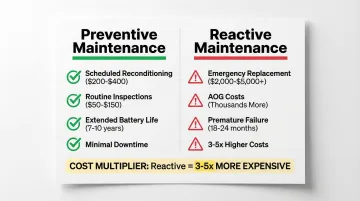
This doesn't include AOG (Aircraft on Ground) downtime costs, which can add thousands more in lost operational time and scheduling disruptions.
FAA Compliance and Airworthiness
Beyond cost savings, proper maintenance ensures regulatory compliance and airworthiness. FAR 43 Appendix A allows owner-performed preventive maintenance on batteries, but major service work requires Part 145 certification. Improper maintenance can void warranties and create serious liability issues.
The FAA considers a battery airworthy only if it meets specific capacity requirements—typically 80% of rated capacity.
A battery that cannot support essential electrical loads for the prescribed time (often 30 minutes) during generator failure is considered unairworthy.
Types of Maintenance for Aircraft Batteries
Aviation battery maintenance requirements differ significantly between NiCd and lead-acid types. Your maintenance approach must account for operational tempo, environmental conditions, and battery chemistry to prevent premature failure.
Routine / Preventive Maintenance
Scheduled preventive maintenance forms your first line of defense against battery failure.
Key activities include:
- Visual inspections for leakage, corrosion, and case distortion
- Electrolyte level checks for flooded batteries
- Terminal cleaning and torque verification
- Voltage testing and load checks
- Ventilation system verification
Common intervals: Every 50-100 flight hours or at each annual inspection. High-temperature climates and high-cycle operations require more frequent checks.
Cost estimate: $50-$150 per routine service, making this the most cost-effective maintenance approach.
Corrective / Reactive Maintenance
Reactive maintenance responds to problems after they appear. This approach carries significant risks.
Common problems requiring corrective action:
- Low voltage readings
- Visible corrosion or electrolyte leakage
- Case distortion or physical damage
- Performance degradation during load testing
Thermal runaway in NiCd batteries can cause temperatures exceeding 160°F, leading to catastrophic failure. Lead-acid batteries develop sulfation damage when left discharged, permanently reducing capacity.
The reactive approach costs 3-5x more than preventive maintenance because you're replacing entire batteries rather than maintaining them. Emergency replacements also create AOG situations that disrupt operations.
Reconditioning / Capacity Testing
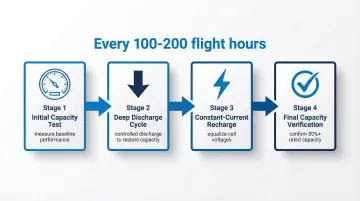
NiCd batteries require periodic reconditioning every 100-200 flight hours to restore full capacity, equalize cell voltages, and prevent cell imbalance. This involves deep discharge and recharge cycles using constant-current chargers. Lead-acid batteries benefit from periodic equalization charging to prevent sulfation.
Critical requirement: FAA regulations and manufacturer guidelines require capacity testing, with replacement required when batteries fall below 80-85% of rated capacity. Voltage checks alone are insufficient. Only capacity testing reveals true battery health.
Professional reconditioning services average cost $200-$400 and require FAA Part 145 approved facilities. Ni-Cad Systems, which has serviced over 47,000 units since 1974, provides these specialized reconditioning services.
Major Overhaul / Cell Replacement
NiCd batteries allow individual cell replacement when cells fail capacity tests or show physical damage, potentially extending battery life by 5+ years. Sealed lead-acid batteries require full replacement when they fail.
Replacement triggers:
- Failure to hold charge
- Case distortion or physical damage
- Reaching manufacturer's cycle life limits (typically 500-1,000 cycles)
- Capacity below 80% of rated specification
Cost comparison: NiCd cell replacement/overhaul costs significantly less than full battery replacement ($2,000-$5,000+), making proper maintenance and timely overhaul a smart financial decision.
How to Check If Aircraft Battery Needs Maintenance
Catching battery problems early prevents costly AOG situations. Watch for these warning indicators that signal maintenance needs before complete failure occurs.
Voltage and Performance Degradation
Critical voltage thresholds:
- Open circuit voltage (OCV) below 12.5V for 12V lead-acid batteries after 2-hour rest period
- Below 24V for 24V systems after settling
- Rapid voltage drop under load during alternator-off checks
Performance indicators:
- Difficulty starting engines, especially in cold weather
- Excessive cranking time required
- Battery unable to maintain electrical loads during ground checks
Voltage alone doesn't tell the full story—only capacity testing reveals whether your battery can support essential loads during generator failure.
Temperature and Physical Indicators
Beyond electrical performance, physical condition reveals critical battery health information. Temperature monitoring is especially critical for preventing thermal runaway in NiCd batteries.
Warning signs:
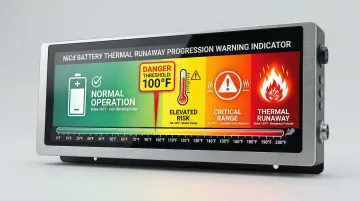
- Battery case warm or hot to touch during normal operations (above 100°F indicates thermal runaway risk)
- Case distortion, bulging, or cracking indicating internal pressure buildup
- Electrolyte leakage showing corrosion on terminals or battery box
- White or greenish powder accumulation around terminals
NiCd batteries operating above 100°F during charging face significantly increased thermal runaway risk, where temperature and charging current create an uncontrollable cycle leading to battery destruction.
Operational and Electrical Anomalies
Electrical system behavior often provides the earliest warning signs. Watch for these indicators:
- Ammeter showing unusually high charging current during cruise (may indicate internal short or cell failure)
- Frequent low-voltage warnings or electrical system alerts
- Battery requiring water additions more frequently than normal (indicates overcharging or internal cell damage)
For lead-acid batteries, hydrometer testing provides definitive health data. Specific gravity readings should be 1.275-1.285 when fully charged. Differences greater than 0.050 between cells indicate the battery is nearing end of life.
Aircraft Battery Maintenance Schedule (General Guidelines)
Maintenance intervals vary significantly by battery type, operational tempo, and environmental conditions. This table provides general guidelines—always consult your battery manufacturer's specifications and aircraft maintenance manual.
Maintenance Frequency Table
| Interval | Inspection Tasks | Battery Type |
|---|---|---|
| Pre-flight/Post-flight | Visual inspection for leakage, corrosion, secure mounting, ventilation tube attachment | All types |
| Every 50 flight hours or monthly | Electrolyte level check (flooded batteries), terminal cleaning and torque check, voltage test | All types |
| Every 100-200 flight hours or quarterly | Professional capacity test, reconditioning service (NiCd), equalization charge (lead-acid) | NiCd: 100 hrs / Lead-acid: 200 hrs |
| Annual inspection | Complete battery system inspection including ventilation, battery box condition, sump jar service, detailed capacity testing | All types |
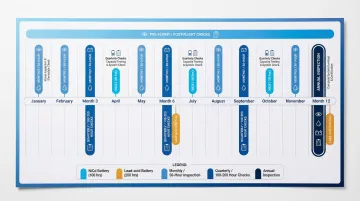
These baseline intervals adjust based on how you operate your aircraft and the environment where it flies.
Operational Considerations
NiCd vs Lead-Acid Requirements:
NiCd and lead-acid batteries have distinct maintenance needs:
- Require more frequent reconditioning (every 100-200 hours)
- Tolerate deep discharge without permanent damage
- Need professional capacity testing to maintain reliability
- Must prevent sulfation through electrolyte monitoring
- Require simpler charging procedures
- Permanently damaged by deep discharge events
High-Cycle Operations (flight schools, charter):
Aircraft with frequent daily use need accelerated maintenance:
- Reconditioning every 50-100 hours due to frequent engine starts
- Aggressive maintenance schedule prevents premature failure
- Temperature monitoring becomes critical with high-cycle charging
Low-Cycle Operations (private ownership):
Infrequently flown aircraft face different challenges:
- Can extend to 200+ hours between reconditioning services
- Must maintain float charge when aircraft sits idle
- According to Concorde Battery documentation, storage requires boost charging when voltage drops to 25.0V (24V battery) or every 30 days
Temperature Considerations:
Environmental conditions significantly impact service intervals:
- High-temperature environments (>90°F average) require 25-50% more frequent servicing
- According to Savvy Aviation research, lead-acid battery self-discharge rate doubles for every 18°F increase above standard temperature
- Cold climates (<32°F) require capacity testing before winter season to ensure adequate cold-cranking performance
Conclusion
Aircraft battery maintenance isn't optional—it's essential for flight safety and required for airworthiness. The right approach combines three critical elements:
- Preventive care through regular inspections and proper storage
- Professional reconditioning at manufacturer-recommended intervals
- Proper charging practices that extend battery life and reliability
Following manufacturer guidelines and FAA requirements protects your investment and prevents costly emergency replacements. For complex service needs—from capacity testing to deep-cycle reconditioning—FAA Part 145 certified facilities like Ni-Cad Systems provide the specialized equipment and expertise to keep your aircraft's electrical system performing reliably when you need it most.
Frequently Asked Questions
What are the FAA rules for batteries?
FAR 43 Appendix A allows aircraft owners to perform preventive maintenance including battery servicing, but major work requires Part 145 certification. FAA AC 00-33A provides specific guidance for NiCd battery maintenance, while AC 43.13-1B covers general standards.
How often should aircraft batteries be serviced?
Inspect every 50-100 flight hours, with professional reconditioning every 100-200 hours for NiCd batteries and annual capacity testing for lead-acid. High-temperature operations require more frequent servicing.
What's the difference between NiCd and lead-acid battery maintenance?
NiCd batteries require periodic reconditioning to prevent cell imbalance and tolerate deep discharge. Lead-acid batteries need electrolyte monitoring, are permanently damaged by deep discharge, and require different charging voltages.
How do I know when my aircraft battery needs replacement?
Replace when capacity falls below 80-85% of rated capacity, case shows distortion or cracking, battery won't hold charge, cell voltage differences exceed 0.5V, or the manufacturer's cycle life limit is reached.
Can I use an automotive battery charger on my aircraft battery?
No. Automotive chargers typically output higher voltages (14.5-15V) than aircraft batteries can safely handle (13.8-14.2V for lead-acid, 28V for NiCd), which can cause overheating, thermal runaway, and permanent damage. Always use aviation-specific temperature-compensated chargers designed for your battery type.
What causes aircraft battery thermal runaway?
Thermal runaway occurs when battery temperature exceeds 100°F during charging, causing internal resistance to drop and current draw to increase in an uncontrollable cycle until battery destruction. Most common with inadequate ventilation or incorrect charging procedures.