
Introduction
Every day, aircraft operators face a challenging trade-off: maintain rigorous inspection schedules or keep aircraft flying to meet operational demands. The cost of getting this wrong is steep.
Unplanned downtime costs commercial operators between $10,000 to $150,000 per hour. Between 1988 and 1997, maintenance-related failures caused 7.1% of General Aviation accidents, resulting in 504 fatalities. Regulatory violations and ballooning lifecycle costs multiply when programs fall short of FAA standards.
This guide breaks down the essential preventive maintenance strategies that keep aircraft reliable, compliant, and airworthy—from establishing effective inspection intervals to implementing condition monitoring systems that catch issues before they ground your fleet.
Key Takeaways
- Prevents catastrophic failures and ensures FAA compliance while reducing accident rates significantly
- Systematic programs cut maintenance costs by 30-40% versus reactive approaches
- Combines routine inspections, condition monitoring, predictive analytics, and scheduled overhauls
- Systematic inspections catch failures early, preventing groundings and operational disruptions
- FAA Part 43 documentation maintains airworthiness and protects compliance status
Why Preventive Maintenance Is Critical for Aircraft Reliability
Preventive maintenance forms the foundation of aviation safety and operational efficiency, delivering measurable benefits across safety, financial, and operational dimensions.
Impact on Safety and Regulatory Compliance
Proper preventive maintenance directly prevents catastrophic failures and ensures compliance with FAA regulations under 14 CFR Parts 43 and 91. The stakes are high.
Historical FAA/NTSB data reveals that 7.1% of General Aviation accidents were maintenance-related, with installation errors accounting for 20% of these accidents and producing the highest severity outcomes. In commercial aviation, maintenance issues contributed to approximately 3.8% of accidents between 1998 and 2019, though improved industry standards have driven down the rate per kilometer flown.
Regulatory responsibilities are clear:
- 14 CFR § 91.403(a): Aircraft owners bear primary responsibility for maintaining airworthiness
- 14 CFR § 91.403(c): Operators must comply with FAA-approved Airworthiness Limitations sections of maintenance manuals
Effect on Aircraft Availability and Operational Readiness
Beyond safety, preventive maintenance directly impacts your bottom line through aircraft availability. Scheduled preventive maintenance minimizes unplanned Aircraft on Ground (AOG) situations that devastate operational schedules. Comprehensive monitoring and predictive maintenance programs have improved dispatch reliability from 97.5% to 99.2%, directly translating to more available flight hours and consistent service delivery.
Financial Impact
The operational benefits translate into substantial cost savings:
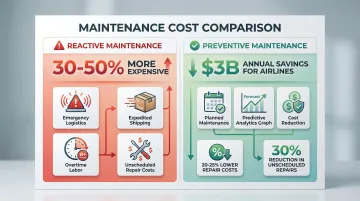
- Reactive maintenance costs 30-50% more than planned maintenance due to emergency logistics, expedited shipping, and overtime labor
- Predictive maintenance strategies reduce unscheduled repairs by 30% and lower total repair costs by 20-25%
- IATA estimates predictive maintenance saves airlines approximately $3 billion annually
- Supply chain inefficiencies and maintenance challenges are projected to cost the aviation industry over $11 billion in 2025
Extending Component and Aircraft Lifespan
Preventive maintenance also protects your capital investment. Regular maintenance extends the useful life of critical systems including engines, avionics, batteries, and hydraulics.
Manufacturers establish Time Between Overhaul (TBO) standards to prevent age-related degradation:
| Component | TBO Standard | Calendar Limit |
|---|---|---|
| Lycoming O-320/O-360 engines | 2,000-2,400 hours | 12 years |
| Continental O-200 engines | 1,800-2,200 hours | 12 years |
| P&WC PT6A engines | 3,600 hours (basic) | Condition-based extensions available |
| Landing gear systems | 60,000-70,000 cycles | 10 years |
Adhering to these standards prevents premature failures and maximizes return on capital investments in aircraft and components.
Types of Preventive Maintenance in Aviation
Aviation maintenance includes multiple complementary strategies, each addressing different aspects of aircraft reliability and airworthiness.
Routine/Scheduled Preventive Maintenance
Routine maintenance consists of time-based or flight-hour-based inspections mandated by manufacturers and FAA regulations. These predictable tasks form the baseline of any comprehensive maintenance program.
Common tasks include pre-flight inspections, oil changes, fluid level checks (hydraulic, coolant, fuel), tire inspections, battery servicing and capacity testing, and lubrication of moving components. For aircraft battery systems specifically, facilities like Ni-Cad Systems in Hayward, CA provide FAA Part 145 certified capacity testing and deep-cycle testing to verify performance against specifications.
When most effective: For predictable wear items and manufacturer-recommended service intervals. An annual inspection for a Cessna 172 typically requires 15-18 labor hours, with total costs reaching $5,400 when including parts and rectification work.
Condition-Based Maintenance
While routine maintenance follows fixed schedules, condition-based maintenance triggers service based on actual equipment condition using inspections and monitoring to identify needs before failure occurs.
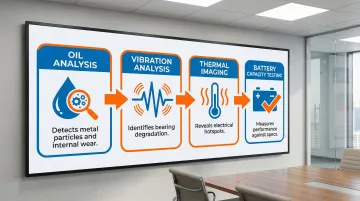
This strategy uses several diagnostic methods:
- Oil analysis - Detects metal particles indicating internal wear
- Vibration analysis - Identifies bearing degradation and imbalances
- Thermal imaging - Reveals electrical hotspots and insulation breakdown
- Battery capacity testing - Measures actual performance against specifications
Evidence-based timing prevents both premature servicing and unexpected failures.
Predictive Maintenance
Taking condition-based monitoring a step further, predictive maintenance employs real-time sensors, IoT devices, and analytics to forecast maintenance needs before degradation impacts operations.
Airlines deploy advanced technologies including:
- Flight data monitoring systems tracking engine parameters
- Engine health monitoring analyzing performance trends
- Structural health monitoring detecting fatigue and stress
Collins Ascentia demonstrated a 30% decrease in delays and cancellations for Boeing 787 fleets and a 20% decrease in unscheduled removals for Boeing 777 fleets. Delta Air Lines reduced maintenance-related delays by 20% through predictive tools.
Major Overhauls and Heavy Maintenance
Major overhauls involve comprehensive inspections and component replacements at specified intervals, addressing structural integrity and system-wide refurbishment.
Operators perform these extensive checks when:
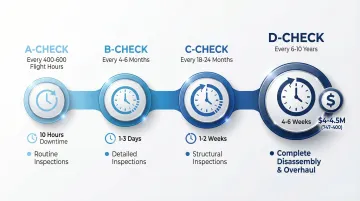
- Manufacturer specifications (C-checks, D-checks for commercial aircraft)
- FAA Airworthiness Directives
- Time or cycle limits on life-limited components
Typical work includes:
- Structural inspections for cracks and corrosion
- Engine overhauls (costing $200,000 to over $2 million)
- System replacements and upgrades
- Corrosion treatment and prevention
A D-Check for a Boeing 747-400 costs approximately $4.0M-$4.5M and requires several weeks of downtime for extensive disassembly and inspection.
How to Identify When Aircraft Need Maintenance
Early detection of maintenance needs is essential for preventing failures and maintaining airworthiness. Multiple indicators signal when aircraft require attention.
Performance Degradation Indicators
- Reduced engine power output during takeoff or climb
- Decreased fuel efficiency compared to baseline performance
- Inconsistent instrument readings or gauge fluctuations
- Longer takeoff rolls indicating thrust or drag issues
- Reduced climb rates suggesting engine or aerodynamic problems
Operational Anomalies
Watch for unusual characteristics during operations:
- Unusual noises (grinding, squealing, knocking)
- Abnormal vibrations during specific flight phases
- Unfamiliar odors (burning, fuel, hydraulic fluid)
- Visible fluid leaks during walkarounds
- Warning lights or system malfunction indicators
- Control surface resistance or binding
Physical Inspection Findings
Regular inspections reveal visible deterioration:
- Corrosion on structural components or fasteners
- Cracks in airframe, engine mounts, or skin panels
- Worn components showing excessive play or damage
- Loose fasteners or missing hardware
- Damaged surfaces (dents, punctures, delamination)
- Fluid contamination (discoloration, metal particles)
Scheduled Inspection Intervals
The FAA and manufacturers establish mandatory inspection intervals based on multiple factors:
- Annual inspections — required for all aircraft
- 100-hour inspections — required for aircraft used for hire
- 12-month component replacement cycles — calendar-based aging limits
- 50-hour service intervals — for specific high-wear components
- Pressurization cycles — for commercial aircraft structures
- Landing gear cycle limits — based on takeoff/landing counts
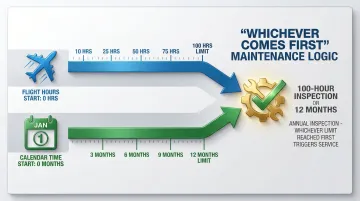
Most maintenance tasks use "whichever comes first" logic. This ensures both high-use aircraft (reaching hour limits quickly) and low-use aircraft (reaching calendar limits first) receive appropriate attention for operational wear and age-related degradation.
Best Practices for Implementing Preventive Maintenance Programs
Successful preventive maintenance programs require systematic planning, rigorous documentation, and continuous improvement.
Develop Comprehensive Maintenance Schedules
Create detailed maintenance calendars integrating manufacturer recommendations, regulatory requirements, and operational needs. Track multiple interval types simultaneously:
- Flight hours since last service
- Calendar time since installation
- Pressurization or landing cycles
- Engine starts and operating hours
Textron extended maintenance intervals for the Cessna Citation XLS+ from 12 months/600 hours to 12 months/800 hours, demonstrating how data-driven schedule optimization improves aircraft utilization while maintaining safety.
Maintain Detailed Maintenance Records
FAA Part 43 mandates specific documentation for all maintenance activities. Required logbook entries must include:
- Description of work performed (or reference to approved data)
- Date of completion
- Signature and certificate number of approving person
- Type of certificate held by approving person
Retention requirements under 14 CFR § 91.417 specify that owners must retain maintenance records until work is repeated or superseded, with total time-in-service records maintained indefinitely.
Digital record-keeping systems improve accessibility and traceability while ensuring compliance.
Train Maintenance Personnel
Effective maintenance requires qualified personnel with current certifications:
- FAA-certified A&P mechanics for most maintenance tasks
- Ongoing training on new technologies and procedures
- Adherence to manufacturer service bulletins and technical updates
- Specialized certifications for specific aircraft systems
Continuous professional development ensures maintenance teams stay current with evolving technologies and regulatory requirements.
Establish Vendor Relationships
Partnering with specialized service providers enhances maintenance program capabilities.
Battery and power system specialists, for instance, can offer fast turnaround times and rental equipment during maintenance, minimizing aircraft downtime. Facilities with Part 145 FAA approval and 24/7 AOG support provide immediate assistance when critical components require service.
These specialized partnerships deliver measurable operational benefits:
- Access to specialized equipment and expertise
- Faster turnaround times through dedicated facilities
- Rental or loaner components during service periods
- 24/7 emergency response capabilities
- Regulatory compliance support and documentation
Implement Quality Assurance Processes
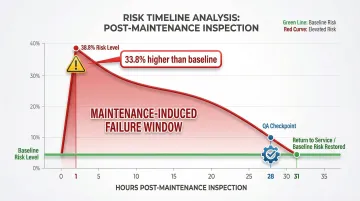
Systematic quality assurance prevents maintenance-induced failures:
- Post-maintenance inspections verify work completion and quality
- Return-to-service procedures ensure airworthiness before flight
- Trend monitoring identifies recurring problems requiring systemic solutions
- Root cause analysis for maintenance-related incidents
Research shows aircraft accident risk is 33.8% higher in the first hour following inspection compared to baseline, remaining elevated for at least 31 hours.
This "maintenance-induced failure" risk underscores the critical importance of quality assurance and proper return-to-service procedures.
Common Preventive Maintenance Mistakes to Avoid
Even well-intentioned maintenance programs can fail due to common pitfalls that compromise safety and increase costs.
Delaying Scheduled Maintenance
Deferring inspections to save time or money creates a false economy. Delayed maintenance leads to:
- Compounding problems that increase repair complexity
- Component failures requiring expensive emergency repairs
- Extended downtime when multiple deferred items require simultaneous attention
- Regulatory violations and potential certificate actions
The cost differential is substantial: reactive maintenance costs 30-50% more than planned maintenance due to emergency logistics and expedited parts procurement.
Inadequate Documentation
Poor record-keeping creates serious consequences:
- FAA inspections reveal violations when maintenance records are incomplete
- Manufacturers void warranties without documented proof of proper maintenance
- Recurring problems become harder to identify without trend tracking
- Aircraft resale value drops when buyers see incomplete maintenance history
- Legal liability increases if airworthiness cannot be demonstrated
Complete, accurate documentation protects operators legally, financially, and operationally.
Using Non-Approved Parts or Procedures
FAA regulations require approved parts and acceptable maintenance methods for all aircraft work:
- PMA (Parts Manufacturer Approval) parts meet FAA design standards
- TSO (Technical Standard Order) parts comply with minimum performance standards
- Acceptable maintenance methods follow manufacturer instructions or FAA-approved data
Using non-approved parts creates airworthiness issues, liability exposure, and certificate violations.
For battery systems specifically, FAA-PMA approved alternatives provide regulatory compliance while reducing costs. Ni-Cad Systems holds 30+ FAA-PMAs for second-source battery packs, receptacles, temperature sensors, and modification kits—all meeting the same design standards as OEM components while offering faster availability and competitive pricing.
Frequently Asked Questions
What are the 5 types of preventive maintenance?
The five main categories are routine/scheduled maintenance (time or hour-based), condition-based maintenance (triggered by equipment condition), predictive maintenance (using real-time data), corrective maintenance (addressing deficiencies), and major overhauls (comprehensive inspections at intervals). Aviation operators typically combine these approaches for complete aircraft care.
How often should aircraft preventive maintenance be performed?
Frequency depends on manufacturer recommendations, FAA regulations, and flight hours. FAA requires annual inspections for all aircraft and 100-hour inspections for aircraft used for hire. Component intervals vary—engines typically need service every 50-100 hours, while major overhauls occur at 1,800-3,600 hours.
What is the difference between preventive and corrective maintenance in aviation?
Preventive maintenance is proactive, performed on a schedule before failures occur to maintain airworthiness and prevent problems. Corrective maintenance is reactive, fixing problems after they're discovered through inspections or operational issues. Effective preventive programs significantly reduce the need for corrective maintenance, lowering costs and improving reliability.
Who can perform preventive maintenance on aircraft?
FAA Part 43 authorizes FAA-certified A&P mechanics, FAA Part 145 repair stations (like Ni-Cad Systems for battery service), and aircraft owners with private pilot certificates for limited tasks (oil changes, tire replacement). All work requires proper documentation and return-to-service approval.
What are the cost savings of preventive maintenance for aircraft?
Preventive maintenance delivers 30-40% cost reductions compared to reactive approaches. Additional savings include reduced AOG downtime (avoiding $10,000-$150,000 per hour), extended component life, lower insurance premiums, and improved resale value from complete maintenance documentation.
What documentation is required for aircraft preventive maintenance?
FAA Part 43.9 requires each entry to include work description, completion date, technician name, and signature with certificate number. FAA regulations require maintenance records be retained until work is repeated or superseded, with total time-in-service records kept indefinitely.