This article covers what the AMPS-500 does, why OEM sourcing is problematic, what FAA-PMA certification and full traceability mean in practice, and how Ni-Cad Systems' certified replacement solves the problem without compromising airworthiness or regulatory compliance.
Key Takeaways
- The URDC AMPS-500 provides backup DC power to critical aircraft systems during main power loss
- OEM supply constraints cost the aviation industry $11.3 billion a year in delays, excess inventory, and AOG events
- FAA-PMA certification confirms a replacement is legally approved for airworthy installation
- Ni-Cad Systems holds 30+ FAA-PMA approvals and offers a fully traceable AMPS-500 replacement backed by full traceability
- Every unit ships install-ready with airworthiness documentation ready for sign-off
What Is the URDC AMPS-500 Emergency Power Supply?
The AMPS-500 is an aviation emergency power supply designed to deliver backup DC power to critical aircraft systems when main power is lost or degraded. It supports emergency lighting, cabin emergency power systems, and other safety-critical avionics required during emergency landing or ditching scenarios.
Aircraft Compatibility
While the AMPS-500's specific Type Certificate Data Sheet (TCDS) is not publicly indexed, the unit is documented through OEM service bulletins and cross-reference data. Ni-Cad Systems' FAA-PMA approved replacement supports a wide range of transport category and business aviation airframes, including:
- DC-9, DC-10, L-1011
- Falcon 900/900EX/2000/2000EX
- Canadair CL600
- Cessna 425/441/500/550/S550/552/560/650 series
Why Certification Is Non-Negotiable
Under 14 CFR §25.1362, emergency electrical supplies must be "sufficiently and robustly designed, protected, and installed so that the risk of the services being rendered ineffective under emergency conditions is minimized." Any replacement that falls short of these standards introduces serious risk:
- Airworthiness violations — non-conforming parts can render the aircraft unairworthy under FAA regulations
- Traceability gaps — undocumented units fail maintenance record requirements and complicate audits
- Liability exposure — operators using uncertified parts assume full legal and insurance risk in the event of a system failure
The OEM Supply Problem: Why Sourcing the AMPS-500 Is Getting Harder
OEM Supply Constraints and Lead Times
OEM supply constraints and legacy parts obsolescence are driving significant costs across the aviation aftermarket. An October 2025 joint study by IATA and Oliver Wyman estimates these challenges will cost the airline industry $11.3 billion in 2025 alone, driven by:
- $4.2 billion in excess fuel costs from delayed fleet renewals
- $3.1 billion in additional maintenance expenses
- $2.6 billion in excess engine leasing costs
- $1.4 billion in surplus inventory holding costs

The AMPS-500 faces the same pressure. As a legacy component with a limited OEM supply base, it's vulnerable to discontinuation, reduced support, and extended lead times — the exact conditions that ground aircraft.
The Cost of AOG Delays
When OEM parts are unavailable, aircraft are grounded. Boeing estimates that a single AOG event costs operators between $10,000 and $150,000 per hour depending on aircraft type and route. A detailed study of a Boeing 777 fleet found the average AOG event costs over $31,500 when factoring in parts and flight delays.
For MRO shops and operators, this translates to:
- Delayed maintenance schedules
- Revenue loss from grounded aircraft
- Pressure to source parts quickly—often through questionable channels
Documentation Requirements and Compliance Risk
Faced with AOG pressures, some operators source "used serviceable" parts without proper documentation. FAA AC 21-29D warns that airworthiness is compromised if a part's approval status is suspect or unknown. Parts lacking required documentation are classified as Suspected Unapproved Parts (SUP), and installing them violates 14 CFR Part 43.
FAA-PMA second-source parts are the industry-accepted solution — a regulatory pathway that lets certified manufacturers produce approved replacement parts. This is a fully legal, widely used practice, not a regulatory workaround.
FAA-PMA Certification: What It Means and Why It's Non-Negotiable
Definition and Regulatory Basis
The FAA defines a Parts Manufacturer Approval (PMA) as "a combined design and production approval for modification and replacement articles." Under 14 CFR Part 21 Subpart K, applicants must prove their design meets airworthiness requirements using one of three approval bases:
- Identicality with a licensing agreement — Design obtained via a licensing agreement with the original type certificate holder
- Identicality without a license — The replacement article is identical in every respect (dimensions, tolerances, processes) to an article approved under a type certificate
- Test and Computation — Test reports and computations demonstrate the design meets all applicable airworthiness requirements
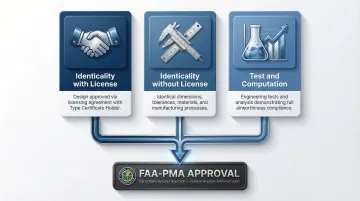
PMA is a full engineering review and production approval process — overseen directly by the FAA.
74% Airline Adoption Rate
PMA parts are industry standard. A November 2025 IATA survey of 46 airlines revealed that 74% confirm the use of PMA parts within their fleets. When evaluating PMA parts, 82% of airlines cited cost savings and part availability as their top priorities.
Major airlines, military operators, and MRO organizations routinely use PMA parts. PMA parts carry the same legal installation authority as OEM — that's the regulatory standard, not an exception.
Legal Equivalency for Installation
Once a part holds a PMA, it is legally approved for installation on the applicable aircraft. Under 14 CFR §21.9, replacement articles may be produced when manufactured under an FAA production approval such as a PMA.
For maintenance sign-offs, the path is equally straightforward:
- 14 CFR §43.3 and §43.7 authorize certificated mechanics and repair stations to approve aircraft for return to service
- An A&P mechanic installs the PMA part and signs the logbook exactly as with an OEM part — no additional airline engineering approvals required
Ni-Cad Systems' In-House DER Capability
That regulatory framework is only as strong as the engineering behind it. Ni-Cad Systems holds 30+ FAA-PMA approvals developed under the direction of Stephen Andrues — an FAA Designated Engineering Representative (DER), A&P mechanic, and pilot with 40 years of NiCd battery and power supply experience. This internal DER capability means the engineering review is done in-house, not outsourced — ensuring close oversight and faster approval cycles.
Full Traceability: What It Means and What Documentation Ships With the Part
What "Full Traceability" Means
In aviation, full traceability means every component in the unit can be traced back through its manufacturing and inspection history. This is required under FAA regulations and protects the operator during audits, incidents, or fleet-wide investigations.
FAA Form 8130-3 (Airworthiness Approval Tag)
FAA Order 8130.21J governs the completion of FAA Form 8130-3, the Authorized Release Certificate. This form serves as:
- Airworthiness approval for new articles manufactured under an FAA production approval (like a PMA)
- Export airworthiness approval
- Approval for Return to Service (RTS) after maintenance under Part 43
Only authorized persons—such as FAA Aviation Safety Inspectors (ASIs), FAA-authorized designees, or authorized personnel at a Production Approval Holder (PAH)—may sign and issue the 8130-3. Any new or overhauled part going onto a type-certificated aircraft requires this document before installation.
Certificate of Conformance (CoC)
A Certificate of Conformance (CoC) is a manufacturer's declaration that the part was produced in conformance with its approved design data. Under quality management standards like AS9100D and AS9120B, distributors must maintain Evidence of Conformance.
What operators and quality departments look for in a valid CoC:
- Part number and serial number
- Approval basis (e.g., FAA-PMA)
- Manufacturer signature and date
- Reference to applicable design data
A CoC proves adherence to a manufacturing spec, but it cannot substitute for an 8130-3. The 8130-3 is the official regulatory document proving airworthiness and conformity to FAA-approved design data.
Why Undocumented Parts Create Downstream Problems
Installing parts without proper documentation violates 14 CFR §43.9 and §91.417, which mandate maintenance recordkeeping. Consequences include:
- Inability to pass quality audits
- Rejection by airline quality departments
- Potential FAA enforcement action, including certificate revocation under 49 U.S.C. §44726
The FAA's position on documentation fraud leaves no room for interpretation. In 2023, the AOG Technics scandal — where counterfeit FAA forms were supplied for CF6 engine parts — resulted in immediate fleet-wide inspections and demonstrated exactly how quickly undocumented parts escalate from a paperwork issue to a safety crisis.
Ni-Cad Systems' Certified Replacement for the AMPS-500
The Product
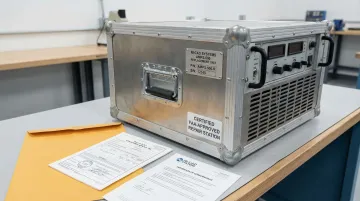
Ni-Cad Systems offers a direct, FAA-PMA approved second-source replacement for the URDC AMPS-500. The replacement supports multiple battery types:
- SAFT nickel cadmium
- Marathon nickel cadmium
- Varta nickel cadmium
- Concorde lead-acid
- Gill (Teledyne) lead-acid
It features low-impedance battery receptacles compatible with SAFT, Marathon, G.E., and Varta systems, for drop-in installation across most legacy and current configurations.
What Sets This Replacement Apart
Three things separate this replacement from generic alternatives:
- Manufactured at a Part 145 FAA-approved repair facility in Hayward, CA — every unit conforms to approved design data and airworthiness standards
- Ships with FAA Form 8130-3 and Certificate of Conformance, install-ready from day one
- Backed by over 50 years in service since 1974, with 47,000+ units serviced under that same FAA oversight
Immediate AOG Support
For operators who cannot afford extended downtime, Ni-Cad Systems offers:
- 24/7 AOG technical support at +1 510 501-9391
- Rental batteries to keep aircraft operational while your replacement is processed
- Fast turnaround times to minimize grounding periods
Call or email to confirm availability and get a unit moving the same day.
How to Order and What to Expect
How to Place Your Order
Contact Ni-Cad Systems by phone or email with the following information:
- Aircraft type and tail number
- Current part number (URDC AMPS-500 or equivalent)
- Required documentation format (if specific to your quality department)
- Timeline requirements (standard vs. AOG)
Contact Information:
- Standard orders: +1 510 785-9391 (Monday-Friday, 8:00 AM - 6:00 PM)
- AOG orders: +1 510 501-9391 (24/7 technical support)
- Email: Sales@NiCadSystems.com
Delivery Documentation
Every replacement unit ships complete with the airworthiness documentation package needed for installation sign-off:
- FAA Form 8130-3 (Airworthiness Approval Tag)
- Certificate of Conformance (CoC)
Both documents are included at no additional step — your quality department gets everything needed to clear the unit for installation.
Frequently Asked Questions
Frequently Asked Questions
What is the URDC AMPS-500 emergency power supply used for?
The AMPS-500 is an aviation emergency power supply designed to provide backup DC power to critical aircraft systems during main power loss. It's a safety-critical component subject to strict airworthiness requirements under 14 CFR §25.1362.
Is a FAA-PMA replacement part legally the same as the OEM part for installation purposes?
Yes. An FAA-PMA approved part is legally approved for installation on the applicable type-certificated aircraft. An A&P mechanic can install it and sign the maintenance record just as with an OEM part, without requiring additional airline engineering approvals.
What does "fully traceable" mean for an aviation replacement part?
Full traceability means every component has documented manufacturing and inspection history. The part ships with an FAA Form 8130-3 and Certificate of Conformance that satisfy regulatory and quality department requirements, protecting operators during audits and investigations.
What documentation comes with the Ni-Cad Systems AMPS-500 replacement?
The replacement unit ships with FAA Form 8130-3 airworthiness approval documentation and a Certificate of Conformance, covering both installation sign-off and audit compliance in a single package.
Can Ni-Cad Systems support AOG situations for the AMPS-500 replacement?
Yes. Ni-Cad Systems offers immediate AOG support with 24/7 technical assistance at +1 510 501-9391, fast turnaround times, and rental batteries available for immediate operational needs. Contact them directly for expedited availability.
How do I know the Ni-Cad AMPS-500 replacement will fit and perform correctly?
FAA-PMA approval requires the part to match the original design's form, fit, and function — verified by the FAA before approval. Ni-Cad's in-house DER and 50+ years of aviation power supply experience back every unit, so performance is equivalent to OEM.