Introduction
When an aircraft loses primary power mid-flight, the emergency battery is the only thing standing between the crew and total electrical failure. For Challenger and Falcon 50 operators, the URDC AMPS-2000 is that last line of defense—supplying backup power to essential avionics, instruments, and lighting when the main electrical system fails.
The problem: the AMPS-2000 is increasingly difficult to source from the OEM. Limited production runs, extended lead times, and uncertain supply chain status create real AOG (Aircraft on Ground) risk for operators.
FAA-PMA certified drop-in replacements do exist, meeting the same airworthiness standards as the original. This article covers what that certification means, how compatibility is verified, and where operators can source a ready-to-ship unit.
Key Takeaways
- The URDC AMPS-2000 delivers emergency backup power to critical avionics on Challenger and Falcon 50 aircraft during primary electrical failures
- OEM availability is increasingly unreliable, driving costly AOG delays for operators
- FAA-PMA certified drop-in replacements are form-fit-function equivalent, fully compliant, and in stock now
- Rental batteries are available for AOG situations to return aircraft to service while permanent replacements are sourced
Why the URDC AMPS-2000 Is Mission-Critical for Challenger & Falcon 50 Aircraft
The Role of Emergency Power in Business Jet Architecture
The AMPS-2000 (Airborne Multi-Purpose System) is designed to provide backup electrical power to essential avionics, instruments, and lighting when the main electrical system fails in flight. According to aftermarket PMA providers, the unit delivers 200 watts for 30 minutes when fully charged, supplying power to cockpit indication signals including FAULT and Battery ON indicators.
The AMPS-2000 is a dedicated emergency power supply unit with airworthiness requirements that specify both rated output and minimum duration. Without a functioning unit installed, the aircraft cannot dispatch. There is no workaround.
Aircraft Coverage and Fleet Significance
The AMPS-2000 is installed on specific Challenger variants (including the CL-600-2B16 Challenger 601-3A/3R) and the Dassault Falcon 50. These platforms represent a large share of the active corporate aviation fleet:
- Bombardier Challenger 604: 363 aircraft remain active, with 64% operating in North America
- Bombardier Challenger 605: 287 aircraft remain active, with 60% in North America
- Dassault Falcon 50: 213 aircraft remain active globally
With over 860 combined aircraft still in operation, the demand for compatible emergency power supplies remains high—but the original supply chain is increasingly strained.
What's at Stake When the AMPS-2000 Fails
Emergency battery systems are classified as required equipment under 14 CFR 91.213 and 14 CFR 135.179. MELs rarely permit dispatch with inoperative emergency power, particularly for Part 135 passenger-carrying operations. When an AMPS-2000 fails a capacity test or is unavailable, the consequences are immediate:
- Aircraft is grounded until a compliant unit is installed
- Part 135 operators face additional MEL restrictions with no dispatch relief
- No interim operational workaround exists for this required equipment category
Unlike main flight batteries, the AMPS-2000's certification and specification match are critical because it is a dedicated emergency power supply. Any deviation from the original form, fit, and function requires an STC or engineering order — adding lead time, cost, and regulatory complexity that most operators cannot absorb during an AOG event.
Why Sourcing the AMPS-2000 Has Become a Growing Challenge
The OEM Supply Chain Problem
The original manufacturer of the AMPS-2000—commonly referenced as URDC—no longer appears as an active manufacturer in current FAA databases. URDC isn't listed in current FAA Type Certificate Data Sheets (TCDS) or OEM manuals as an active production source, though the part number remains widely referenced by PMA providers who have stepped in to fill the gap.
What this means for operators:
- OEM production runs are limited or nonexistent
- Lead times can stretch to weeks or months
- Direct OEM replacements are difficult or impossible to source
- AOG situations become inevitable when emergency batteries fail unexpectedly
The Age Factor
Many Challenger and Falcon 50 aircraft are 20–35+ years old. As these platforms mature, older battery part numbers are being discontinued or supported with increasingly sparse inventory. Production for the Challenger 604 ended in 2005, the Challenger 605 in 2015, and the Falcon 50 in 1996. The original AMPS-2000 supply chain was designed for active production fleets, not aging legacy platforms.
The Financial Impact of AOG
When an aircraft is grounded due to a failed component, the financial toll is severe. AOG events cost corporate operators between $10,000 and $150,000 per day in direct and indirect expenses. For a standard corporate jet, a three-day AOG event costs approximately $79,440, factoring in aircraft lease costs, idle crew wages, expedited shipping, and emergency maintenance labor.
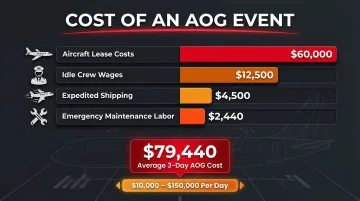
That exposure can be avoided entirely — but only if a certified replacement is on hand before the failure occurs. That's where compliance becomes the second constraint.
Why "Close Enough" Isn't Certified
Desperate operators facing AOG situations may be tempted to install unapproved commercial batteries or extend service intervals beyond recommended limits. This creates serious FAA regulatory exposure and safety risk.
Installing unapproved parts in required equipment positions invalidates the aircraft's airworthiness certificate and exposes operators and mechanics to civil penalties and certificate revocation. For Part 135 operators, the consequences are unambiguous: no airworthiness certificate means no legal flight operations, full stop.
True Drop-In Replacement: Specs, Fit, and Aircraft Coverage
What "Drop-In Replacement" Really Means
A true drop-in replacement must match the original AMPS-2000's:
- Form: Physical dimensions and mounting configuration
- Fit: Connector type and pinout
- Function: Voltage, capacity, and output profile
Any deviation requires an STC or engineering order, which adds time, cost, and regulatory complexity. A certified drop-in replacement eliminates all of that.
FAA-PMA Approval and Aircraft Compatibility
Ni-Cad Systems holds FAA-PMA approval for their AMPS-2000 replacement, one of over 30 PMA approvals the company has earned across aviation battery and power supply applications. Under 14 CFR Part 21 Subpart K, the replacement must pass identical performance testing as the OEM part—this is the legal and technical basis for it being a direct swap with no additional airworthiness action required.
The Ni-Cad Systems AMPS-2000 replacement is compatible with:
- Bombardier Challenger 601-3A/3R (CL-600-2B16)
- Dassault Falcon 50
- Additional aircraft including DC-9, DC-10, L-1011, Falconjet, and various Cessna and Citation models
The unit is also qualified across multiple battery chemistries and manufacturers, with low-impedance receptacles for direct plug-in compatibility:
- SAFT, Marathon, and Varta nickel cadmium batteries
- Concorde and Gill (Teledyne) lead-acid batteries
Immediate Availability and AOG Support
OEM channels for legacy parts like the AMPS-2000 often carry uncertain lead times. Ni-Cad Systems maintains stock for immediate shipment, and AOG support is built into the process:
- Rental units available to return aircraft to service same-day
- Permanent replacement ships while the rental is in use or an existing unit is being repaired
- No waiting on backordered or discontinued OEM inventory
FAA-PMA Certification: Why It's Non-Negotiable for Emergency Batteries
What FAA-PMA Means
A Parts Manufacturer Approval (PMA) is a combined design and production approval issued by the FAA under 14 CFR 21.303. It legally permits a manufacturer to produce a replacement part for a certificated aircraft without requiring an OEM license.
The FAA grants PMA approval through one of two methods:
- Identicality: The design is identical in every respect to the approved article, proven through detailed engineering analysis
- Test and Computation: The design meets airworthiness requirements through extensive testing, engineering analysis, and a certifying statement of compliance
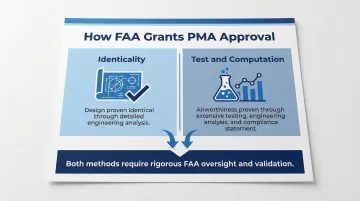
Both methods require rigorous FAA oversight and validation.
Why PMA Certification Is Critical for Emergency Power Systems
Emergency batteries are classified as required equipment per the aircraft's Type Certificate Data Sheet (TCDS) and MEL. An unapproved part in this position is an airworthiness violation with direct safety consequences.
Emergency power systems carry zero tolerance for regulatory shortcuts. A "will-fit" battery with no approval basis isn't a cost-saving workaround — it's an illegal installation on a certificated aircraft, exposing the operator, the mechanic, and the certificate holder to enforcement action.
PMA vs. Gray-Market Alternatives
14 CFR 45.15 requires that each PMA article be permanently and legibly marked with the PMA holder's name, part number, and the letters "FAA-PMA". Every PMA part must come with an FAA Form 8130-3 (Airworthiness Approval Tag) and full traceability documentation.
Without that documentation chain, a battery has no legal basis for installation — regardless of how well it fits the mounting location. Gray-market "will-fit" parts offer none of it.
The consequences are concrete:
- Civil penalties and potential certificate revocation for operators
- Criminal referrals for counterfeit parts violations under FAA enforcement
- Active investigation through the FAA's Suspected Unapproved Parts (SUP) program
Sourcing, Lead Times & AOG Emergency Support
The Order Process
Placing an order takes four steps:
- Contact the supplier with aircraft tail number and configuration
- Confirm part number applicability and compatibility
- Receive a quote with availability
- Arrange immediate shipment or rental unit deployment
Most operators have a unit confirmed and shipping same day — a significant difference from the weeks-long lead times common through OEM channels.
Rental Battery Program for AOG Situations
When an aircraft is grounded, waiting on a replacement isn't an option. Ni-Cad Systems' rental program lets operators put a certified battery on the aircraft immediately — while the permanent replacement ships or the existing unit goes through service. Ni-Cad Systems maintains rental inventory and offers 24/7 AOG support at +1 510 501-9391.
Part 145 Repair Station Advantage
Using a Part 145 FAA-approved repair station means one facility handles both supply and ongoing maintenance. That same source can perform:
- Capacity checks
- Deep-cycle reconditioning
- Recertification
- Storage services for customer spare batteries
Ni-Cad Systems has been doing this work since 1974 — with 47,000+ units serviced and 30+ FAA-PMA approvals held by the same team managing your battery today.
Frequently Asked Questions
What aircraft use the URDC AMPS-2000 emergency battery?
The AMPS-2000 is primarily installed on Bombardier Challenger 601-3A/3R (CL-600-2B16) and Dassault Falcon 50 aircraft. For exact model variant coverage under FAA-PMA approval, contact Ni-Cad Systems at +1 510 785-9391.
Is an FAA-PMA replacement battery legally airworthy for Part 135 and Part 91 operations?
FAA-PMA parts are fully legal replacements under 14 CFR, accepted by the FAA as meeting the same airworthiness standard as the OEM part — for both Part 135 and Part 91 operators.
What does "drop-in replacement" mean — will any modifications be required?
No modifications are required. The Ni-Cad Systems AMPS-2000 replacement matches the original form, fit, and function exactly — no STCs, engineering orders, or wiring changes needed for installation.
How quickly can a replacement AMPS-2000 unit be obtained for an AOG situation?
Ni-Cad Systems maintains inventory for immediate shipment and offers rental batteries to restore aircraft to service while a permanent replacement is sourced or the existing unit is being repaired. For AOG support, call +1 510 501-9391 (24/7).
What is the service life or inspection interval for the AMPS-2000 replacement battery?
Service intervals are governed by the applicable Component Maintenance Manual (CMM) and aircraft maintenance manual. Ni-Cad Systems can perform capacity testing and recertification to keep the unit in compliance.
Can Ni-Cad Systems also repair or recondition an existing AMPS-2000 unit?
Yes. Ni-Cad Systems is a Part 145 FAA-approved repair facility and can service existing OEM URDC units. Repair and new PMA replacement options are both available.