For maintenance planners and AOG coordinators, this scenario triggers a cascade of problems: revenue loss, crew repositioning, contract penalties, and regulatory scrutiny. When a critical-path component like the XL246-A is unserviceable, dispatch readiness vanishes—and every day of waiting costs exponentially more than the part itself.
This article explains why Securaplane XL246-A lead times are growing, what FAA-PMA certification means for replacement parts, and how operators can secure a fully certified, drop-in alternative that ships the same day.
Key Takeaways
- The Securaplane XL246-A is a critical emergency power supply used across corporate jets, regional aircraft, and commercial platforms
- OEM lead times stretch weeks to months due to batch production, defense prioritization, and supply chain consolidation
- AOG events cost $10,000 to $150,000 per hour — OEM wait times make that cost unsustainable
- FAA-PMA replacements are federally authorized, airworthy alternatives that meet the same standards as OEM parts
- Ni-Cad Systems' FAA-PMA approved XL246-A replacement ships same day, supported by 30+ PMA approvals and 47,000+ units serviced
What Is the Securaplane XL246-A and Where Is It Used?
The Securaplane XL246-A is an aircraft emergency power supply that delivers 6 amps at 18-24VDC, classified under ATA Chapter 24 (Electrical Power). It serves as mainship or emergency backup power, ensuring critical systems remain operational during electrical failures.
Aircraft Coverage
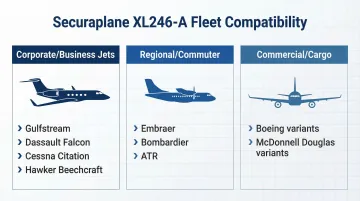
The XL246-A supports a broad fleet through Supplemental Type Certificates (STCs):
- Corporate/Business Jets: Gulfstream (G-II, G-III, G-IV), Dassault Falcon (F-50, 2000), Cessna Citation (500, 550, 560XL), Hawker Beechcraft (125 Series, 800XP)
- Regional/Commuter: Embraer (EMB 170/175), Bombardier (CRJ/CL-600 series, DHC-8), ATR (42/72 series)
- Commercial/Cargo: Boeing/McDonnell Douglas (DC-9, DC-10, MD-10, MD-11)
Operational Impact
The XL246-A isn't optional equipment. When it fails, the aircraft is grounded until a replacement is installed. Every hour of sourcing delay is an hour of lost dispatch.
Procurement typically falls to MRO departments, procurement managers, and Part 145 repair stations — teams that have to weigh airworthiness compliance against operational uptime simultaneously.
One sourcing note: Securaplane Technologies is a Parker Meggitt brand (Parker Hannifin completed its $8.4 billion acquisition of Meggitt PLC in 2022). For OEM escalations, direct inquiries to Parker Meggitt — not Safran.
Why Securaplane XL246-A Lead Times Are Getting Longer
Three macro forces are stretching OEM lead times for legacy parts like the XL246-A:
The "Long Tail" Batch Production Problem
Low-volume legacy components suffer from intermittent demand. OEMs don't maintain continuous production lines for parts like the XL246-A. Instead, they batch production runs to achieve economies of scale—manufacturing only when Minimum Order Quantities (MOQs) are met.
If you need a unit mid-cycle, you wait until the next batch is scheduled. The FAA acknowledges this challenge in Advisory Circular AC 21.303-4, noting that older products face approval and production problems due to incomplete design data and out-of-production status.
Defense Prioritization Squeezes Commercial MRO
With global defense spending projected to reach $2.1 trillion in 2025, high-margin military contracts monopolize shared resources: raw materials, castings, forgings, and specialized labor.
Dual-use aerospace manufacturers serve both commercial and defense markets. With global defense spending projected to reach $2.1 trillion in 2025, high-margin military contracts monopolize shared resources: raw materials, castings, forgings, and specialized labor.
When defense demand spikes, commercial MRO parts get pushed down the production queue. Legacy components like the XL246-A are among the first to feel that reallocation.
Supply Chain Consolidation
Consolidation within the aerospace supplier base has reduced alternative manufacturing channels. According to Oliver Wyman's 2025 MRO Survey, 60% of respondents reported increased turnaround times for avionics and components, alongside an 8.3% spike in material costs.
Fewer suppliers mean more concentrated bottlenecks, and operators at the end of that chain absorb the delay.
Most operators don't learn about extended lead times until they're already in a crunch. By then, the aircraft is grounded and costs are mounting. Having a certified replacement sourced in advance — one that ships same day — is what keeps that scenario from becoming a multi-week AOG event.
The Real Cost of Waiting: What AOG Time Means for Your Operation
An Aircraft on Ground (AOG) event caused by an unserviceable XL246-A carries an immediate, measurable financial cost — one that compounds every hour the aircraft stays grounded.
Financial Impact
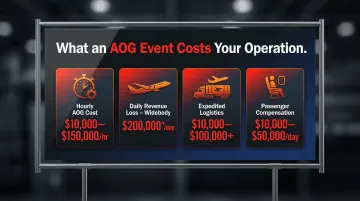
Industry data shows AOG events cost between $10,000 and $150,000 per hour, depending on aircraft type and operation. For widebody commercial aircraft, daily revenue loss can exceed $200,000.
AOG Cost Breakdown:
| Cost Factor | Estimated Impact |
|---|---|
| Hourly AOG Cost | $10,000 to $150,000 per hour |
| Daily Revenue Loss (Widebody) | Up to $200,000+ per day |
| Expedited Logistics | $10,000 to $100,000+ per incident |
| Passenger Compensation | $10,000 to $50,000 per day |
IATA estimates supply chain challenges will cost the airline industry $11.3 billion in 2025, driven by excess inventory holding, delayed parts, and operational disruptions.
Non-Financial Costs
Beyond direct revenue loss:
- Contract Penalties: Charter operators face liquidated damages for missed flights
- Crew Repositioning: Expensive logistics to move crews and passengers
- Reputational Damage: Corporate flight departments lose client trust
- Regulatory Scrutiny: Extended groundings attract FAA attention
The ROI of Same-Day Replacement
Waiting three weeks for a $5,000 part while absorbing $50,000/day in AOG costs is not a cost-saving decision — it's the most expensive procurement choice you can make. A same-day certified replacement eliminates that exposure and gets the aircraft back in revenue service fast.
What FAA-PMA Certification Means — And Why It Matters for Replacements
Parts Manufacturer Approval (PMA) is often misunderstood. A PMA part is a federally authorized replacement that meets the same airworthiness standards as the original equipment — approved and overseen by the FAA, not just the manufacturer.
What Is FAA-PMA?
Under 14 CFR Part 21 Subpart K, a PMA is a combined design and production approval. The FAA authorizes a manufacturer to produce and sell replacement parts for type-certificated aircraft.
PMA parts are fully airworthy and legal for installation on certificated aircraft—no additional engineering approval required.
Two Pathways to PMA Approval
The FAA recognizes two primary approval pathways under 14 CFR 21.303:
- Identicality: The applicant demonstrates the design is identical to the OEM article
- Test and Computation: The applicant provides test reports and computations proving the design meets airworthiness requirements
The test/analysis pathway is the more rigorous standard, requiring independent demonstration of equivalence. Ni-Cad Systems holds 30+ FAA-PMA approvals earned through this process.
Debunking the Warranty Myth
A common misconception: using a PMA part voids OEM warranties. This is false.
Industry precedents confirm warranty impacts are contractual, not regulatory. In a landmark 2018 agreement, CFM International explicitly stated: "The mere installation of non-OEM parts and/or repairs in the engine does not in itself render the warranty void."
Warranty claims are evaluated based on causation—an OEM can only deny a claim if engineering analysis proves the PMA part caused the specific failure. The FAA's position is clear: PMA holders assume manufacturer responsibility for their designs.
Documentation That Accompanies PMA Parts
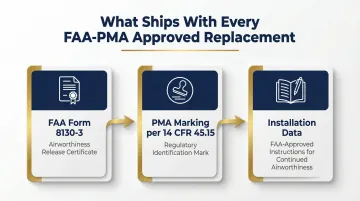
When you receive an FAA-PMA approved replacement, it ships with:
- FAA Form 8130-3: Federal airworthiness release certificate confirming the part is approved for installation
- PMA Marking: Physical "FAA-PMA" stamp on the part per 14 CFR 45.15, traceable through your maintenance records
- Installation Data: Approved instructions and approved data required for logbook entry and maintenance record compliance
For Part 145 repair stations and operators under Part 121/135, PMA parts are routinely used and tracked in approved parts programs. Across corporate, airline, and military operations, PMA parts are standard procedure — not the exception.
Ni-Cad Systems' FAA-PMA Approved XL246-A Replacement: Certified, Ready, Same Day
Ni-Cad Systems offers a FAA-PMA approved replacement for the Securaplane XL246-A emergency power supply—in stock and ready to ship the same day you order.
Who Is Ni-Cad Systems?
Based in Hayward, CA, Ni-Cad Systems is a FAA Part 145 certified repair facility specializing in aircraft battery and power supply servicing. Since 1974, the company has serviced over 47,000 units across corporate, airline, and military aviation.
Key Credentials:
- 50+ years in aviation battery service
- 30+ active FAA-PMA approvals for replacement battery packs, temperature sensors, receptacles, and modification kits
- FAA Part 145 certified repair facility
- 47,000+ units serviced since 1974
The Engineering Team Behind the Product
Stephen Andrues, VP/GM, holds 30+ FAA-PMA approvals and brings 40 years of NiCd battery experience. He's an FAA Designated Engineering Representative (DER), A&P mechanic, and pilot—not a commodity parts distributor, but a specialist manufacturer with direct engineering accountability.
As a DER, Stephen signs the engineering data behind each PMA approval — meaning technical accountability stops with the person who built the product, not a middleman. That chain of ownership matters when a part needs to perform in an emergency.
Operational Advantage: Same-Day Shipment
The XL246-A replacement is in stock and ships the same day you place your order. For AOG operators, Ni-Cad Systems also offers rental batteries as a bridge solution while paperwork or logistics are finalized.
Support Services:
- Same-day shipment for in-stock units
- Rental batteries for immediate AOG needs
- 24/7 AOG emergency support at +1 510 501 9391
- Capacity testing and deep-cycle testing
- Fast turnaround times
Battery Compatibility
Ni-Cad Systems' XL246-A replacement supports multiple battery types:
- SAFT nickel cadmium
- Marathon nickel cadmium
- Varta nickel cadmium
- Concorde lead-acid
- Gill (Teledyne) lead-acid
Mixed-fleet operators can consolidate battery service and replacement sourcing under a single FAA-approved facility — one approval holder, one point of contact, regardless of battery chemistry.
How to Switch From OEM to a PMA-Approved XL246-A Replacement
Switching to Ni-Cad Systems' XL246-A replacement follows a clear four-step process that most operators complete in a single business day:
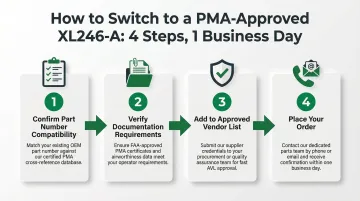
Step 1: Confirm Part Number Compatibility
Verify the PMA part number maps to your aircraft type and ATA Chapter 24 reference in your maintenance manual or Illustrated Parts Catalog (IPC). Ni-Cad Systems' technical team can assist with cross-referencing.
Step 2: Verify Documentation Requirements
Check with your quality department on 8130-3 and PMA data plate documentation requirements. Ni-Cad Systems provides:
- FAA Form 8130-3 Airworthiness Approval Tag
- PMA markings per 14 CFR 45.15
- Installation data for logbook entry
Step 3: Add Ni-Cad Systems to Your Approved Vendor List (AVL)
If your operation uses an approved parts program or AVL, you may need to qualify Ni-Cad Systems as a supplier. Their FAA Part 145 certification and 30+ PMA approvals satisfy standard vendor qualification requirements for Part 135 and Part 121 quality programs.
Typical documentation requested includes the FAA Part 145 certificate, PMA supplement showing approval scope, quality manual, and FAA Form 8130-3 samples.
Step 4: Place Your Order
Contact Ni-Cad Systems to confirm availability, get pricing, and arrange same-day shipment:
- Email: Sales@NiCadSystems.com
- Phone: +1 510 785 9391
- 24/7 AOG Support: +1 510 501 9391
Have ready: aircraft type, tail number, battery type preference, and urgency level.
For operators facing AOG situations, rental batteries are available as an immediate bridge while the replacement ships — typically the same day initial contact is made.
Frequently Asked Questions
Is an FAA-PMA replacement for the Securaplane XL246-A considered airworthy?
Yes. FAA-PMA parts are federally authorized replacements that meet the same airworthiness standards as OEM parts and are fully legal for installation on type-certificated aircraft under 14 CFR Part 21 Subpart K.
What documentation comes with a PMA-approved XL246-A replacement?
A PMA replacement ships with an FAA Form 8130-3 Airworthiness Approval Tag and PMA markings per 14 CFR 45.15. Ni-Cad Systems includes installation data to support logbook entries and compliance documentation.
How long are typical OEM lead times for the Securaplane XL246-A?
OEM lead times can range from several weeks to multiple months depending on production schedules, defense contract prioritization, and overall demand.
Can I use a PMA part without additional engineering or DER approval?
Yes. An FAA-PMA part already carries the FAA's engineering approval. No additional DER sign-off is required for standard installation per the approved data provided with the part.
How quickly can Ni-Cad Systems ship the XL246-A replacement?
Ni-Cad Systems ships same day for in-stock units. They also offer rental batteries for AOG operators who need an immediate bridge while the replacement is in transit or paperwork is finalized.
Does switching to a PMA part affect my aircraft's type certificate or maintenance program?
No. PMA parts do not alter the aircraft's type certificate. Most Part 145 facilities and airline maintenance programs already have procedures for approving and tracking PMA parts in their quality systems.
Ready to ship today. Contact Ni-Cad Systems for a fully certified, FAA-PMA approved XL246-A replacement — in-stock units ship same day.
📧 Sales@NiCadSystems.com
📞 +1 510 785 9391
🚨 24/7 AOG Support: +1 510 501 9391