Introduction
Sourcing the Securaplane XL246-A emergency battery for Challenger 601 and Falcon 50 aircraft has become a genuine operational problem. Lead times stretch for weeks, costs keep climbing, and availability is unpredictable—all of which drive up AOG costs and disrupt flight schedules.
80% of MRO facilities cite piece-part availability as their top operational challenge, and supply chain constraints have added $3.1 billion in excess maintenance costs across the aviation industry. Relying solely on OEM channels for legacy components is no longer operationally or financially sustainable.
This article introduces Ni-Cad Systems' FAA-PMA approved second-source replacement for the Securaplane XL246-A emergency battery. You'll learn what PMA approval means for safety-critical battery replacements, how this specific replacement compares to the OEM part, and how to source it quickly—including 24/7 AOG support when your aircraft is grounded.
TLDR:
- Ni-Cad Systems offers an FAA-PMA approved drop-in replacement for the Securaplane XL246-A emergency battery used on Challenger 601 and Falcon 50 aircraft
- PMA parts meet identical airworthiness standards as OEM components and are legally acceptable for Part 91, 135, and 121 operations
- Supports NiCd and lead-acid chemistries, with fast turnaround and rental batteries available for AOG situations
- Contact +1 510 501 9391 for 24/7 AOG support or +1 510 785 9391 for technical inquiries
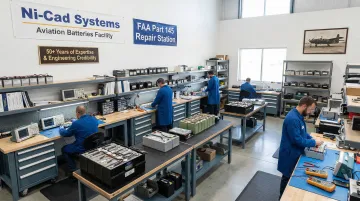
- Ni-Cad Systems operates an FAA Part 145 repair facility with over 50 years of battery service experience
What Is the Securaplane XL246-A and Why Operators Are Looking for Alternatives
The Role of the XL246-A Emergency Battery System
The Securaplane XL246-A (part numbers 100-0202-01 and 100-0202-02) is an emergency battery system listed for use on Challenger 601-3A/3R and Falcon 50 aircraft. It serves as a direct replacement for legacy URDC AMPS-2000 systems and is built around sealed lead-acid (SLA) technology. Key specifications include:
- Delivers 6 amps at 18–24VDC for a minimum of one hour
- Integrated battery charger and battery test function
- Continuous Built-In Test Equipment (BITE) diagnostics
This emergency power supply supports critical aircraft functions — emergency lighting, backup avionics, and essential communications — automatically activating the moment main aircraft power is lost.
Securaplane Technologies, now part of Parker-Hannifin following its $8.8 billion acquisition of Meggitt PLC in 2022, produces safety-critical components for business aviation platforms worldwide.
Supply Chain Challenges Driving the Search for PMA Alternatives
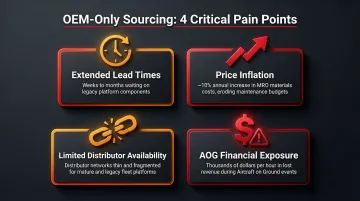
The consolidation of Securaplane into a larger aerospace conglomerate has introduced new challenges for operators seeking replacement batteries:
Extended Lead Times: Legacy platforms like the Challenger 601 and Falcon 50 sit low on OEM priority lists, pushing procurement timelines to weeks or months.
Price Inflation: MRO materials prices are rising at roughly 10% annually, and corporate consolidation tends to compound that trend as smaller specialists get absorbed into larger organizations.
Limited Distributor Availability: Distributor networks thin out for mature fleets as OEM attention — and stocking priority — shifts toward newer aircraft programs.
AOG Financial Exposure: A grounded aircraft waiting on a single battery can rack up thousands of dollars per hour in lost charter revenue, contract penalties, and emergency freight costs.
Operational Necessity, Not Cutting Corners
The demand for reliable PMA alternatives isn't driven by cost-cutting at the expense of safety—it's driven by operational necessity. Flight departments need to:
- Minimize AOG time when emergency batteries fail
- Control MRO budgets without compromising airworthiness
- Maintain aircraft on schedule with predictable parts availability
- Diversify supply chains to reduce dependence on single-source OEM channels
A properly approved PMA replacement addresses all four of those needs — and the section below covers exactly what that approval requires and what it covers for the XL246-A.
What PMA Approval Really Means — And Why It Matters for Safety-Critical Parts
FAA-PMA: A Combined Design and Production Approval
Parts Manufacturer Approval (PMA) is an FAA authorization that allows a manufacturer other than the OEM to produce a replacement part for a certificated aircraft. Contrary to common misconceptions, obtaining PMA is not a regulatory shortcut—it requires rigorous FAA oversight and comprehensive engineering validation.
Two regulations govern the process. 14 CFR §21.303 requires test reports and computations proving the replacement design meets the airworthiness requirements of the aircraft it will be installed on. A companion regulation, 14 CFR §21.307, requires PMA holders to establish FAA-standard quality systems, ensuring fabrication and inspection are equivalent to OEM requirements.
Two Primary Approval Pathways: Identicality vs. Test and Computation
FAA Advisory Circular 21.303-4 outlines two paths for PMA approval:
| Pathway | How Approval Is Demonstrated |
|---|---|
| Identicality | Proves the replacement matches the type-certificated part exactly — same dimensions, tolerances, materials, and manufacturing processes |
| Test and Computation | Independently demonstrates equivalence or superiority through engineering analysis, comparative testing, and safety assessments — often involving reverse engineering |
Both pathways demand extensive technical validation and FAA review before approval is granted.
Dispelling the "Inferior PMA Parts" Misconception
A persistent myth in aviation maintenance is that PMA parts are somehow inferior to OEM components. The regulatory record says otherwise.
PMA parts must meet the same airworthiness standards as OEM parts and carry full FAA approval for installation on certificated aircraft. Historical reviews of Airworthiness Directives for transport aircraft engines found that 286 out of 287 ADs were generated by OEM problems — not PMA replacements.
The Role of Designated Engineering Representatives (DERs)
Under 14 CFR Part 183, Designated Engineering Representatives (DERs) are FAA-authorized engineers who validate the technical basis for PMA approval. DERs approve engineering technical data and determine compliance with applicable airworthiness regulations, recording their findings on FAA Form 8110-3 (Statement of Compliance with Airworthiness Standards).
Ni-Cad Systems' Vice President Stephen Andrues is himself an FAA DER with 40 years of nickel-cadmium battery experience. The engineering behind Ni-Cad Systems' PMA products is developed in-house by someone who holds that designation authority directly.
Regulatory Acceptability Across All Operations
PMA parts are legally acceptable for installation across all operation types:
- Part 91 — General aviation
- Part 135 — Commuter and on-demand operations
- Part 121 — Scheduled air carriers
Maintenance technicians document them on return-to-service records just as they would an OEM part.
Installation is governed by 14 CFR Part 43, which requires maintenance return the aircraft to at least its original or properly altered condition. FAA Order 8130.21 establishes the use of FAA Form 8130-3 (Authorized Release Certificate) to document airworthiness and ensure traceability.
For international operators, the US-EU Bilateral Aviation Safety Agreement (BASA) Technical Implementation Procedures explicitly mandate EASA acceptance of FAA-PMA parts, removing a compliance barrier for European-registered aircraft.
Ni-Cad Systems' PMA-Approved Replacement for the Securaplane XL246-A: Technical Overview
Direct Drop-In Replacement for Multiple Aircraft Platforms
Ni-Cad Systems manufactures an FAA-PMA approved second-source replacement battery pack specifically engineered for the Securaplane XL246-A and XL246-S power supplies. This replacement is confirmed for use on Challenger 601-3A/3R and Falcon 50 aircraft and is designed as a direct, drop-in replacement—no aircraft modifications are required for installation.
For specific Ni-Cad Systems part numbers and PMA approval documentation, contact their technical support team at +1 510 785-9391.
Technical Specifications and Battery Chemistry Options
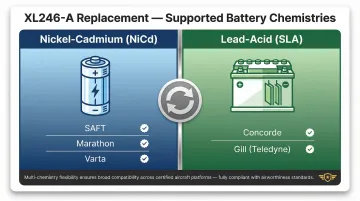
The Ni-Cad Systems replacement supports multiple battery chemistries, providing flexibility that may not be available with OEM-only sourcing:
Supported Battery Types:
- SAFT nickel-cadmium
- Marathon nickel-cadmium
- Varta nickel-cadmium
- Concorde lead-acid
- Gill (Teledyne) lead-acid
This multi-chemistry capability lets operators choose the battery type that fits their maintenance schedule and budget—without compromising airworthiness.
The replacement battery pack is compatible with low-impedance battery receptacles for SAFT, Marathon, G.E., and Varta systems, covering the most common aircraft electrical configurations without modification.
Manufacturing Quality and Part 145 Certification
Ni-Cad Systems operates as a Part 145 FAA-approved repair facility, applying the same rigorous quality standards to its PMA manufacturing as required for aircraft component repair and overhaul. The company has serviced over 47,000 units since 1974, built through hands-on experience across these battery systems in corporate, airline, and military aviation.
Vice President Stephen Andrues holds 30+ FAA-PMAs and serves as an FAA Designated Engineering Representative (DER)—that credential directly backs the engineering rigor behind every replacement product.
Rental Batteries: Keeping Aircraft Operational During Service
Ni-Cad Systems' rental battery program keeps aircraft flying while the permanent replacement is being prepared or the original unit is in for service. Rental units are available for AOG situations and scheduled maintenance alike.
Contact the team at +1 510 785-9391 to confirm rental availability and lead times before your next service event.
Challenger 601 and Falcon 50: Aircraft-Specific Considerations
Challenger 601 Electrical Architecture
The Bombardier Challenger 601 series, governed by FAA Type Certificate Data Sheet (TCDS) A21EA, includes the CL-600-2A12 (601 Variant) and CL-600-2B16 (601-3A and 601-3R Variants). The aircraft's electrical system relies on an emergency battery to provide backup DC power to the battery bus and essential systems during electrical failures.
The emergency battery packs serve as critical backups for:
- Communications systems
- Navigation equipment
- Emergency lighting
- Essential avionics
When main generator power is lost, the emergency battery automatically provides power to these systems, ensuring crew situational awareness and safe aircraft operation until power is restored or the aircraft lands.
Falcon 50 Emergency Power Requirements
The Dassault Mystere-Falcon 50 is governed by FAA TCDS A46EU. The Falcon 50 utilizes discrete emergency light battery packs (EPS) located in different areas of the aircraft, including the aft equipment bay, to power various emergency systems.
When the emergency light switch is placed in AUTO while main aircraft power is on, these batteries are trickle-charged to maintain voltage. Upon loss of main power, the batteries automatically activate to provide emergency illumination and backup power to critical systems.
Platform-Specific Installation Guidance
For specific Aircraft Maintenance Manual (AMM) chapter references and approved data, technicians should contact Ni-Cad Systems' technical support team at +1 510 785-9391. Their engineers have direct experience servicing batteries from both the Challenger 601 and Falcon 50 airframes and can provide platform-specific installation guidance.
With over 50 years servicing aircraft batteries across hundreds of airframe types, they can address questions specific to your electrical configuration and maintenance procedures.
The Falcon 50 TCDS link has also been updated: FAA TCDS A46EU
OEM vs. PMA: Practical Comparison for MRO Decision-Makers
Side-by-Side Comparison
| Factor | OEM (Securaplane XL246-A) | PMA (Ni-Cad Systems) |
|---|---|---|
| Part Availability | Extended lead times, often weeks to months | Fast turnaround with rental batteries available |
| Unit Cost | Higher pricing due to conglomerate structure | Competitive pricing with potential significant savings |
| FAA Approval Status | Type-certificated OEM part | FAA-PMA approved (legally equivalent) |
| Warranty/Support | Through OEM/distributor channels | Direct manufacturer support, 24/7 AOG availability |
| Sourcing Channels | Limited to OEM and authorized distributors | Direct from Part 145 repair facility |
| Battery Chemistry Options | Typically single specification | Multiple chemistries (NiCd and lead-acid options) |
| Emergency AOG Support | Limited after-hours availability | 24/7 dedicated AOG hotline |
Total Cost of Ownership Analysis
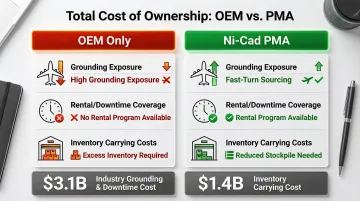
Beyond the unit price, operators must weigh the full cost of ownership when choosing between OEM and PMA battery replacements. Three factors consistently tip the calculation toward the PMA option:
- Grounding exposure: Supply chain constraints already cost operators an estimated $3.1 billion in additional maintenance costs, with 80% of MROs citing piece-part availability as their top operational hurdle. Fast-turn PMA sourcing cuts that exposure directly.
- Rental battery program: Ni-Cad Systems keeps aircraft operational during battery service or replacement — eliminating downtime entirely and avoiding thousands in lost revenue or contract penalties.
- Inventory carrying costs: Operators tied up an estimated $1.4 billion in excess inventory just to buffer against parts shortages. A responsive PMA supplier lets flight departments reduce that stockpile without adding operational risk.
Compliance and Documentation
The financial case for PMA only holds if the paperwork holds up. Fortunately, it does. PMA parts are produced under FAA design and production approval and are legally acceptable for return-to-service under Part 43 — using one does not void the aircraft type certificate or create any airworthiness issues.
Ni-Cad Systems provides FAA Form 8130-3 (Authorized Release Certificate) with every PMA replacement, documenting that the part conforms to its approved design and is in condition for safe operation. This form supports straightforward return-to-service documentation for Part 91, 135, and 121 operations.
How to Order or Get AOG Support
Direct Contact Information
For Orders and Technical Inquiries:
- Phone: +1 (510) 785-9391 (Monday–Friday, 8:00 AM – 6:00 PM)
- Email: Sales@NiCadSystems.com or Sandrues@aol.com
For 24/7 AOG Emergency Support:
- Phone: +1 (510) 501-9391 (Available around the clock)
Location: Ni-Cad Systems, Inc. 25216 Cypress Ave Hayward, CA 94544
Fast-Turn Capability and AOG Response
When your Challenger 601 or Falcon 50 is grounded due to a failed XL246-A emergency battery, every minute counts. Ni-Cad Systems' flexible repair facility is designed for quick response, with 24/7 technical support available to minimize aircraft downtime.
If you need to stay operational immediately, the rental battery program can dispatch a unit while your permanent replacement is prepared — no waiting weeks for an OEM part to clear traditional distribution channels.
With over 50 years of experience servicing aircraft batteries and power supplies, Ni-Cad Systems has structured its entire operation around getting grounded aircraft back in the air — fast.
Frequently Asked Questions
Is a PMA-approved battery legally equivalent to the OEM Securaplane XL246-A for return-to-service purposes?
Yes. FAA-PMA approved parts are legally approved for installation on certificated aircraft and are acceptable for return-to-service documentation under Part 43, just as an OEM part would be. PMA parts must meet the same airworthiness standards as OEM components.
Which aircraft does Ni-Cad Systems' PMA replacement for the XL246-A cover?
The replacement is confirmed for use on Challenger 601-3A/3R and Falcon 50 aircraft. For specific serial number ranges or variant coverage details per the PMA approval data, contact Ni-Cad Systems' technical support at +1 510 785-9391.
How do I know the PMA replacement will fit and perform correctly in my aircraft?
The PMA approval is based on engineering validation — identicality or test and computation — demonstrating the part meets OEM airworthiness standards. Ni-Cad Systems' in-house FAA Designated Engineering Representative (DER) oversaw this process directly.
What is the typical lead time for Ni-Cad Systems' XL246-A replacement battery?
Ni-Cad Systems stocks inventory for immediate shipment and is built around fast turnarounds. For current lead time specific to your requirement, call +1 510 785-9391 or the 24/7 AOG line at +1 510 501-9391.
Can Ni-Cad Systems also repair or overhaul an existing XL246-A or its replacement?
Yes. Ni-Cad Systems is a Part 145 FAA-approved repair facility with over 50 years servicing NiCd batteries and emergency power supplies. Call +1 510 785-9391 to confirm repair capability for your specific XL246-A unit.
What should I do if my Challenger 601 or Falcon 50 is grounded right now due to a failed XL246-A?
Contact Ni-Cad Systems immediately at their 24/7 AOG support line: +1 510 501-9391. They maintain rental batteries to keep your aircraft operational while a permanent replacement is prepared, minimizing costly downtime.