Introduction
Marathon NiCad battery failures in turbine aircraft can trigger a chain of safety risks—loss of critical avionics during flight, emergency power system collapse, and unplanned diversions. According to FAA incident reports, thermal runaway incidents (often caused by improper maintenance) account for the majority of reported NiCad battery failures.
A properly maintained Marathon NiCad battery can deliver reliable service for 5-7 years, while neglected units may fail catastrophically in under six months.
Understanding why these batteries are so critical starts with their unique chemistry. Marathon Nickel-Cadmium (NiCad) batteries have become the standard for turbine-powered aircraft due to their superior high-current delivery and operational robustness across extreme temperature ranges (-58°F to +160°F).
Unlike lead-acid batteries, NiCad chemistry provides consistent voltage under heavy loads, rapid recharge acceptance, and tolerance for deep discharge cycles—critical for engine starting and emergency backup power.
This guide covers:
- Systematic maintenance approaches and inspection protocols
- Regulatory compliance requirements (FAA/EASA)
- Troubleshooting procedures for common failure modes
- Best practices to prevent costly failures and extend service life
Key Takeaways
- Proper maintenance extends battery life from 2-3 years to 5-7 years, preventing costly replacements
- Test capacity every 6-12 months to verify batteries maintain the 80% airworthiness threshold
- Monthly visual inspections catch leakage, swelling, corrosion, and thermal damage early
- Never apply lead-acid procedures to NiCad batteries—use distilled water only and separate charging protocols
- Deep discharge reconditioning eliminates voltage depression and restores full capacity when performance degrades
Why Maintenance of Marathon NiCad Aircraft Batteries Is Important
Marathon NiCad batteries are critical safety components requiring proactive maintenance, not reactive repairs. These batteries serve as the last line of defense when primary electrical systems fail, making their reliability non-negotiable for flight safety.
Safety and Reliability Impact
Marathon NiCad batteries provide emergency backup power for essential avionics, navigation systems, communication equipment, and engine starting systems.
During electrical system failures, these batteries must deliver immediate, reliable power to maintain aircraft control and safe operation.
FAA Advisory Circular AC 00-33A identifies thermal runaway as the primary safety risk in NiCad batteries, triggered by improper charging, high ambient temperatures, or cell imbalance.
Thermal runaway creates uncontrollable temperature increases that destroy batteries, generate toxic smoke, and damage aircraft electrical systems.
Battery failure consequences during flight operations include:
- Loss of primary navigation and GPS systems
- Communication equipment blackout
- Emergency lighting system failure
- Critical flight instrument power loss
- Inability to restart engines after in-flight shutdown
NTSB investigations have documented severe incidents where undetected NiCad battery failures progressed to thermal runaway events, resulting in emergency landings and aircraft damage. Proper maintenance prevents these failures through early detection of degradation patterns.
Performance and Efficiency
Performance degradation accelerates when maintenance is neglected. Voltage depression (commonly called "memory effect") occurs when batteries experience repeated shallow discharge cycles without periodic deep cycling, reducing available capacity and voltage output under load.
Neglected batteries exhibit:
- Reduced charge acceptance requiring longer charging times
- Voltage drops during high-current demands like engine starting
- Cell imbalance causing uneven performance across the battery pack
- Increased internal resistance generating excess heat
- Premature capacity loss requiring earlier replacement
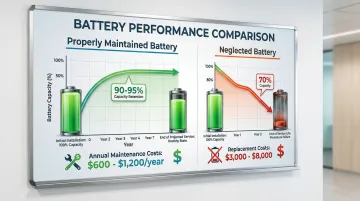
Research on aircraft NiCad battery maintenance demonstrates that properly maintained batteries retain 90-95% capacity after three years of service. Poorly maintained units may drop below 70% capacity in the same period—a 25% performance differential directly tied to maintenance quality.
Service Life and Cost Savings
These performance impacts translate directly to operational costs. Maintenance quality is the single largest factor affecting Marathon NiCad battery longevity and total cost of ownership.
Well-maintained batteries routinely achieve 5-7 years of service life, while neglected batteries often fail within 2-3 years—less than half the potential lifespan.
Cost comparison of replacement vs. maintenance:
- Marathon NiCad battery replacement: $2,000-$5,000 per unit
- Installation labor: $300-$800 per replacement
- Aircraft downtime costs: $500-$2,000 per day (lost operational capability)
- Emergency AOG service premiums: 50-100% markup on expedited parts
Annual preventive maintenance costs:
- Quarterly capacity testing: $400-$800 annually
- Deep cycle reconditioning: $800-$2,000 every 2-3 years
- Routine inspections and servicing: $200-$400 annually
- Total preventive maintenance: $600-$1,200 per year
The ROI equation is compelling: spending $600-$1,200 annually on preventive maintenance versus $3,000-$8,000 for premature replacement represents a 3:1 to 10:1 cost advantage.
Specialized FAA Part 145 certified facilities provide professional maintenance services that extend battery life while maintaining full airworthiness compliance. Ni-Cad Systems, Inc., for example, has serviced over 47,000 units since 1974.
Regulatory Compliance
Beyond cost considerations, regulatory requirements mandate systematic battery maintenance. FAA regulations require strict compliance with manufacturer maintenance procedures for aircraft batteries.
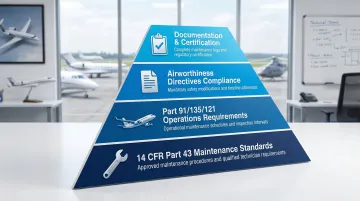
Under 14 CFR Part 43, all maintenance must follow methods prescribed in current manufacturer Component Maintenance Manuals (CMMs) or Instructions for Continued Airworthiness.
Key regulatory requirements:
- Part 43 Maintenance Standards: Battery servicing must be performed by authorized personnel using approved procedures
- Part 91/135/121 Operations: Operators must maintain airworthiness through compliance with Airworthiness Directives and service bulletins
- Documentation Requirements: All maintenance actions require detailed records including work description, date, and technician certification
Specific Airworthiness Directives affect Marathon batteries, such as AD 2000-SW-38-AD, which mandated inspection of #10-32 screws for proper knurling to prevent short circuits and potential battery explosion. Compliance intervals typically require action within 12 months or at the next scheduled battery maintenance.
Non-compliance consequences include certificate actions, aircraft grounding, liability exposure in incident investigations, and potential civil penalties. Operators are primarily responsible for maintaining airworthiness, making systematic maintenance documentation essential for regulatory compliance.
Types of Maintenance for Marathon NiCad Aircraft Batteries
Marathon NiCad maintenance follows a tiered approach from routine inspections to major overhauls, each serving specific purposes in maintaining battery health and performance.
Routine/Preventive Maintenance
Monthly visual inspections form the foundation of preventive maintenance. These inspections catch problems before they become safety hazards or cause performance degradation, preventing costly in-flight failures.
Monthly inspection checklist:
- Check for electrolyte leakage or white crystalline deposits around vents
- Inspect case for cracks, swelling, or distortion indicating overheating
- Examine terminal connections for corrosion (green/white deposits)
- Verify secure mounting and proper retention hardware
- Confirm vent system is clear and functioning
- Clean terminals and case exterior with approved cleaners
Quarterly servicing procedures:
- Check electrolyte levels at the end of a full charge cycle
- Add only distilled or deionized water—never potassium hydroxide
- Clean terminals with baking soda solution (neutralizes alkaline residue)
- Measure open-circuit voltage (should be 1.2V per cell, 24V for 20-cell battery)
- Verify cell voltage balance (variations should not exceed 0.1V)
- Document all findings and actions taken
Typical labor requirements: 1-2 hours per service. Material costs: $50-$100 for cleaning supplies, distilled water, and terminal protection compounds.
While visual inspections catch external issues, they can't measure internal performance degradation. That's where capacity testing comes in.
Capacity Testing and Monitoring
Regular capacity tests verify batteries can deliver rated ampere-hours under controlled conditions. These tests provide objective performance data that visual inspections miss, revealing declining capacity before it affects flight operations.
Testing procedure:
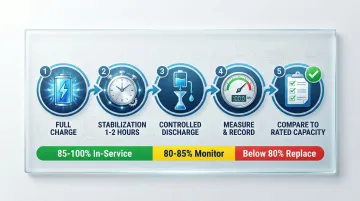
- Fully charge battery using constant-current method
- Allow battery to stabilize for 1-2 hours
- Discharge at C-rate (1-hour rate) or C/2 rate (2-hour rate) to specified voltage cutoff
- Measure actual discharge time and compare to rated capacity
- Record individual cell voltages throughout discharge cycle
Acceptance criteria:
- In-service batteries: Must achieve minimum 85% of rated capacity
- New/reconditioned batteries: Should meet 100% rated capacity
- End-of-life threshold: Batteries consistently below 80% capacity require replacement
Testing frequency: Every 6-12 months for standard operations, every 6 months for high-utilization aircraft (>100 flight hours monthly). Capacity testing takes 2-4 hours depending on battery size and discharge rate selected.
Corrective/Reactive Maintenance
Corrective maintenance addresses specific failures or degradation identified through testing or operational issues. Necessary when problems occur, but waiting for failures to appear costs significantly more than preventive maintenance.
Common triggers requiring corrective action:
- Capacity test results below 85% threshold
- Cell voltage imbalance exceeding 0.1V during discharge
- Physical damage from impact, vibration, or thermal events
- Electrolyte contamination or excessive consumption
- Thermal runaway incidents requiring complete battery evaluation
Typical corrective actions:
- Individual cell replacement: $500-$1,500 depending on cell type
- Case repair or replacement: $300-$800
- Terminal reconditioning: $200-$400
- Complete battery replacement: $2,000-$5,000
The risk of reactive-only maintenance: unexpected in-flight failures, extended aircraft downtime waiting for parts, premium AOG service charges, and potential safety incidents from undetected degradation.
Deep Cycle Reconditioning and Overhaul
Deep discharge reconditioning eliminates voltage depression (memory effect from repeated shallow discharges) and restores full capacity. The process completely drains cells and allows them to rebalance, reversing temporary capacity loss caused by shallow cycling patterns.
Reconditioning procedure:
- Discharge battery to 0.5 volts per cell or less
- Apply short-out clips or resistors to each cell
- Allow battery to remain shorted for minimum 4 hours (overnight preferred)
- Remove clips and perform controlled recharge
- Conduct capacity test to verify restoration
Severely degraded batteries may require 2-3 deep cycles to fully recover. If capacity remains below 80% after three reconditioning cycles, cell replacement or battery retirement is necessary.
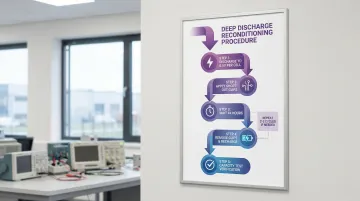
When reconditioning isn't enough, major overhaul becomes necessary.
Major overhaul requirements:
- After 3-5 years of service regardless of apparent condition
- Following severe discharge events (deep discharge below 0.5V per cell)
- When multiple cells show degradation patterns
- After thermal events or suspected internal damage
Professional overhaul services cost $800-$2,000. FAA-approved facilities should perform these overhauls to ensure airworthiness compliance.
Ni-Cad Systems, Inc., a Part 145 FAA-approved facility with 50+ years in aviation battery service, provides overhaul services including complete disassembly, cell-by-cell evaluation, component replacement, and full capacity verification before return to service.
How to Check If Your Marathon NiCad Battery Needs Maintenance
Early detection of degradation prevents in-flight failures and extends battery life through timely intervention. Multiple indicators reveal when maintenance is needed.
Voltage and Capacity Indicators
Check open-circuit voltage for a quick health assessment. Measure with the battery disconnected and at rest for at least 2 hours after charging.
Normal voltage parameters:
- Individual cell: 1.2V nominal (acceptable range: 1.15-1.25V)
- 20-cell battery: 24V nominal (acceptable range: 23-25V)
- Cell voltage variation: Should not exceed 0.1V between cells
Capacity decline symptoms:
- Discharge time shorter than previous tests (trending downward)
- Voltage drops rapidly under load during engine start
- Battery cannot maintain voltage during high-current demands
- Charging system shows battery reaching full charge faster than normal
Simple load test procedure:
- Apply a known load (such as landing lights or avionics bus)
- Monitor voltage under load for 5 minutes
- Voltage should remain stable within 0.5V of starting voltage
- Rapid voltage drop (>1V in 5 minutes) indicates capacity problems
Physical Inspection Warning Signs
Physical examination catches problems that voltage tests miss. Conduct thorough inspections monthly and before/after long flights.
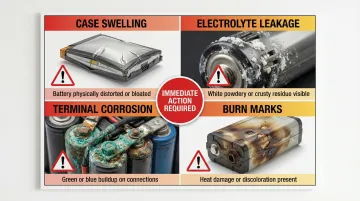
Critical warning signs requiring immediate action:
- Case swelling or distortion: Indicates internal pressure buildup from overheating or cell failure
- Electrolyte leakage: White crystalline deposits around vents or connections signal active leakage
- Terminal corrosion: Green or white powdery deposits indicate electrolyte contact with terminals
- Burn marks or discoloration: Brown or black marks on case or hardware suggest overheating
- Cracked case: Structural damage compromises containment and creates shock hazards
Overheating indicators:
- Discolored plastic case (yellowing or browning)
- Melted or deformed connector housings
- Burnt electrical smell during or after charging
- Thermal switch activation or repeated thermal warnings
Safety Warning: If you observe swelling, cracks, burns, or active leakage, immediately remove the battery from service and quarantine it away from flammable materials. Never attempt to charge or discharge a damaged battery.
Operational Performance Issues
Monitor your aircraft's electrical system for real-time condition feedback. These symptoms indicate developing problems.
In-flight warning signs:
- Low battery voltage warnings during normal operations
- Battery fails to accept charge (charging current remains low)
- Excessive charging current (higher than normal for conditions)
- Battery temperature alarms or thermal warnings
- Electrical system instability or voltage fluctuations
Cell imbalance indicators:
- Some cells reach charging voltage cutoff while others lag behind
- Individual cell voltages vary by more than 0.1V during discharge
- Uneven water consumption between cells during routine servicing
- Specific cells consistently run hotter than others
Charging system anomalies:
- Circuit breakers trip repeatedly during charging
- Charging time significantly longer or shorter than historical baseline
- Battery voltage fails to reach normal float voltage
- Excessive gassing or electrolyte consumption during charging
Operational symptoms like these require immediate action. Professional capacity testing determines whether reconditioning or cell replacement is necessary. FAA Part 145 certified facilities can perform deep-cycle testing to accurately assess remaining battery life and identify failing cells before they compromise flight safety.
Marathon NiCad Battery Maintenance Schedule
Maintenance schedules vary by aircraft usage, operating environment, and manufacturer recommendations. These guidelines serve as a baseline, but always consult your specific Marathon battery Component Maintenance Manual.
Maintenance Frequency Table
| Interval | Tasks | Duration |
|---|---|---|
| Daily/Pre-flight | Visual inspection for leaks, damage, secure mounting, clean terminals | 5 minutes |
| Monthly | Detailed visual inspection, voltage check, terminal cleaning, vent system verification | 30 minutes |
| Quarterly | Electrolyte level check and servicing, capacity test, cell voltage balance check | 2 hours |
| Annual | Deep discharge reconditioning, comprehensive capacity test, professional inspection, documentation review | 4-6 hours |
Each maintenance interval builds on the previous one, creating a layered approach to battery care.
Daily pre-flight inspections catch obvious problems before flight: active leaks, loose connections, physical damage, or unusual odors. This quick check takes only minutes but prevents in-flight failures.
Monthly checks provide deeper evaluation without extensive testing. Check voltage with a multimeter, clean any corrosion from terminals, verify all vent caps are clear, and document battery condition trends.
Quarterly servicing includes capacity testing to verify performance meets minimum standards. Check electrolyte levels only at the end of a charge cycle when electrolyte is fully expanded. Add only distilled water if needed—never potassium hydroxide.
Annual deep maintenance involves complete reconditioning through deep discharge cycles, professional inspection of internal components, and comprehensive documentation review to track long-term trends and plan for eventual replacement.
Usage-Based Adjustments
Standard schedules require modification based on actual operating conditions and usage patterns.
High-utilization aircraft (>100 flight hours/month) place greater demands on battery systems:
- Increase capacity testing to every 6 months
- Perform monthly electrolyte level checks
- Monitor cell voltage balance monthly
- Consider professional inspection every 18 months
Operating environment significantly affects maintenance frequency. High-temperature operations (consistently above 90°F) require monthly capacity checks and increased water servicing. Frequent deep discharges necessitate quarterly reconditioning cycles. Constant float charging demands monthly voltage balance checks to detect cell imbalance early.
Low-utilization or seasonal aircraft need attention even when grounded:
- Maintain quarterly inspections minimum regardless of flight hours
- Perform annual reconditioning even if battery shows no symptoms
- Consider storage procedures for extended ground time (>60 days)
- Conduct capacity test before returning to regular service after extended storage
Professional testing services can maintain aggressive schedules without excessive downtime. Ni-Cad Systems, Inc. offers fast-turnaround capacity testing with rental batteries available, allowing high-utilization aircraft to meet demanding maintenance intervals while staying operational.
Conclusion
Marathon NiCad battery maintenance is essential for flight safety, operational reliability, and regulatory compliance.
Systematic preventive maintenance extends battery life from 2-3 years to 5-7 years, reduces total ownership costs by 70-80%, and prevents dangerous in-flight failures.
The cost-benefit equation strongly favors proactive care. Spending $600-$1,200 annually on capacity testing, reconditioning, and routine servicing prevents $3,000-$8,000 emergency replacements while maintaining the emergency power capability your aircraft depends on during electrical system failures.
To implement these practices, develop a structured maintenance program based on manufacturer guidelines and document all actions for regulatory compliance.
Partner with experienced service providers who offer the specialized equipment and expertise needed for comprehensive battery care. FAA Part 145 certified facilities like Ni-Cad Systems, Inc. provide capacity testing, reconditioning services, and 24/7 AOG support with rental batteries to minimize operational disruptions during maintenance.
Your Marathon NiCad battery is the last line of defense when electrical systems fail. Proactive maintenance ensures it performs when you need it most.
Frequently Asked Questions
How often should I check electrolyte levels in my Marathon NiCad battery?
Check electrolyte levels every 2-4 months depending on usage intensity and operating temperatures. Always check levels at the end of a full charge when electrolyte is fully expanded—adding water to discharged batteries causes spewing during recharge.
Can I use the same maintenance procedures for NiCad batteries as I do for lead-acid batteries?
No—NiCad and lead-acid batteries require completely different procedures. Never add acid to NiCad batteries (use only distilled water), use constant current charging (not constant voltage), and service them in separate facilities to prevent cross-contamination between alkaline and acidic electrolytes.
What causes the "memory effect" in NiCad batteries and how do I prevent it?
Repeated shallow discharge cycles cause voltage depression (memory effect), reducing available capacity. Prevent it through annual deep discharge reconditioning—fully discharge to 0.5V per cell, short the cells for 4+ hours, then recharge completely. Perform when capacity drops below 85%.
How do I know when my Marathon NiCad battery needs to be replaced rather than reconditioned?
Replace batteries when capacity stays below 80% after three reconditioning cycles, physical damage compromises the case, age exceeds 7-10 years, or repeated cell failures occur. Facilities like Ni-Cad Systems can professionally evaluate whether reconditioning is viable.
What safety precautions should I take when servicing NiCad batteries?
Wear face shields, rubber gloves resistant to 50% potassium hydroxide, and protective aprons. Work in well-ventilated areas and use insulated tools. For skin contact, flush with water and neutralize with 3% boric acid or vinegar. For eye contact, flush for 15-20 minutes and seek immediate medical attention.
How should I store a spare Marathon NiCad battery?
Store between -65°F and +120°F in a non-corrosive environment. For storage exceeding 3 months, discharge cells to 0.5V and store in deep discharged condition between 32°F and 86°F. Perform capacity testing before returning long-stored batteries to service.