Introduction: Understanding Marathon Batteries in Aviation
Aircraft battery failures can ground fleets, delay flights, and in rare cases, create serious safety hazards. Battery-related incidents account for a significant portion of aviation electrical system failures, making proper battery management a critical operational concern.
Aviation batteries provide essential power for engine starting, emergency backup, and avionics operation across commercial, corporate, and military aircraft.
The aviation battery landscape is dominated by two primary chemistries: nickel-cadmium (NiCd) and lead-acid. Each chemistry offers distinct advantages for specific applications, with NiCd batteries preferred for high-discharge turbine starting and lead-acid batteries commonly found in general aviation.
Understanding the chemistry fundamentals, maintenance requirements, and performance optimization strategies for these battery types directly impacts flight safety, operational reliability, and lifecycle costs.
According to FAA Advisory Circular 00-33A, thermal runaway incidents in NiCd batteries represent a majority of reported aviation battery failures. This guide examines the chemistry fundamentals, maintenance protocols, and performance strategies essential for maximizing battery reliability.
TLDR: Key Takeaways on Marathon Aviation Batteries
- NiCd batteries excel at turbine starting but need reconditioning to prevent memory effect
- Lead-acid batteries require no maintenance yet fail permanently from deep discharge
- Capacity testing at manufacturer-specified intervals (typically 12 months/1,000 hours initially) is mandatory for airworthiness
- Operating NiCd batteries above 100°F significantly increases thermal runaway risk
- Temperature-compensated charging doubles operational lifespan in most aircraft applications
Battery Chemistry Fundamentals in Aviation
Nickel-Cadmium (NiCd) Electrochemistry
NiCd batteries are the standard for turbine aircraft applications due to their ability to deliver high current with minimal voltage drop.
The electrochemical reaction involves cadmium at the negative electrode and nickel hydroxide at the positive electrode, producing approximately 1.2 volts per cell.
Key Performance Characteristics:
- High discharge capability: Low internal resistance enables 300-500 ampere starting currents
- Temperature sensitivity: Performance degrades rapidly above 100°F (38°C)
- Memory effect: Repeated shallow discharges cause crystalline formation that reduces available capacity
- Cycle life: Properly maintained NiCd batteries can achieve up to 20 years of service life in controlled environments
Critical Limitation - Thermal Runaway:
FAA guidance warns that NiCd batteries are prone to thermal runaway when overcharged or operated in high temperatures. As temperature rises, internal resistance decreases, drawing more charging current and generating additional heat in a destructive feedback loop.
This condition can destroy the battery and poses fire risks.
Valve-Regulated Lead-Acid (VRLA) Electrochemistry
VRLA batteries, commonly called sealed lead-acid (SLA), use sulfuric acid electrolyte interacting with lead plates to generate approximately 2.0 volts per cell.
These batteries use internal gas recombination technology—oxygen generated during charging recombines with lead to form water—eliminating the need for water replenishment.
Performance Characteristics:
- Maintenance-free operation: No electrolyte level checks required
- Sulfation vulnerability: Discharged batteries develop lead sulfate crystals that increase resistance
- Storage requirements: Must maintain voltage above 25.0V (for 24V batteries) to prevent permanent damage
- Cycle life: Typically 1-5 years for turbine starting applications, 3-6 years for piston aircraft
Comparative Performance: NiCd vs. VRLA
| Feature | Nickel-Cadmium (NiCd) | Valve-Regulated Lead-Acid (VRLA) |
|---|---|---|
| Voltage per cell | 1.2V | 2.0V |
| Energy density | Moderate (40-60 Wh/kg) | Lower (30-50 Wh/kg) |
| Cycle life | High (up to 20 years with maintenance) | Moderate (1-6 years depending on application) |
| Temperature tolerance | Poor above 100°F (thermal runaway risk) | Degrades in extreme cold; sulfation accelerates in heat |
| Maintenance needs | High (reconditioning, electrolyte checks) | Low (capacity testing only) |
| Failure mode | Thermal runaway, short circuit | Capacity loss, sulfation, open circuit |
| Best application | Turbine starting, high-discharge | General aviation, emergency backup |
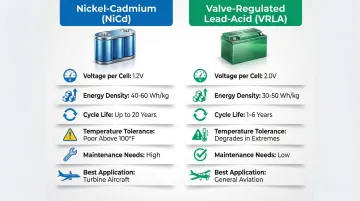
Understanding these performance differences helps operators select the right battery chemistry for their specific aircraft and mission profile.
The Memory Effect in NiCd Batteries
The "memory effect" (technically voltage depression) occurs when NiCd batteries are repeatedly discharged to the same shallow depth. Crystal formations develop on the electrode plates, reducing the battery's ability to deliver its full rated capacity.
Prevention strategies:
- Perform deep discharge cycles (reconditioning) every 3-6 months
- Avoid repeatedly stopping discharge at the same voltage level
- Complete full discharge/charge cycles during capacity testing
Types of Aviation Batteries and Marathon Models
What batteries are allowed on aircraft?
The FAA strictly regulates aircraft battery types through Technical Standard Order (TSO) C173, which references RTCA/DO-293 Minimum Operational Performance Standards. Only batteries meeting these certification requirements are approved for aircraft installation.
Approved battery types:
- Nickel-cadmium (NiCd) batteries meeting TSO-C173 standards
- Sealed lead-acid (VRLA) batteries meeting TSO-C173 standards
- Specific models requiring Parts Manufacturer Approval (PMA) or Supplemental Type Certificate (STC)
Critical regulatory note: Automotive batteries are NOT approved for aircraft use due to fundamentally different design requirements, including vibration resistance, leak-proof construction, and temperature performance specifications mandated for aviation applications.
What are the two most common batteries used in aviation?
Understanding these two battery chemistries helps operators select the right power source for their aircraft type and mission profile.
1. Nickel-Cadmium (NiCd) Batteries
NiCd batteries are the primary choice for turbine aircraft and high-performance applications.
Their low internal resistance delivers the 300-500 ampere currents required for jet engine starting without significant voltage drop. Common industry models include:
- TCA series (turbine commercial aircraft)
- CA series (commercial aircraft applications)
- SP series (special purpose applications)
2. Sealed Lead-Acid (VRLA) Batteries
VRLA batteries dominate general aviation and smaller aircraft installations.
Key advantages include:
- Maintenance-free design (no water additions required)
- Lower acquisition cost than NiCd
- Adequate starting power for piston engines
- Simpler charging requirements
Comparison: Aviation Battery Specifications
| Specification | NiCd (Typical) | Sealed Lead-Acid (Typical) |
|---|---|---|
| Nominal voltage | 24V (20 cells × 1.2V) | 24V (12 cells × 2.0V) |
| Capacity range | 25-45 amp-hours | 28-42 amp-hours |
| Weight | 45-65 lbs | 35-55 lbs |
| Starting current | 300-500 amperes | 200-350 amperes |
| Typical aircraft | Turbine business jets, commercial aircraft | Piston singles/twins, light turboprops |
| Temperature range | -40°F to 160°F (with limitations above 100°F) | -40°F to 140°F |
Aircraft matching considerations: Turbine engines require the high starting currents that NiCd batteries provide, while piston engines operate effectively with the lower (but adequate) current output of lead-acid batteries. Temperature extremes in high-altitude operations favor NiCd's wider operating range.
Ni-Cad Systems services both battery chemistries and offers FAA-PMA approved replacement components for either type, helping operators maintain reliable power systems regardless of their aircraft's battery configuration.
Maintenance Best Practices for Marathon Batteries
Regulatory Inspection Intervals
14 CFR Part 43 and Part 91.409 mandate battery inspections during 100-hour and annual inspections. However, manufacturer-specific intervals take precedence and are often more strict.
Standard inspection schedule:
- Initial capacity check: 12 months or 1,000 hours (whichever comes first)
- Subsequent checks: Every 6 months or 500 hours if capacity remains above 90%
- Visual inspections: Every 100 hours or 3 months
Capacity Testing Procedures
Capacity testing is the definitive method for determining battery airworthiness. Voltage checks alone miss capacity degradation—only discharge testing reveals true performance.
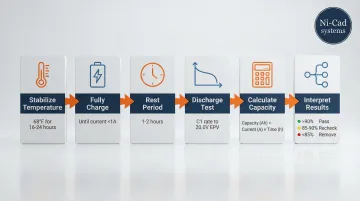
Step-by-step capacity test protocol:
- Stabilize temperature - Maintain at 68°F (20°C) or higher for 16-24 hours before testing
- Fully charge - Use manufacturer-specified charging voltage until current drops below 1 ampere
- Rest - Allow 1-2 hours after charging before discharge testing
- Discharge at C1 rate - For a 42Ah battery, discharge at 42 amperes to End Point Voltage (EPV) of 20.0V
- Calculate capacity - % Capacity = (Minutes to EPV ÷ 60) × 100
- Interpret results:
- >90%: Return to service; recheck in 12 months
- 85-90%: Return to service; recheck in 6 months
- <85%: Remove from service immediately
Electrolyte Level Checks (Serviceable NiCd Batteries)
Non-sealed NiCd batteries require regular electrolyte monitoring:
- Check levels every 100 hours or 3 months
- Add distilled water only (never acid) to manufacturer's specified mark
- Fill to proper level (typically 1/4" above plates)
- Avoid overfilling—electrolyte expands during charging and can overflow
Terminal Cleaning and Torque Specifications
Proper terminal maintenance prevents voltage drop and arcing that can lead to premature failure.
Cleaning procedure:
- Remove battery—disconnect negative terminal first
- Clean terminals with baking soda solution to neutralize acid
- Rinse with distilled water and dry thoroughly
- Inspect for corrosion, pitting, or arcing damage
- Apply protectant—light coat of petroleum jelly or battery terminal sealant
Torque specifications:
- Battery terminal bolts: 40-60 inch-pounds (verify manufacturer specifications)
- Cable lugs: 25-35 inch-pounds
- Never overtighten, as this can crack battery posts
Temperature Monitoring During Charging
Temperature monitoring prevents thermal runaway and extends battery life.
Critical temperature thresholds:
- NiCd batteries: Maximum charging temperature 100°F (38°C)
- VRLA batteries: Maximum charging temperature 113°F (45°C)
- Action required: If temperature exceeds limits, immediately disconnect charger and investigate cause
Temperature compensation for charging voltage:
- Below 32°F: Increase voltage to 29.0-29.5V (for 24V systems)
- 32-113°F: Standard voltage 28.2-29.0V
- Above 113°F: Reduce voltage to 27.0-27.5V
Essential Maintenance Checklist
Visual inspection every 100 hours:
- Check case for cracks, bulging, or distortion
- Inspect terminals for corrosion, pitting, or burns
- Verify secure mounting and proper ventilation connection
- Examine wiring for chafing or damage
- Check electrolyte level (serviceable NiCd only)
Capacity testing per manufacturer schedule:
Follow the six-step protocol above. Document results and compare to previous tests for trend analysis. Batteries showing declining performance may benefit from professional evaluation—facilities like Ni-Cad Systems provide comprehensive capacity testing and certification services for NiCd and lead-acid aviation batteries.
Storage maintenance for inactive aircraft (>30 days):
Disconnect battery or connect to approved maintenance charger. Check Open Circuit Voltage every 2-4 months and boost charge if voltage drops below 25.0V for 24V batteries.
Performance Optimization Strategies
Charging Profiles: Constant Current vs. Constant Voltage
Choosing the right charging method can extend battery life by years and prevent premature capacity loss.
Constant Potential (CP) Charging - Recommended for VRLA:
- Charging voltage: 28.2-29.0V for 24V batteries
- Current naturally decreases as battery approaches full charge
- Prevents overcharging and thermal stress
- Ideal for maintenance charging and normal operations
Constant Current (CC) Charging - Used for NiCd Reconditioning:
- Fixed current (typically C/10 rate: 3.5A for 35Ah battery)
- Voltage rises as battery charges
- Requires monitoring to prevent overcharge
- Critical for deep-discharge recovery and reconditioning cycles
Temperature Compensation in Charging Systems
Battery chemistry responds differently to temperature extremes. Without voltage compensation, batteries overcharge in hot conditions and undercharge in cold weather—both reducing lifespan.
Concorde Battery specifications provide these voltage adjustments for 24V systems:
| Temperature Range | Charging Voltage | Purpose |
|---|---|---|
| Cold (<32°F) | 29.0-29.5V | Increases charging acceptance |
| Normal (32-113°F) | 28.2-29.0V | Standard charging range |
| Hot (>113°F) | 27.0-27.5V | Prevents thermal stress |
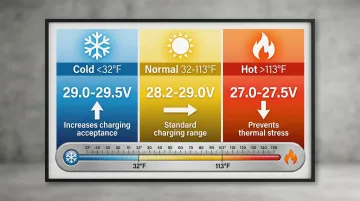
Impact of proper temperature compensation:
- Extends battery life by 50-100%
- Prevents sulfation (crystal buildup) in cold weather
- Reduces thermal runaway risk in hot conditions
- Ensures complete charging across temperature ranges
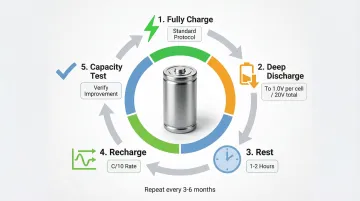
Battery Reconditioning Cycles for NiCd Batteries
Reconditioning restores capacity in NiCd batteries by breaking down crystalline formations and balancing cell voltages.
When to recondition:
- Every 3-6 months for batteries in regular service
- When capacity drops below 90% but remains above 85%
- After extended storage periods
- When voltage imbalance between cells exceeds 0.1V
Reconditioning procedure:
- Fully charge battery using standard protocol
- Deep discharge to 1.0V per cell (20V for 24V battery)
- Rest for 1-2 hours
- Recharge using constant current at C/10 rate
- Perform capacity test to verify improvement
Troubleshooting Common Battery Issues
Symptoms of Battery Degradation
Signs of reduced capacity include:
- Engine starts become sluggish or require GPU assistance
- Avionics dim during starting
- Battery fails capacity testing (<85%)
Inability to hold charge manifests as:
- Voltage drops rapidly after charging
- Battery requires frequent recharging between flights
- Open Circuit Voltage below 25.0V within days of charging
Physical damage indicators include:
- Case swelling or distortion (indicates overheating)
- Electrolyte leakage (VRLA batteries cannot be refilled)
- Corrosion around terminals or vents
- Discoloration of case material
Diagnosing Weak Cells Within Battery Packs
Recognizing these symptoms is the first step—next comes identifying the specific cause. Weak cells reduce overall battery performance and can cause cell reversal during discharge, requiring systematic diagnosis.
Use these diagnostic methods to identify weak cells:
Individual cell voltage testing:
- Measure each cell voltage under load
- Variation >0.1V between cells indicates imbalance
- Cells reading <1.0V (NiCd) or <1.75V (lead-acid) are weak
Capacity testing:
- Weak cells reach end point voltage earlier than expected
- Battery delivers less than rated capacity
- Voltage drops rapidly during discharge
Implications of weak cells:
- Entire battery pack must be replaced
- Individual cell replacement not recommended for aviation applications
- Weak cells can cause adjacent cells to reverse polarity
- Continued operation risks thermal runaway or complete failure
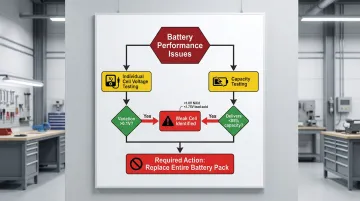
Facilities like Ni-Cad Systems perform comprehensive capacity testing on over 47,000 units to identify weak cells before they cause in-flight failures.
Common Installation Errors Leading to Premature Failure
Improper ventilation causes:
- Blocked or disconnected vent tubes trap hydrogen gas
- Inadequate airflow causes heat buildup during charging
- Solution: Verify vent tube routing and secure connections
Incorrect charging parameters lead to:
- Using automotive chargers or unregulated GPU can overcharge batteries
- Lack of temperature compensation causes thermal stress
- Solution: Use only approved aviation battery chargers with proper voltage regulation
Parasitic drain neglect results in:
- A 50-milliampere parasitic drain depletes 10% capacity in just 2.3 days
- Repeated deep discharges from parasitic loads cause permanent sulfation
- Solution: Disconnect battery or use approved maintenance charger during extended inactivity
Improper storage damages batteries through:
- Storing batteries in discharged state causes irreversible sulfation
- High storage temperatures accelerate self-discharge
- Solution: Store fully charged in cool environment; boost charge every 2-4 months
Regulatory Compliance and Safety Considerations
FAA Airworthiness Requirements
14 CFR Part 43 - Maintenance Requirements:
A&P mechanics or certificated repair stations must perform all battery maintenance work. Each service requires detailed logbook entries documenting the date, work description, and approving signature. Capacity test results must include the actual percentage value rather than a simple "Pass" notation.
TSO-C173 Certification:
- All aviation batteries must meet Technical Standard Order C173
- Installation requires compliance with Part 43 or applicable airworthiness requirements
- PMA approval required for replacement batteries not identical to original equipment
FAA Airworthiness Directives:
- Specific ADs may mandate inspection of battery hardware (mounting screws, terminals)
- Compliance with manufacturer service bulletins often mandatory
- Non-compliance can ground aircraft until corrective action completed
Battery Handling and Storage Procedures
Beyond documentation requirements, FAA regulations emphasize proper safety protocols during hands-on battery work. These procedures protect both personnel and aircraft systems.
Personal Protective Equipment (PPE) requirements:
- Chemical-resistant gloves when handling batteries
- Safety glasses or face shield during electrolyte service
- Protective apron when working with serviceable batteries
- Eye wash station accessible within 10 seconds
Proper equipment protects against chemical exposure, but technique matters just as much during battery service.
Safe handling practices:
- Always disconnect negative terminal first, reconnect last
- Use proper lifting techniques for batteries weighing 35-65 lbs
- Never lay batteries on their side (can damage internal plates)
- Keep metallic objects away from terminals to prevent short circuits
Batteries not immediately installed require careful storage to maintain readiness.
Storage requirements:
- Store in cool, dry location below 68°F (20°C) ideal
- Maintain batteries in fully charged state
- Check Open Circuit Voltage every 2-4 months
- Boost charge if voltage drops below 25.0V (24V battery) or 12.5V (12V battery)
Disposal Regulations for Aviation Batteries
Aviation batteries contain hazardous materials including cadmium, lead, and sulfuric acid. The EPA and state agencies regulate disposal through strict requirements that apply to every aviation facility.
Regulatory framework:
- EPA Resource Conservation and Recovery Act (RCRA) classifies batteries as hazardous waste
- State regulations may impose additional requirements
- Improper disposal can result in significant fines
Facilities like Ni-Cad Systems, Inc., with over 47 years of Part 145 certification experience, follow established protocols for safe battery disposal and can guide operators through compliance requirements.
Proper disposal procedure:
- Contact FAA-approved battery recycling facility
- Package battery in leak-proof container with absorbent material
- Label as "Hazardous Waste - Lead/Cadmium Battery"
- Maintain disposal records for minimum 3 years
- Never dispose in regular trash or landfills
Frequently Asked Questions
What batteries are allowed on aircraft?
FAA-approved nickel-cadmium and sealed lead-acid batteries meeting TSO-C173 standards are permitted in aircraft. Specific models require PMA or STC approval, and automotive batteries are strictly prohibited.
What are the two most common batteries used in aviation?
Nickel-cadmium batteries dominate commercial and turbine aircraft applications due to their high-current delivery capabilities, while sealed lead-acid batteries are the standard in general aviation piston aircraft for their maintenance-free operation and lower cost.
How often should aviation batteries be replaced?
Lead-acid batteries typically last 2-4 years in starting applications, while properly maintained NiCd batteries can achieve 5-10 years or longer. Capacity testing determines actual replacement need, not calendar time alone.
What causes the memory effect in NiCd batteries?
Repeated shallow discharge cycles cause crystalline formations on electrode plates that reduce available capacity. Full discharge/charge cycles (reconditioning) every 3-6 months help prevent this effect by breaking down crystalline structures and restoring battery performance.
Can I use automotive batteries in aircraft?
Absolutely not. Automotive batteries lack the vibration resistance, leak-proof construction, temperature performance, and FAA certification required for aviation applications. Installing non-approved batteries violates airworthiness regulations and creates serious safety risks.
What are the signs that a battery needs immediate replacement?
Critical indicators include visible case damage or swelling, electrolyte leakage, capacity testing below 85%, inability to hold charge, cell voltage imbalance exceeding 0.1V, or thermal runaway/freezing exposure.
About Ni-Cad Systems, Inc.
Since 1974, Ni-Cad Systems has specialized in aviation battery testing, repair, and FAA-PMA approved replacement components for corporate, airline, and military operators. As a Part 145 certified repair facility, we provide capacity testing, deep-cycle reconditioning, and fast turnaround service for corporate, airline, and military customers. With over 47,000 units serviced and 24/7 AOG support, we deliver the expertise and responsiveness aviation operators demand. Contact us at +1 510-785-9391 for technical support or emergency battery services.