Introduction
The global aviation maintenance, repair, and overhaul (MRO) market continues to expand rapidly, driven by growing aircraft fleets and aging equipment requiring specialized service.
For aviation entrepreneurs and existing repair facilities, FAA Part 145 certification represents the essential gateway to legally performing aircraft maintenance and approving components for return to service—capabilities that non-certified facilities simply cannot offer.
Part 145 certification is a business-critical credential that determines whether you can compete for airline contracts, serve international customers, and command premium pricing in the aviation maintenance industry.
Whether you're an MRO professional evaluating certification options, an aviation entrepreneur planning a new facility, or an existing shop seeking to expand capabilities, understanding the Part 145 process is your first step. This guide walks you through the complete certification journey—from initial requirements to final approval—so you can build a legally compliant, competitive aviation maintenance business.
Key Takeaways
- Part 145 certification grants legal authority to approve aircraft return to service
- Expect 12-24 months across 5 phases with significant facility, equipment, and personnel investment
- Requires Accountable Manager and Chief Inspector with FAA A&P or 18+ months experience
- Choose from six rating categories: Airframe, Powerplant, Propeller, Radio, Instrument, Accessory
- Ongoing compliance, FAA surveillance, and quality control are essential after approval
What Is FAA Part 145 Certification?
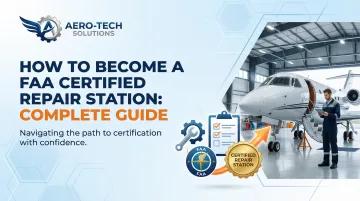
FAA Part 145 certification is federal authorization granted to repair stations that meet strict regulatory standards under 14 CFR Part 145. It allows facilities to perform aircraft maintenance, repairs, and alterations—and to approve aircraft and components for return to service.
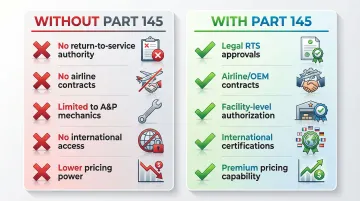
The return-to-service distinction is crucial: Non-certified repair facilities may possess technical expertise and sophisticated equipment, but they lack the legal authority to issue return-to-service approvals. This limitation forces them to rely on individual A&P mechanics working under their own certificates, severely restricting commercial viability and competitive positioning.
Certification Ratings and Scope
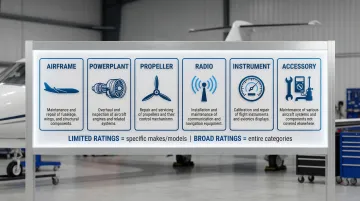
The rating system defines your certification scope. The FAA grants certifications for specific categories and classes:
- Six major categories: Airframe, Powerplant, Propeller, Radio, Instrument, Accessory
- Limited ratings cover specific makes and models; broad ratings cover entire categories
- Classes within each category define authorized work in your Operations Specifications
Ni-Cad Systems operates as a Part 145 certified repair station in Hayward, California, specializing in aircraft battery service and testing. Their certification allows them to approve batteries for return to service after capacity testing, deep-cycle testing, and repair.
Since 1974, the facility has serviced over 47,000 units under this authorization.
Why Pursue FAA Repair Station Certification?
Part 145 certification opens doors that remain closed to uncertified facilities. Without it, you cannot legally approve components or aircraft for return to service—which means no airline contracts, no OEM partnerships, and no access to the most profitable work in aviation maintenance.
Business advantages of Part 145 certification include:
- Legal authority for return-to-service approvals - The primary differentiator that separates certified stations from competitors
- Access to airline and OEM contracts - Major operators require Part 145 certification for vendor qualification
- International market access - Part 145 enables EASA, UK CAA, and Brasil ANAC certifications through bilateral agreements
- Premium pricing capability - Certified stations command higher rates due to regulatory compliance and quality system requirements
- Competitive differentiation - Certification creates barriers to entry protecting your market position
These advantages apply across multiple facility types.
Common scenarios where Part 145 certification is essential:
- Component repair businesses serving airlines or corporate aviation
- Aircraft maintenance facilities performing major inspections or modifications
- Specialty shops focused on avionics, interiors, engines, or accessories
- Manufacturing companies offering aftermarket support and service
- Battery service facilities like Ni-Cad Systems that test and repair critical aircraft power systems
For facilities targeting corporate, airline, or military customers, Part 145 certification isn't optional—it's the baseline credential competitors already hold.
The FAA Part 145 Certification Process: 5 Phases Explained
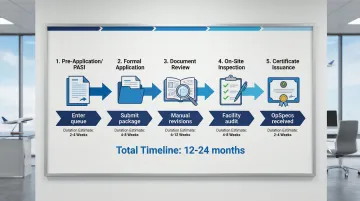
The FAA follows a structured five-phase certification process that your local Flight Standards District Office (FSDO) manages. Understanding each phase helps you prepare properly, avoid delays, and manage expectations throughout the 12-24 month journey.
Phase 1: Pre-Application (PASI Submission)
Submit FAA Form 8400-6 (Pre-Application Statement of Intent) to your FSDO to enter the certification queue. This non-binding submission signals your intent and allows the FAA to assign a Certification Project Manager (CPM) who will guide your application.
Given FAA backlog, submitting your PASI early—even before you're fully committed—secures your position in the queue and can reduce overall timeline by 3-6 months.
Phase 2: Formal Application
Submit your complete application package including:
- FAA Form 8310-3 (Application for Repair Station Certificate and/or Rating)
- Business documentation and organizational structure
- Proposed Operations Specifications defining your requested capabilities
- Facility information including address, layout, and environmental controls
- Evidence of capability to meet Part 145 requirements
Allow 2-4 months to prepare a complete, high-quality application package.
Phase 3: Document Review and Compliance Assessment
FAA Aviation Safety Inspectors (ASIs) review your repair station manuals:
- Repair Station Manual (RSM) - Defines your operational procedures
- Quality Control Manual (QCM) - Details inspection procedures, testing protocols, non-conformity tracking, and corrective actions
- Training Program Manual - Documents employee qualification and training procedures
The FAA will provide feedback requiring changes to ensure manuals meet regulatory standards and don't contradict Part 145 requirements. Plan for 3-6 months of back-and-forth revisions—multiple rounds are standard.
Pro tip: Use industry templates from organizations like the Aeronautical Repair Station Association (ARSA) to accelerate manual development and reduce revision cycles.
Phase 4: On-Site Inspection and Demonstration
FAA inspectors conduct facility inspection to verify:
- Adequate workspace and environmental controls
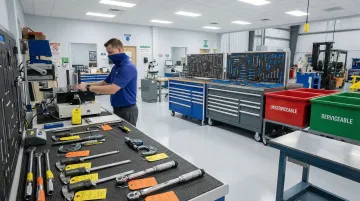
- Required equipment, tooling, and test instruments (properly calibrated)
- Technical data availability (Component Maintenance Manuals, service bulletins)
- Personnel qualifications and training records
- Material storage and handling procedures
Inspectors may require demonstration of maintenance procedures to validate your team's competency. Allow 2-4 months for facility preparation and the inspection process.
Phase 5: Certificate Issuance and Operations Specifications
Upon successful completion, the FAA issues:
- Part 145 Certificate - Your official authorization to operate as a repair station
- Operations Specifications (OpSpecs) - The detailed document defining your approved ratings, limitations, authorized maintenance activities, and any special conditions
Your OpSpecs are the legal boundaries of your operation. Any work outside these specifications requires an OpSpecs amendment before you can perform that work.
Key Requirements and Factors for Success
Critical Personnel: Accountable Manager and Chief Inspector
Accountable Manager:
- Holds overall operational responsibility and serves as primary FAA contact
- Does NOT require an A&P certificate but must demonstrate aviation maintenance knowledge
- Can be the business owner, facility manager, or designated executive
Chief Inspector:
- Must hold an FAA Airframe and/or Powerplant (A&P) mechanic certificate appropriate to the work scope
- OR be eligible for an FAA Repairman certificate with 18+ months documented experience in the relevant maintenance area
- Oversees all inspection activities and quality control functions
Finding qualified candidates with both technical expertise and regulatory knowledge is difficult. Start your personnel search early in the certification process—ideally before submitting your formal application.
For example, at Ni-Cad Systems, Vice President/General Manager Stephen Andrues brings exceptional qualifications including A&P certification, FAA Designated Engineering Representative (DER) status, and 40 years of specialized experience servicing aircraft batteries—credentials that exceed typical Chief Inspector requirements.
Maintenance Manual Availability
This is a critical go/no-go decision point: You cannot add capabilities to your Operations Specifications without access to manufacturer Component Maintenance Manuals (CMMs) for those specific components.
Before investing in certification:
- Identify exactly which components or aircraft you plan to service
- Confirm you can obtain the required CMMs from manufacturers
- Budget for manual subscription services ($5,000-$20,000 annually)
- Understand that some OEMs restrict manual access to independent MROs
Independent repair stations face growing challenges obtaining OEM manuals. Some manufacturers limit access to protect their own service networks, forcing you to remove those capabilities from your application.
Use CMM back sections to identify required tools, test equipment, and specialized tooling for your planned capabilities before making equipment purchases.
Facility and Equipment Requirements
Facility standards:
- Adequate size for the scope of work (no specific square footage requirement)
- Environmental controls appropriate to the work (temperature, humidity, cleanliness)
- Security measures to prevent unauthorized access
- Proper layout supporting logical maintenance flow and preventing cross-contamination
Equipment requirements:
- All measuring and test equipment (MTE) must be calibrated to standards traceable to NIST or equivalent
- Specialized equipment per CMM requirements for your capabilities
- Adequate tooling for all approved maintenance activities
- Material storage systems ensuring proper segregation and traceability
Equipment investment ranges from $10,000 for limited capabilities to $100,000+ for broad ratings with specialized test equipment.
Quality Control and Documentation Systems
Your Quality Control Manual must detail:
- Inspection procedures for incoming materials and completed work
- Testing protocols and acceptance criteria
- Non-conformity identification and tracking
- Corrective action processes
- Supplier evaluation procedures
Beyond the QC manual, you'll need comprehensive documentation systems covering:
- Maintenance tracking for all work performed
- Personnel training and qualification records
- Equipment calibration records with traceability
- Material traceability systems
Consider ERP or Computerized Maintenance Management System (CMMS) software designed for aviation to manage these requirements efficiently. Manual paper systems become unmanageable as volume grows.
Common Challenges and How to Overcome Them
Inadequate manual preparation is the most frequent pitfall. The FAA will require extensive revisions if your manuals lack detail, contradict regulations, or fail to address required procedures. Investing in professional consulting support ($20,000-$45,000) or using industry templates can significantly reduce revision cycles.
Personnel qualifications derail applications when key staff don't meet regulatory standards. Verify that your Chief Inspector holds the required A&P certificate or documented experience before submitting your application. Don't assume technical competence equals regulatory qualification.
Equipment calibration presents another common hurdle. Facility inspections often reveal measuring tools lacking current calibration certificates or traceability to recognized standards. Establish your calibration program early and maintain detailed records.
Maintenance manual access can force you to reduce capabilities when OEMs refuse to provide CMMs. Strategies to address this challenge:
- Build direct manufacturer relationships early in the process
- Subscribe to manual services like Flatirons or ATP
- Join industry coalitions advocating for fair manual access
- Remove unavailable capabilities from your application if needed
Timeline management requires realistic expectations:
- Well-prepared applicants need minimum 12 months; FAA backlog typically extends this to 18-24 months
- Budget for facility upgrades, equipment purchases, calibration setup, manual subscriptions, quality software, and personnel costs during preparation
- Ongoing expenses include manual subscriptions, calibration maintenance, training programs, and quality system updates
Building strong FAA relationships proves critical throughout the process. Key practices include:
- Establish trust with FSDO inspectors through professionalism and transparency
- Communicate proactively during application lulls to show continued progress
- Address challenges openly rather than concealing problems
- Push back respectfully when requests seem unreasonable and understand the escalation process through FAA regional offices
Timeline, Costs, and Post-Certification Considerations
Understanding the certification timeline helps you plan resources, secure stakeholder buy-in, and set realistic expectations. Most applicants underestimate the process—factor in 12-24 months from initial submission to receiving your certificate.
Timeline Breakdown
| Phase | Duration | Key Activities |
|---|---|---|
| PASI Submission | Immediate | Enter FAA queue, receive CPM assignment |
| Application Preparation | 2-4 months | Develop manuals, gather documentation, prepare facility |
| Document Review Cycles | 3-6 months | Multiple revision rounds with FAA feedback |
| Facility Preparation & Inspection | 2-4 months | Equipment installation, calibration, personnel training |
| Final Approval | 1-2 months | Certificate and Operations Specifications (OpSpecs) issuance |
| FAA Backlog Buffer | 3-6 months | Variable delay based on FSDO workload |
Total realistic timeline: 12-24 months from PASI to certificate
Cost Breakdown
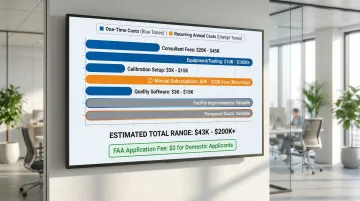
Financial planning should account for both one-time certification expenses and ongoing operational costs. Budget conservatively—unexpected facility upgrades or extended consultant support can quickly inflate initial estimates.
| Category | Estimated Range | Notes |
|---|---|---|
| FAA Application Fee | $0 | Domestic applicants only |
| Consultant Fees | $20,000-$45,000 | Manual development, audit prep, application support |
| Facility Improvements | Variable | Depends on existing infrastructure |
| Equipment & Tooling | $10,000-$100,000+ | Based on ratings and capabilities sought |
| Calibration Program Setup | $5,000-$15,000 | Initial calibration and system establishment |
| Manual Subscriptions | $5,000-$20,000/year | Ongoing annual cost |
| ERP/Quality System Software | $3,000-$15,000 | Initial setup plus annual licensing |
| Personnel Costs | Variable | Salaries during preparation phase |
Post-Certification Requirements
Obtaining your certificate is just the beginning. The FAA expects continuous compliance with your approved systems and periodic verification through surveillance activities.
Ongoing obligations include:
- Quality control system maintenance - Your Quality Control Manual (QCM) defines inspection and testing requirements you must follow for every work order
- FAA surveillance inspections - Expect unannounced inspections every 12-24 months to verify continued compliance with your OpSpecs and manuals
- Operations Specifications amendments - Any capability additions (new ratings, work scopes, or locations) require formal OpSpecs amendment approval before you can perform that work
- Personnel training and qualification - Maintain current training records for all employees, with recurring training cycles documented per your training program manual
- Calibration program adherence - Follow your established calibration intervals for all precision measuring equipment, with records traceable to NIST standards
- Document control - Keep all manuals, procedures, and technical data current; notify FAA of any manual revisions requiring approval
- International certifications - If serving foreign customers, consider EASA Part 145, UK CAA, or Brasil ANAC approvals (requires existing FAA Part 145 certificate and demonstrated foreign customer need)
Frequently Asked Questions
How do I become an FAA certified repair station?
Submit PASI (Form 8400-6) to enter the queue, prepare your formal application with required manuals, undergo FAA document review and facility inspection, and demonstrate Part 145 compliance. The process typically requires 12-24 months and significant investment in facilities, equipment, personnel, and quality systems.
What are the three options for entering the FAA repair station business?
You can buy an existing certificated repair station ($100,000-$500,000+, fastest route), partner with an existing repair station (shared resources and risk), or start certification from scratch (12-24 months, most control). Each approach has distinct advantages depending on your timeline, budget, and strategic goals.
How long does it take to get FAA Part 145 certification?
Minimum 12 months for exceptionally well-prepared applicants, typically 18-24 months accounting for document revision cycles and FAA backlog. Submit your PASI early to secure your queue position even before full commitment, as FAA backlog can add 3-6 months to the process.
What qualifications must the Chief Inspector have?
Must hold an FAA A&P mechanic certificate appropriate to the work scope, OR be eligible for an FAA Repairman certificate with 18+ months documented experience. Repairman certificates are only valid while employed by the specific repair station.
Can one person serve as both Accountable Manager and Chief Inspector?
Yes, one person can fill both roles in small repair stations, but that person must hold the required mechanic or Repairman certificate since the Chief Inspector position requires it (whereas the Accountable Manager position does not). This is common in specialty shops with focused capabilities.
What happens if I can't obtain maintenance manuals for certain aircraft components?
Without manufacturer Component Maintenance Manuals (CMMs), you cannot add those specific components to your capabilities list or Operations Specifications. Manual availability is a go/no-go decision point before investing significant resources in certification efforts for specific product lines. You must either obtain the manuals, choose different capabilities, or accept a more limited scope of approval.
Ready to pursue FAA Part 145 certification? The process is rigorous but achievable with proper planning, adequate resources, and realistic expectations. Companies like Ni-Cad Systems have successfully navigated certification and served corporate, airline, and military customers for over 50 years. With the right preparation and commitment to quality, your facility can join the ranks of FAA-certified repair stations serving the growing aviation MRO market.
For specialized battery service and testing needs, contact Ni-Cad Systems at +1 510 785 9391 or visit their Hayward, California facility to learn how their Part 145 certification and 30+ FAA-PMA approvals enable them to serve aviation customers worldwide.