Introduction
Aircraft batteries power everything from engine starts to emergency backup systems. When your battery fails at a remote airstrip without ground power, you quickly realize just how essential these power sources are.
Three main battery types dominate aviation today: lead-acid (economical but heavy), nickel-cadmium (reliable but maintenance-intensive), and lithium-ion (lightweight but expensive). Each offers distinct trade-offs in weight, maintenance requirements, cost, and performance characteristics.
The right choice depends on your specific aircraft, mission profile, operating environment, and budget.
Understanding these differences helps you select the best battery for your operation.
Key Takeaways
- Aircraft batteries enable engine starting, emergency backup power, and electrical system stability
- Lead-acid batteries offer the lowest initial cost but suffer from heavy weight and shorter service life
- Nickel-cadmium batteries deliver proven reliability in extreme conditions with 2,000+ cycle life
- Lithium-ion batteries cut weight by 45-63% with minimal maintenance requirements
- Total cost of ownership often matters more than initial purchase price
What Is an Aircraft Battery?
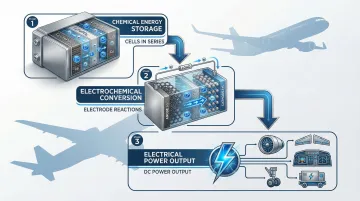
An aircraft battery converts chemical energy into electrical energy, functioning as both a primary power source during ground operations and a critical backup system in flight.
These batteries deliver either 12V or 24V power depending on the aircraft's electrical system requirements.
Basic components include:
- Cells connected in series - Each cell produces a specific voltage (2V for lead-acid, 1.2V for nickel-cadmium, 3-4.2V for lithium-ion)
- Electrodes - Anode (negative) and cathode (positive) where chemical reactions occur
- Electrolyte - Facilitates ion movement between electrodes to generate current
These components work together to create a complete power system. Aircraft batteries integrate with the charging system (alternator or generator) and provide stable DC power to essential systems throughout flight operations.
Why Are Aircraft Batteries Important in Aviation?
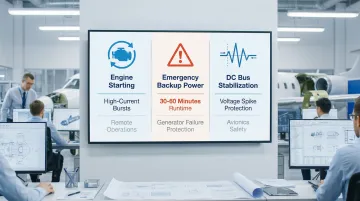
Aircraft batteries enable three mission-critical functions that directly impact flight safety and operational readiness.
Critical functions:
- Engine starting - Delivers high-current bursts to crank engines, especially critical at remote locations without ground power units
- Emergency backup power - Supplies 30-60 minutes of power to essential avionics and communications when generators fail
- DC bus stabilization - Absorbs voltage spikes during electrical load changes to protect sensitive avionics
Understanding these functions reveals why battery failures create serious operational and safety consequences.
Consequences of battery failure:
Battery failures create immediate operational challenges. You can't start engines without battery power, leaving aircraft stranded and creating costly Aircraft on Ground (AOG) situations.
During in-flight generator failures, a dead battery means complete loss of essential avionics, navigation systems, and communications—exactly when you need them most.
Battery reliability directly impacts flight safety across corporate, commercial, and military aviation. The FAA verified 89 lithium battery incidents in 2024 alone, with nearly 1 in 5 resulting in diverted landings or emergency evacuations.
Types of Aircraft Batteries
Aircraft batteries fall into three main categories based on their battery chemistry, each developed in different eras and offering distinct performance characteristics. Understanding these differences helps you match battery technology to your specific operational requirements.
The "right" battery type depends on your aircraft's electrical system, weight constraints, operating environment, maintenance capabilities, and total cost of ownership—not just the sticker price.
Lead-Acid Batteries
Description:
Lead-acid batteries represent the oldest rechargeable technology, introduced in 1859 and still widely used in general aviation. They use lead dioxide positive plates, pure lead negative plates, and sulfuric acid electrolyte.
Two subtypes exist: flooded (wet cell) requiring regular electrolyte maintenance, and VRLA (valve-regulated lead-acid or "sealed") with absorbed electrolyte requiring no fluid checks.
How it differs:
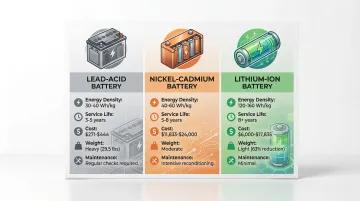
Lead-acid batteries are significantly heavier than other types, with the lowest energy density at approximately 30-40 Wh/kg. Each cell produces roughly 2V, requiring six cells for a 12V battery.
Voltage drops noticeably under load as the state of charge decreases, affecting performance during high-demand operations like cold-weather starts.
Best suited for:
- Small general aviation aircraft where weight is less critical
- Auxiliary systems with lower power requirements
- Emergency backup systems
- Budget-conscious operators prioritizing low initial cost ($271-$444 for standard models)
Key strengths:
- Lowest upfront cost in the industry
- Proven reliability over 160+ years of development
- Wide availability of service providers nationwide
- Simple charging requirements (constant voltage)
- Well-established recycling infrastructure
Limitations and trade-offs:
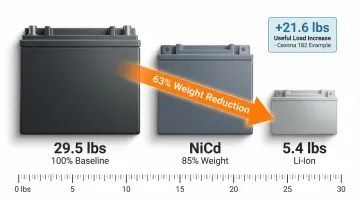
Lead-acid batteries impose significant weight penalties—a typical 12V 29Ah battery weighs 29.5 lbs. Service life is relatively short at 3-5 years or 300-500 cycles, with critical mission operators often replacing them annually. Flooded types require regular electrolyte level checks and capacity testing.
Cold-weather vulnerability is severe: A fully charged battery resists freezing to -95°F, but a discharged battery can freeze at just -4°F, cracking internal plates and destroying the unit. At 25% charge, the freezing point rises to -35°F—well within typical winter conditions.
Temperature extremes accelerate degradation, with performance declining rapidly above 60°C. The corrosive sulfuric acid electrolyte can leak, damaging aircraft structures and components.
Nickel-Cadmium (NiCd) Batteries
Description:
Nickel-cadmium batteries use nickel oxyhydroxide positive plates, metallic cadmium negative plates, and potassium hydroxide electrolyte. Each cell produces approximately 1.2V, requiring 19-20 cells for 24V aircraft systems. Two configurations exist: vented (flooded) requiring electrolyte maintenance, and recombinant (sealed with pressure relief valves).
How it differs:
NiCd batteries offer superior power delivery and temperature tolerance compared to lead-acid, with moderate energy density of 40-60 Wh/kg. They require specific charging protocols—constant current charging is preferred over constant voltage. The chemistry is susceptible to "memory effect" (reversible capacity loss from repeated partial discharges) and thermal runaway if improperly charged.
Best suited for:
- Commercial transport aircraft
- Business jets and helicopters
- Military aircraft
- Any platform requiring reliable performance from -50°C to +71°C (-58°F to +160°F)
- High-vibration environments
- Frequent engine starts
Key strengths:
NiCd batteries deliver exceptional durability with 2,000+ cycle life and 5-8 years of service—significantly outlasting lead-acid. They excel at high-current delivery for engine starting, even in extreme cold.
The chemistry tolerates deep discharge without permanent damage and resists vibration damage that would destroy other battery types.
Decades of proven performance in demanding aviation applications have established NiCd as the traditional standard for turbine aircraft.
Limitations and trade-offs:
NiCd batteries cost significantly more than lead-acid ($11,833 to over $24,000 for turbine aircraft batteries). They're maintenance-intensive, requiring regular capacity checks, cell balancing, and periodic deep-cycle reconditioning to address cell imbalance and memory effect.
Thermal runaway risk is serious—under constant-voltage charging or temperatures above 160°F, rising temperature lowers internal resistance, drawing more current and generating more heat in a dangerous self-reinforcing cycle. Many aircraft require battery temperature monitoring systems specifically for this reason.
NiCd batteries remain heavier than lithium alternatives and contain toxic cadmium (approximately 8% of battery weight), mandating strict disposal procedures. They cannot be incinerated or landfilled.
Professional servicing extends NiCd performance and safety. Certified repair facilities provide reconditioning, cell balancing, capacity testing, and FAA-PMA approved replacement options that reduce total cost of ownership. Ni-Cad Systems, for example, has serviced over 47,000 units since 1974 with 30+ FAA-PMA approvals for second-source battery components.
Lithium-Ion Batteries
Description:
Lithium-ion batteries represent the newest technology, using graphite anodes, lithium compound cathodes (typically lithium iron phosphate/LiFePO4 for aviation due to superior safety), and non-aqueous electrolyte. Each cell produces 3-4.2V, requiring significantly fewer cells for the same voltage. Sophisticated Battery Management Systems (BMS) provide continuous monitoring and protection against overcharging, over-discharging, and thermal issues.
How it differs:
Lithium-ion batteries offer dramatically higher energy density at 120-160 Wh/kg—3-4 times that of lead-acid or NiCd. They maintain consistent voltage throughout the discharge cycle, providing full power until nearly depleted. Weight savings are exceptional: 45-63% lighter than equivalent capacity lead-acid or NiCd batteries. They require no scheduled maintenance and deliver 8+ years of service life.
Best suited for:
- Weight-critical aircraft seeking useful load increases
- Business aviation prioritizing performance
- Electric and hybrid propulsion systems
- Advanced air mobility platforms (eVTOL)
- Modern avionics requiring stable power
- Operations prioritizing reduced maintenance burden
Key strengths:
Lithium-ion batteries deliver transformative weight savings—40-85 lbs reduction per battery in typical installations. A Cessna 182 gains 21.6 lbs of useful load by switching from a 27 lb lead-acid battery to a 5.4 lb lithium alternative. Weight reductions can reach 63% for helicopters.
No scheduled maintenance required—capacity checks every 2 years or on-condition monitoring via BMS. This offers 50-90% maintenance savings versus annual lead-acid/NiCd inspections. Service life exceeds 8 years or 3,000+ cycles, meaning one lithium battery outlasts 3-4 lead-acid batteries.
Other benefits include faster recharging (30 minutes or less) and flat discharge curve maintaining full power until depleted. No memory effect occurs, and disposal is simpler than lead-acid or NiCd due to the absence of toxic heavy metals. Reduced aircraft weight translates to fuel savings over the battery's lifetime.
Limitations and trade-offs:
Initial purchase cost is significantly higher—$6,000-$17,835 depending on capacity, compared to $271-$444 for lead-acid. Installation requires certified BMS and proper mounting per STC requirements, adding complexity and cost.
Strict regulatory requirements apply: batteries must meet FAA TSO-C179b or equivalent EASA certification standards. Performance sensitivity to extreme cold reduces capacity below -20°C. Regulators classify lithium batteries as Class 9 Dangerous Goods, requiring shipment at 30% state of charge or less.
Only certified aviation-grade lithium chemistry (lithium iron phosphate) meets safety standards—consumer-grade alternatives are prohibited. Proper disposal requires lithium-specific recycling channels, though the process is simpler than lead-acid or NiCd disposal due to the absence of toxic heavy metals.
How to Choose the Right Aircraft Battery Type
Selection should focus on mission requirements and operational constraints over brand familiarity or lowest purchase price.
Key factors to consider:
- Aircraft electrical system voltage (12V vs. 24V)
- Available space and weight budget (lithium saves 20-40 lbs)
- Operating environment (temperature range, vibration levels)
- Frequency of use (daily operations vs. occasional flights)
- Maintenance capabilities (in-house expertise vs. outsourced)
Total Cost of Ownership Analysis
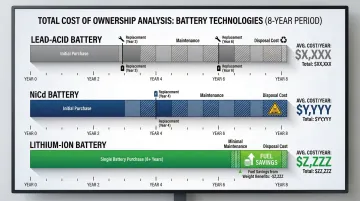
Don't compare purchase prices alone. Calculate the complete picture:
- Purchase price - Initial capital outlay
- Expected service life - Lead-acid: 3-5 years, NiCd: 5-8 years, Lithium: 8+ years
- Maintenance costs - Labor and materials for capacity testing, reconditioning, electrolyte service
- Disposal costs - Hazardous material handling fees
- Weight-related fuel savings - For lithium installations, reduced weight saves fuel over battery lifetime
- AOG impact - Cost of aircraft downtime from battery failures
Analysis shows lithium-ion can be 2.8 times cheaper per usable kWh over the system's life despite higher initial cost, due to longevity and reduced maintenance.
Beyond cost considerations, regulatory compliance and support infrastructure play crucial roles in long-term battery performance.
Regulatory and support considerations:
Confirm the battery has appropriate certifications (FAA-PMA approval, TSO authorization, or STC if replacing OEM type). Confirm compatibility with your specific aircraft make, model, and electrical system configuration.
Assess availability of qualified service providers, AOG support capabilities, and rental battery programs to minimize downtime during maintenance. Consider whether second-source alternatives (FAA-PMA approved equivalents) exist to avoid sole-source dependence.
What to Check Before Finalizing Your Battery Choice
Verify certifications and compatibility:
Confirm the battery carries appropriate FAA-PMA approval, TSO authorization, or STC documentation for your specific aircraft. Check compatibility with your exact make, model, and electrical system configuration—not just similar aircraft.
Assess maintenance infrastructure:
Evaluate your in-house capabilities for the chosen battery type. Key questions include:
- Do you have expertise to perform capacity testing, reconditioning (for NiCd), or electrolyte checks (for flooded lead-acid)?
- Can you handle required charging equipment—constant current chargers for NiCd, proper voltage regulation for lead-acid and lithium?
- Do you have relationships with qualified service providers for capacity testing, reconditioning, and emergency support?
FAA Part 145 certified facilities like Ni-Cad Systems provide capacity testing, deep-cycle reconditioning, and FAA-PMA approved replacement components when in-house maintenance isn't feasible. Rental battery programs and 24/7 AOG support (510-501-9391) help minimize downtime during service intervals.
Consider long-term support factors:
Long-term battery support requires careful supplier evaluation:
- Warranty coverage: Review terms and duration carefully
- Repair options: Determine if replacement cells are available or if you must replace the entire battery
- Supplier stability: Verify track record and financial health for 5-8 year battery lifespan
- Second-source availability: Check for FAA-PMA approved alternatives that provide competitive pricing options
Second-source suppliers offering FAA-PMA approved equivalents give you flexibility throughout the ownership period.
Conclusion
Aircraft batteries are critical safety components available in three main types:
- Lead-acid: Economical but heavy, 3-5 year service life
- Nickel-cadmium: Proven and temperature-tolerant, maintenance-intensive, 5-8 year service life
- Lithium-ion: Lightweight with minimal maintenance, 8+ year service life, higher initial cost
Aircraft operators choose among these types based on specific requirements and operational priorities.
Informed battery selection requires evaluating total cost of ownership—not just purchase price. Factor in expected service life, maintenance labor and materials, weight-related fuel savings, and the impact of battery failures on aircraft availability.
Proper maintenance and professional servicing maximize battery performance and extend service life. FAA Part 145 certified facilities like Ni-Cad Systems provide reconditioning services and FAA-PMA approved replacement components that ensure flight safety while reducing long-term costs across your fleet.
Frequently Asked Questions
What are the main types of aircraft batteries and how do they differ?
Lead-acid batteries are the least expensive ($271-$444) but heaviest at 30-40 Wh/kg energy density. Nickel-cadmium offers proven reliability at 40-60 Wh/kg with moderate weight, while lithium-ion delivers exceptional weight savings at 120-160 Wh/kg with minimal maintenance requirements.
How long do aircraft batteries typically last?
Lead-acid batteries last 3-5 years, nickel-cadmium batteries last 5-8 years with proper maintenance, and lithium-ion batteries exceed 8 years with minimal maintenance. Service life depends on usage patterns, with lithium-ion effectively outlasting 3-4 lead-acid batteries.
What is thermal runaway and which battery types are susceptible?
Thermal runaway is a dangerous self-reinforcing cycle where increasing temperature accelerates heat-generating chemical reactions. Nickel-cadmium batteries are most susceptible when overcharged above 160°F, requiring temperature monitoring. Certified lithium-ion batteries include Battery Management Systems that prevent this through continuous monitoring.
Can I replace my lead-acid or NiCd battery with a lithium-ion battery?
Lithium-ion replacement requires an FAA-approved STC (Supplemental Type Certificate) covering the battery, mounting hardware, and Battery Management System. This isn't a simple swap—proper certification ensures safety and regulatory compliance for your specific aircraft model.
What maintenance do different aircraft battery types require?
Lead-acid batteries need electrolyte checks and capacity testing. Nickel-cadmium batteries require capacity checks, cell balancing, and periodic reconditioning to prevent memory effect. Lithium-ion batteries need only capacity checks every 2 years, offering 50-90% maintenance savings.
How do I dispose of aircraft batteries properly?
Lead-acid and nickel-cadmium batteries contain hazardous materials requiring specialized recycling through certified facilities. Nickel-cadmium batteries cannot be incinerated or landfilled due to toxic cadmium. Lithium-ion batteries need proper recycling but contain no toxic heavy metals. Consult battery service providers for approved disposal methods.