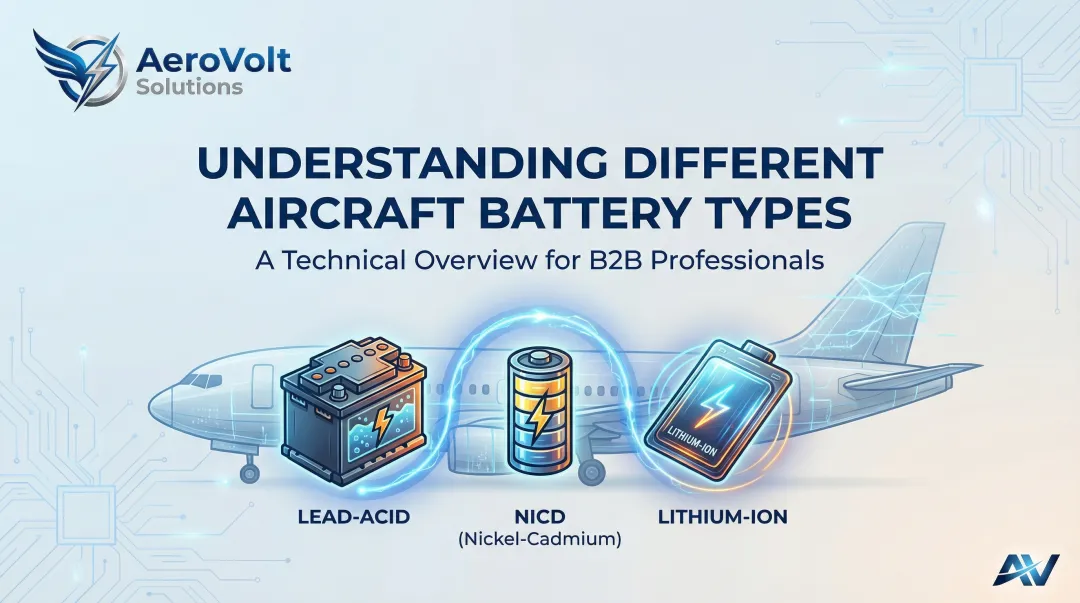
The challenge is real: aircraft batteries are mission-critical components that require specialized knowledge spanning multiple chemistries, each with distinct performance characteristics and maintenance requirements. A mistake in battery selection, charging, or maintenance can ground an aircraft, compromise safety, or lead to costly premature replacement.
This guide consolidates essential technical resources covering battery types, specifications, maintenance protocols, selection criteria, regulatory compliance, and professional servicing considerations. You'll find the information you need to make informed decisions about aircraft battery management, whether you're selecting a new battery, troubleshooting performance issues, or establishing maintenance schedules.
TLDR: Key Takeaways
- Three battery chemistries dominate aviation—Lead-Acid, Nickel-Cadmium, and Lithium—each requiring distinct maintenance protocols
- Airworthiness requires 80% minimum capacity, with testing intervals defined by manufacturer CMMs
- Calculate starting requirements, emergency power duration, and climate factors when selecting batteries
- FAA Part 145 servicing ensures compliance, proper documentation, and extends battery lifespan
Understanding Aircraft Battery Types: A Technical Comparison
Lead-Acid Batteries (Flooded and Sealed AGM)
Aircraft lead-acid batteries operate at 2.0 volts per cell nominal, with 12 cells connected in series to create standard 24-volt aircraft systems. Two distinct types serve different operational needs.
Flooded-cell (vented) batteries contain liquid sulfuric acid electrolyte and feature removable vent caps for maintenance access. Specific gravity measurements indicate state of charge: 1.275 when fully charged, dropping to 1.170 when discharged.
These batteries require regular electrolyte level checks and topping with distilled water as gassing during charging causes water loss.
Sealed AGM (Absorbed Glass Mat) batteries use glass mat separators to hold electrolyte in a starved design. They're sealed with pressure relief valves that open only under abusive conditions, eliminating water maintenance.
AGM batteries deliver approximately 1.5x the energy density of flooded cells, feature lower internal resistance for better cranking performance, and offer superior vibration resistance.
Performance advantages of AGM technology:
- Maintenance-free operation eliminates electrolyte servicing
- Better cold-weather starting performance
- Lower self-discharge rates in storage
- Spill-proof construction for varied mounting positions
- Reduced corrosion of surrounding components
Critical limitations:
- AGM batteries are sensitive to deep discharge below 50% capacity—repeated deep discharge causes permanent damage
- Higher initial cost (typically 1.5-2x flooded-cell batteries)
- More sensitive to overcharging and voltage regulation
- Cannot be reconditioned as effectively as flooded cells
Lead-acid batteries operate across wide temperature ranges, but electrolyte concentration affects freezing point. A fully charged battery (specific gravity 1.275) won't freeze until approximately -71°F (-57°C), while a discharged battery (1.170) freezes around -8°F (-22°C).
Nickel-Cadmium (NiCd) Batteries
While lead-acid batteries dominate general aviation, NiCd batteries serve commercial and military aircraft where performance justifies higher cost.
NiCd batteries use nickel oxide positive plates and cadmium negative plates immersed in potassium hydroxide electrolyte, producing 1.2 volts per cell nominal. A 24-volt NiCd battery typically contains 19-20 cells in series.
Key performance advantages:
- Constant voltage discharge curve maintains stable voltage throughout discharge cycle, providing consistent power to aircraft systems
- Superior low-temperature performance—NiCd batteries maintain capacity in extreme cold where lead-acid batteries struggle
- Longer cycle life: 4-8x that of lead-acid batteries when properly maintained
- Better tolerance to high discharge rates during engine starting
- Tolerate discharged storage without damage (unlike lead-acid)
Thermal Runaway Risk
NiCd batteries face a critical safety concern. If overcharged or subjected to high ambient temperatures, internal heat generation can become self-sustaining. 14 CFR 25.1353(b)(6) mandates that NiCd installations must have either charging rate control systems or temperature sensing with automatic disconnect to prevent thermal runaway.
Unlike lead-acid batteries, specific gravity doesn't indicate charge state in NiCd batteries. The electrolyte concentration remains constant throughout charge/discharge cycles. Capacity testing is the only reliable method to determine NiCd battery health.
Lithium Iron Phosphate (LiFePO4) Batteries for Experimental Aircraft
Lithium batteries represent the newest technology in aviation power, currently limited primarily to experimental aircraft due to regulatory requirements.
Dramatic weight savings: Lithium batteries can be 1/3 to 1/5 the weight of equivalent lead-acid batteries—a 42Ah lead-acid battery weighing 60 pounds might be replaced by a lithium battery of just 12-15 pounds. This weight reduction significantly impacts useful load and performance.
Performance characteristics:
- 13.2V nominal voltage (four 3.3V cells in series for 12V systems)
- Flatter discharge curve maintains voltage longer under load
- Significantly more discharge cycles (2,000-3,000+ vs. 300-500 for lead-acid)
- Extremely low self-discharge rates (2-3% per month vs. 5-15% for lead-acid)
Battery Management System (BMS) requirement: Lithium batteries require sophisticated BMS to protect against over-discharge (below 2.5V per cell), overcharging (above 3.65V per cell), cell imbalance, and thermal damage. The BMS monitors individual cell voltages and temperatures, disconnecting the battery if parameters exceed safe limits.
Critical limitations:
- Poor cold weather performance below 32°F (0°C)—charging below freezing can cause permanent damage
- Higher initial cost ($800-1,500 vs. $300-600 for lead-acid)
- Specific charging requirements incompatible with standard lead-acid charging systems
- TSO-C179 approval required for certified aircraft installations
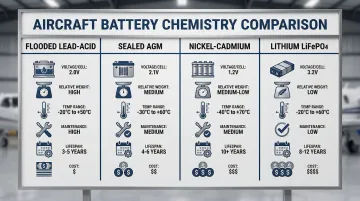
Battery Comparison Table
| Chemistry | Voltage/Cell | Weight | Temperature Range | Maintenance | Typical Lifespan | Relative Cost |
|---|---|---|---|---|---|---|
| Flooded Lead-Acid | 2.0V | Baseline | -40°F to 140°F | High (monthly checks) | 3-5 years | $ |
| Sealed AGM | 2.0V | Same | -40°F to 140°F | Low (quarterly testing) | 3-5 years | $$ |
| Nickel-Cadmium | 1.2V | 1.5x lead-acid | -65°F to 160°F | Medium (quarterly testing) | 8-15 years | $$$ |
| Lithium LiFePO4 | 3.3V | 0.2-0.3x lead-acid | 32°F to 140°F | Low (BMS monitoring) | 8-12 years | $$$$ |
Critical Maintenance Protocols and Best Practices
Testing and Charging Requirements
Capacity testing requirements: FAA and manufacturers generally consider a battery airworthy at 80% of rated capacity. Testing intervals depend on Component Maintenance Manuals (CMMs)—for example, Concorde recommends initial checks at 12 months or 1,000 hours, tightening to every 3 months or 250 hours if capacity drops between 85-90%.
Maintaining proper capacity requires correct charging protocols for each battery chemistry.
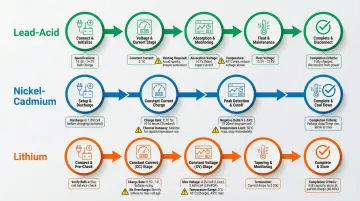
Proper charging methods by battery type:
Lead-Acid batteries use a constant voltage method:
- Charge at 1.42V per cell (28.4V for 24V battery)
- Temperature compensation: reduce voltage 0.005V per cell for each degree above 77°F
- Terminate when current drops below 1-2% of capacity rating
- Never exceed 1.50V per cell to prevent gassing and water loss
Nickel-Cadmium (constant current method):
- Charge at C/10 rate (10% of capacity rating)
- Temperature-compensated voltage cutoff at 1.55V per cell maximum
- Monitor temperature continuously—disconnect if case temperature exceeds 125°F (52°C)
- Periodic reconditioning (deep discharge followed by full charge) restores capacity
Lithium (BMS-controlled charging):
- BMS manages charging automatically—never bypass
- Charge at 0.5C rate maximum (50% of capacity rating)
- Individual cell balancing during final charge phase
- Never charge below 32°F (0°C)—causes lithium plating and permanent damage
Maintenance and Storage Procedures
Electrolyte maintenance for flooded-cell batteries:
- Check levels monthly—plates must remain covered
- Top with distilled water only (never add acid)
- Test specific gravity with hydrometer after charging
- Clean terminals and apply corrosion inhibitor quarterly
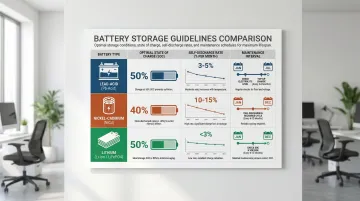
Storage guidelines by chemistry:
| Chemistry | State of Charge | Self-Discharge Rate | Maintenance Interval |
|---|---|---|---|
| Lead-Acid | Fully charged (prevent sulfation) | 5-15% per month at 77°F | Boost charge if voltage drops below 25.0V |
| Nickel-Cadmium | Can be stored discharged | 10-20% per month | Boost charge every 3-6 months |
| Lithium | 50-60% state of charge | 2-3% per month | Check voltage quarterly |
Prevention and Warning Signs
Key preventive measures include:
- Avoid deep discharge below 50% capacity—significantly reduces cycle life
- Ensure proper ventilation during charging (hydrogen gas risk with lead-acid and NiCd)
- Monitor bus voltage regularly—charging voltage outside 27.5-29.0V indicates regulator problems
- Use ground power units during extended maintenance to preserve battery capacity
Recognize early warning signs:
- Slow cranking
- Rapid voltage drop under load
- Physical swelling
Battery Selection Guide: Choosing the Right Battery for Your Aircraft
Sizing Methodology
Starting requirements: Calculate pulse cranking amps (PCA) needed—should be 2x the starter motor rating minimum. A turbine engine starter drawing 1,000 amps requires a battery rated for 2,000 PCA. Cold cranking amps (CCA) ratings apply to automotive batteries but aren't standard for aviation—use PCA or manufacturer's starting current specifications.
Emergency power duration: 14 CFR 25.1351(d) requires minimum 5 minutes of operation without normal electrical power, but operational rules often mandate longer durations. Calculate essential load amperage (avionics, instruments, emergency lighting) and multiply by required duration—30 minutes at 20 amps requires 10Ah minimum capacity.
Selection Criteria by Aircraft Type
Commercial aircraft (FAR Part 25):
- Must comply with 14 CFR 25.1309 system safety assessment
- 14 CFR 25.1333 instrument system reliability requires battery backup
- 14 CFR 25.1353 electrical equipment standards mandate safe temperatures and gas containment
- Typically NiCd batteries for main power, sealed lead-acid for APU and emergency systems
Military specifications:
- MIL-PRF-8565K defines performance requirements including extreme temperature testing
- Part numbers like D8565/7-1 indicate specific performance sheets
- Military qualification alone doesn't grant civilian airworthiness—requires FAA approval
Experimental aircraft:
- Greater flexibility in battery selection
- Lithium batteries popular for weight savings
- Must still meet basic electrical system safety requirements
- Phase I testing may be required for significant weight/balance changes
Climate Considerations
Hot climates (above 90°F average):
- Prefer AGM batteries—lower self-discharge rates
- Increased capacity rating (derate 10-15% for high temperatures)
- Enhanced ventilation for battery compartment
- More frequent capacity testing due to accelerated aging
Cold climates (below 20°F average):
- NiCd batteries offer best performance
- Lead-acid requires 20-30% higher capacity rating
- Battery heaters may be necessary for reliable starting
- Maintain higher state of charge to prevent electrolyte freezing
Weight and Balance Impacts
Switching battery types affects center of gravity. A 60-pound lead-acid battery replaced by a 15-pound lithium battery removes 45 pounds—if located in the nose, this shifts CG aft significantly.
Update weight and balance documentation and verify aircraft remains within CG envelope. Phase I testing may be required for experimental aircraft after major weight changes.
Cost of Ownership Analysis
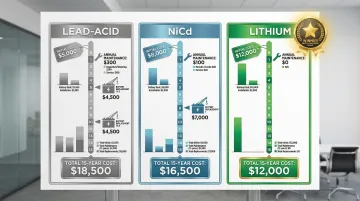
| Factor | Lead-Acid | NiCd | Lithium |
|---|---|---|---|
| Initial Cost | $300-600 | $1,200-2,000 | $800-1,500 |
| Lifespan | 3-5 years | 8-15 years | 8-12 years |
| Maintenance Cost/Year | $100-150 | $150-200 | $50-75 |
| Replacement Frequency | 4-5x over 15 years | 1-2x over 15 years | 1-2x over 15 years |
| Total 15-Year Cost | $2,100-3,750 | $2,250-3,600 | $1,550-2,325 |
Technical Specifications and Performance Data
Ampere-hour capacity represents the quantity of electricity a battery delivers over specified time. Aviation batteries typically use the C1 rate (1-hour discharge rate) to a defined end-point voltage.
A 42Ah battery at C1 rate delivers 42 amps for 1 hour to 21.0V (1.75V per cell for lead-acid).
C-rate is the discharge current equal to capacity. For a 42Ah battery:
- C1 rate = 42 amps (1-hour discharge)
- C/2 rate = 21 amps (2-hour discharge)
- 2C rate = 84 amps (30-minute discharge)
Depth of discharge affects cycle life dramatically:
- 100% DOD (complete discharge): 200-300 cycles
- 50% DOD (half capacity used): 500-800 cycles
- 25% DOD (quarter capacity used): 1,500-2,500 cycles
Peukert's Law shows capacity decreases with higher discharge rates. A battery rated 42Ah at C1 rate might deliver only 35Ah at 2C rate due to increased internal resistance losses and reduced reaction time.
These capacity principles directly impact starting performance. Cranking performance metrics quantify a battery's ability to deliver high currents during engine starts:
- Cold Cranking Amps (CCA): Current delivered at 0°F for 30 seconds while maintaining 1.2V per cell minimum (automotive standard, less common in aviation)
- Pulse Cranking Amps (PCA): Current delivered for 5-10 second bursts during engine starting—more relevant for aviation turbine engines
Temperature derating factors:
- 0°F: 60-70% of rated capacity
- 32°F: 80-85% of rated capacity
- 77°F: 100% of rated capacity (baseline)
- 122°F: 105-110% of rated capacity (but accelerated aging)
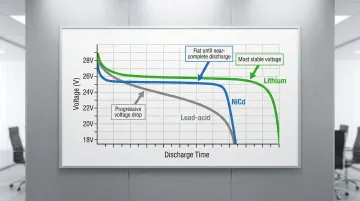
Discharge performance curves show voltage vs. time under various loads. Different chemistries exhibit distinct patterns:
- Lead-acid: Sloping curves with progressive voltage drop during discharge
- NiCd: Flat voltage until near-complete discharge, then rapid drop
- Lithium: Flattest curves, maintaining stable voltage longest
Safety Considerations and Regulatory Compliance
Regulatory Framework
FAA regulatory requirements:
TSO-C179 applies to lithium batteries in certified aircraft, requiring comprehensive testing for thermal runaway prevention, overcharge protection, and failure containment. Most lithium installations currently require Special Conditions due to unique safety considerations not addressed in original Part 25 regulations.
Part 145 approval is required for facilities performing battery repair, overhaul, and testing services. These certified repair stations maintain quality systems, trained personnel, and proper equipment to ensure airworthy repairs.
Preventive maintenance that owners can legally perform:
14 CFR Part 43, Appendix A, Paragraph (c)(24) permits "replacing and servicing batteries" by private pilots on aircraft they own or operate, provided it doesn't involve complex assembly operations. This includes battery replacement, cleaning terminals, and checking electrolyte levels. However, capacity testing or internal repairs require certified facilities.
Battery-Specific Hazards
Understanding the unique risks of each battery chemistry helps operators implement appropriate safety protocols.
Lead-acid hazards:
- Hydrogen gas generation during charging (explosive above 4% concentration)
- Sulfuric acid electrolyte causes severe chemical burns
- Lead content requires hazardous waste handling
- Proper ventilation essential: minimum 0.5 CFM per battery
NiCd hazards:
- Thermal runaway potential requiring temperature monitoring
- Potassium hydroxide electrolyte highly caustic
- Cadmium is toxic heavy metal requiring special disposal
- Oxygen and hydrogen evolution during charging
Lithium hazards:
- Fire risk if damaged, overcharged, or short-circuited
- Thermal runaway can be self-sustaining and difficult to extinguish
- Toxic fumes during thermal events
- Requires specialized fire suppression (Class D extinguishers)
Disposal Procedures
All aircraft batteries require specialized disposal due to hazardous materials content.
Lead-acid batteries:
Classified as hazardous waste due to lead and sulfuric acid content. Federal law requires recycling through authorized facilities. Over 95% of lead-acid battery materials are recyclable. Never dispose in regular trash.
NiCd batteries:
Contain toxic cadmium requiring special handling under RCRA (Resource Conservation and Recovery Act). Return to manufacturer or specialized recycling facility. Some states ban landfill disposal entirely.
Lithium batteries:
Classified as Class 9 hazardous materials for shipping. Discharge to below 30% state of charge before transport. Specialized recycling facilities recover lithium, cobalt, and other materials.
Installation Requirements
- Secure mounting withstanding 9G forward, 6G aft, 3G lateral, and 4.5G vertical loads
- Proper ventilation with overboard venting for flooded batteries
- Electrical system compatibility: voltage regulator settings appropriate for battery chemistry
- Overvoltage protection (crowbar circuits) to prevent battery damage from regulator failures
- Thermal management for NiCd and lithium batteries
Troubleshooting Common Battery Problems
Common Failure Modes by Battery Type
Lead-acid failures:
- Sulfation: Lead sulfate crystals form on plates during discharge; if left discharged, crystals harden and become permanent, reducing capacity
- Cell shorts: Plate material deterioration causes internal shorts, identified by one cell reading significantly lower voltage
- Grid corrosion: Positive plate grids corrode over time, eventually losing mechanical integrity
- Electrolyte stratification: Acid concentration varies by height in flooded cells, causing uneven charging
NiCd failures:
- Cadmium migration: Cadmium crystals grow between plates causing shorts, identified by high self-discharge rates
- Dry-out: Electrolyte evaporation in vented cells reduces capacity
- Memory effect: Repeated shallow discharge/charge cycles can reduce available capacity (though less significant than commonly believed)
- Cell imbalance: Individual cells develop different capacities, causing premature voltage drop
Lithium failures:
- Cell imbalance: Individual cells drift to different voltages, reducing total capacity and potentially causing BMS disconnection
- Thermal damage: Exposure to extreme temperatures (especially charging below freezing) causes permanent capacity loss
- BMS failure: Electronics failure prevents charging or discharging despite healthy cells
Diagnostic Procedures
Identifying these failure modes requires systematic testing. Start with voltage measurements, then move to capacity testing if initial results indicate problems.
Voltage testing:
- Off-load (open circuit) voltage: Indicates state of charge—24V lead-acid should read 25.2-25.6V when fully charged
- On-load voltage: Apply load equal to C1 rate and measure voltage after 10 seconds—should remain above 22.5V for healthy 24V battery
- Individual cell voltage: Cells varying by more than 0.1V indicate imbalance or failing cells
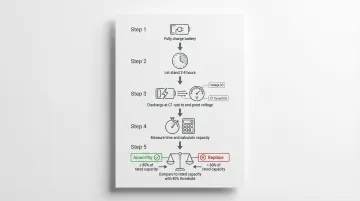
Capacity testing methodology:
- Fully charge battery per manufacturer specifications
- Let stand 2-4 hours to stabilize
- Discharge at C1 rate to end-point voltage (21.0V for 24V lead-acid, 19.2V for 24V NiCd)
- Measure time to end-point—multiply by discharge current to calculate actual capacity
- Compare to rated capacity—batteries meeting ≥80% capacity remain airworthy
Specific gravity measurements (flooded lead-acid only):
- Use temperature-compensated hydrometer
- Readings should be 1.270-1.280 when fully charged
- Cells varying by more than 0.030 indicate problems
- Low readings after full charge indicate sulfation or end of life
When Professional Servicing Is Required
Accurate diagnosis often requires calibrated equipment beyond what most operators have available. FAA Part 145 facilities like Ni-Cad Systems provide specialized equipment and expertise for:
- Accurate capacity testing with calibrated discharge equipment
- Deep-cycle reconditioning to restore capacity
- Cell replacement in NiCd batteries
- Proper documentation for airworthiness compliance
Battery Replacement Decision Tree
Replace immediately if:
- Capacity below 80% of rated
- Physical damage (cracks, swelling, leakage)
- Age exceeds manufacturer recommendations (typically 5 years for lead-acid, 15 years for NiCd)
- Repeated failures to hold charge
- Internal shorts detected
Consider reconditioning if:
- Capacity 80-90% with no physical damage
- Recent sulfation from storage (lead-acid)
- Cell imbalance without shorts (NiCd)
- Cost-effective compared to replacement
Cost-benefit analysis: Professional reconditioning typically costs 30-40% of new battery price. If reconditioning restores capacity above 90%, it can extend service life 1-2 years.
However, batteries near end of design life (4+ years for lead-acid, 12+ years for NiCd) rarely benefit from reconditioning.
Frequently Asked Questions
What is the difference between flooded lead-acid and sealed AGM batteries, and which should I choose?
AGM batteries are maintenance-free with better performance (1.5x energy density, superior cold-weather starting) but cost 1.5-2x more and are sensitive to deep discharge. Flooded cells cost less and tolerate deep discharge better but need monthly maintenance. Choose AGM for convenience and performance; choose flooded if budget is primary or deep discharge is likely.
How often should I have my aircraft battery tested and serviced?
Capacity testing intervals follow manufacturer CMMs—typically 12 months initially, tightening to every 3 months or 250 hours if capacity drops to 85-90%. Check electrolyte levels monthly for flooded cells. FAA Part 145 facilities like Ni-Cad Systems ensure proper testing procedures and airworthiness compliance.
Can I use a lithium battery in my certified aircraft?
Lithium batteries require TSO-C179 approval and comprehensive Battery Management Systems for certified aircraft. Most installations require Special Conditions due to thermal runaway risks. Lithium batteries are popular in experimental aircraft where they offer significant weight savings (1/3 to 1/5 lead-acid weight) and excellent performance, but regulatory requirements currently limit certified aircraft applications.
What does it mean when my battery won't hold a charge?
Common causes include sulfation from sitting discharged, cell shorts from plate degradation, or capacity below 80% indicating end of service life. Reconditioning can restore sulfated batteries if caught early, but shorts or aged batteries require replacement. Capacity testing by Part 145 facilities like Ni-Cad Systems determines if reconditioning is viable.
How do I properly charge and maintain my nickel-cadmium battery?
Charge at C/10 rate (10% of capacity) with temperature-compensated cutoff at 1.55V per cell maximum. Monitor temperature continuously—disconnect if case exceeds 125°F. Periodic reconditioning helps maintain capacity, and unlike lead-acid, NiCd can be stored discharged but needs boost charging every 3-6 months.
What are the signs that my battery needs immediate replacement?
Replace immediately if you experience inability to crank the engine, rapid voltage drop under load (below 22V within 10 seconds for 24V battery), physical swelling or leakage, capacity test results below 80%, or age exceeding manufacturer recommendations (typically 3-5 years for lead-acid, longer for NiCd). Professional capacity testing by facilities like Ni-Cad Systems provides definitive assessment and proper documentation for airworthiness compliance.