Introduction
MROs managing aircraft batteries face mounting pressure when sourcing receptacle replacements across multiple OEM families. SAFT, Marathon, VARTA, and GE battery packs each require periodic receptacle service, and routing these replacements through separate vendors multiplies procurement complexity, compliance paperwork, and AOG exposure.
According to a 2025 Oliver Wyman/IATA survey, 80% of MRO respondents cite piece-part availability as the primary driver of increased turnaround times — forcing airlines to hold 8% more inventory, an additional $1.3 billion tied up globally.
The cost of fragmented sourcing goes beyond delayed parts. Managing multiple vendor qualification files, inconsistent FAA Form 8130-3 documentation, and separate approval references creates administrative drag that worsens during peak maintenance cycles.
A 2017 DOT OIG audit found a 49% error rate in FAA Suspected Unapproved Parts (SUP) database entries — a figure that reflects exactly how multi-vendor traceability chains increase compliance risk.
This article breaks down why MROs are consolidating receptacle replacements for SAFT, Marathon, VARTA, and GE battery packs under a single FAA-PMA approved supplier — and what that means for AOG resolution times, compliance overhead, and procurement cost.
Key Takeaways
- Sourcing SAFT, Marathon, VARTA, and GE receptacle replacements from multiple vendors creates scheduling delays and procurement inefficiency
- A single FAA-PMA approved supplier consolidates compliance documentation, cutting audit exposure across all four OEM families
- FAA-PMA second-source receptacles deliver 25-45% cost savings versus OEM direct pricing while maintaining airworthiness
- Faster AOG response occurs when one supplier stocks compatible parts across all battery OEM families
- Consolidating to one vendor means fewer supplier audits, less qualification paperwork, and cleaner parts traceability on mixed fleets
What Is Single-Source Receptacle Replacement?
Battery receptacle replacement involves servicing the electrical interface between the battery and aircraft—typically MS3509-style connectors used across SAFT, Marathon, VARTA, and GE battery packs. These connectors are rated for 1,500 mating cycles and handle 1,500A peak current, but contact pins and engagement sockets wear with repeated use, increasing electrical resistance and requiring replacement.
"Single-source" means one FAA-PMA approved supplier holds replacement parts or repair capability for receptacle units across multiple OEM battery brands, rather than MROs routing each brand back to its original manufacturer.
The MS3509 Style 1 receptacle, originally developed for military aircraft under MIL-PRF-18148/3, has become the de facto standard for commercial aviation. That standardization allows a single FAA-PMA approved receptacle to replace proprietary OEM part numbers across all four battery families.
For MROs managing mixed-brand battery fleets, consolidating to a single approved source is a deliberate procurement strategy. The operational advantages are straightforward:
- Fewer vendor relationships to manage across the battery fleet
- Consistent quality standards regardless of OEM brand
- Faster fulfillment when multiple battery types need servicing simultaneously
Key Advantages of MRO Single-Source Receptacle Procurement
The advantages below focus on outcomes MROs directly measure: compliance risk, turnaround time, cost per repair event, and vendor management load—not abstract supplier consolidation theory.
Advantage 1: Unified Compliance Documentation Across All Four OEM Families
Every receptacle replacement generates FAA airworthiness documentation, typically FAA Form 8130-3. When SAFT, Marathon, VARTA, and GE replacements each come from different suppliers, MROs must manage separate traceability chains, approval references, and audit records for each.
One supplier's FAA-PMA approvals cover parts across multiple battery OEM families. All paperwork flows through a single quality system with a single set of approval references — cutting documentation errors and keeping internal recordkeeping to one audit trail instead of four.
Compliance errors in receptacle replacement documentation can ground aircraft or trigger FAA audit findings. The 2017 DOT OIG audit analyzed 265 SUP entries and found 16 duplicate, 86 incomplete, and 28 invalid entries—a systemic vulnerability that consolidating to one supplier's quality system directly addresses.
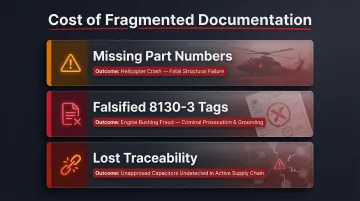
Real-world consequences of fragmented documentation:
| Documentation Failure | Real-World Impact |
|---|---|
| Missing Part Numbers | A Hiller UH-12E helicopter crashed after a main rotor blade drag strut failed at 2,236 hours—the part lacked a P/N, preventing investigators from verifying if it was the correct version |
| Falsified 8130-3 Tags | AOG Technics LTD sold GE CF6 engine bushings with falsified tags missing the mandatory "User/Installer Responsibilities" section |
| Lost Traceability | FAA closed a case involving 1,000 unapproved electrical capacitors without ensuring removal from the supply chain |
During an FAA audit, defending one supplier's quality system takes hours. Defending four takes days — and leaves more surface area for findings.
KPIs impacted:
- Compliance audit pass rates
- Documentation error rates
- Time spent on vendor qualification and re-qualification
- Number of active supplier approvals maintained
When this advantage matters most:
Highest impact for MROs managing mixed fleets where SAFT, Marathon, VARTA, and GE batteries coexist on different aircraft types—the paperwork complexity multiplies without a unified supplier.
Advantage 2: Faster AOG Response and Reduced Aircraft Downtime
When a battery receptacle fails and an aircraft is on the ground, the MRO needs an airworthy replacement part quickly. Routing an AOG request through four separate OEM pipelines—confirming availability, verifying documentation, re-qualifying each source—adds hours that don't exist in an AOG situation. A single supplier stocking FAA-PMA approved replacements for all four OEM families removes that routing step entirely.
With 30+ FAA-PMA approvals covering SAFT, Marathon, VARTA, and GE-compatible receptacles, a consolidated supplier can respond to an AOG request with one call, one purchase order, and one airworthiness tag — regardless of which OEM battery is on the aircraft.
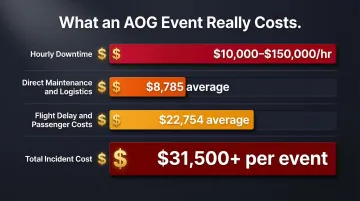
Boeing estimates a single AOG situation costs an airline $10,000 to $150,000 per hour, depending on aircraft type and route flown. Across the global airline industry, AOG events cost an estimated $50 billion annually.
AOG cost breakdown:
| Cost Category | Financial Impact |
|---|---|
| Hourly Downtime | $10,000–$150,000/hour |
| Direct Maintenance & Logistics | $8,785 average parts cost |
| Flight Delay & Passenger Costs | $22,754 average delay cost |
| Total Incident Cost (Average) | >$31,500 per minor event |
Parts availability and documentation readiness — not labor hours — determine whether a receptacle AOG resolves in 4 hours or 24. A supplier offering 24/7 technical support alongside stocked inventory can confirm the correct PMA part, walk through installation requirements, and clear the documentation in a single interaction.
KPIs impacted:
- AOG resolution time
- Mean time to restore (MTTR)
- Aircraft availability rate
- Maintenance event cost
When this advantage matters most:
Most critical for airlines and corporate aviation fleets with tight scheduling windows; also high-impact for military operators where operational readiness requirements are strict.
Advantage 3: Cost Efficiency Through Consolidated Procurement and FAA-PMA Second-Source Pricing
Purchasing receptacle replacements from a single FAA-PMA approved supplier typically yields lower per-unit costs than OEM direct pricing. It also cuts the administrative overhead of maintaining separate vendor relationships, qualification files, and purchase order workflows for each brand.
FAA-PMA second-source replacements are airworthy alternatives manufactured to FAA-approved standards — not unapproved parts — and priced below OEM equivalents. Industry benchmarks put FAA-PMA savings at 25% to 45% over OEM pricing. One commercial airline documented $30–40 million in annual material cost savings through an aggressive PMA approval program. Consolidating volume with one supplier adds pricing leverage on top of those baseline savings.
Beyond direct material savings, each additional supplier relationship carries hidden costs:
- Initial vendor qualification and setup
- Recurring quality audits per supplier
- Separate accounts payable processes
- Staff time across multiple points of contact
A 2025 Aviation Week/Naveo survey found 91% of respondents cited OEM parts availability challenges as at least moderately important in their PMA decisions, and 94% cited long OEM lead times as a driver to seek PMA alternatives. Availability pushes adoption as much as price does.
For high-volume MROs managing mixed-OEM fleets, combining PMA pricing with reduced procurement overhead often adds up to six-figure annual savings — without touching labor rates or service contracts.
KPIs impacted:
- Cost per maintenance event
- Procurement overhead
- Number of active vendor qualification files
- Annual parts spend
When this advantage matters most:
Most impactful for high-volume MROs and airlines managing large mixed-OEM fleets; also relevant for corporate aviation operators seeking predictable maintenance budgets.
What Happens When MROs Split Receptacle Sourcing Across Multiple Vendors
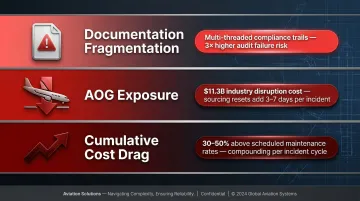
Splitting receptacle sourcing across multiple vendors creates three compounding problems that most MROs only recognize after they've absorbed the cost.
- Documentation fragmentation: Each OEM's supplier operates on a different quality system, approval reference, and paperwork format. Routing SAFT replacements to one vendor and Marathon to another produces a multi-threaded compliance trail that is hard to audit and prone to errors.
- AOG exposure: When a supplier hasn't been pre-qualified for a specific receptacle type and an unplanned failure hits, the sourcing process restarts from zero — adding days to resolution. Oliver Wyman and IATA estimate supply chain disruptions will cost the airline industry $11.3 billion in 2025, including $3.1 billion in higher maintenance costs and $1.4 billion in excess inventory holding.
- Cumulative cost drag: Four separate vendor relationships multiply qualification costs, purchase order volume, and staff coordination time. These costs don't show up in per-event accounting, but at fleet scale they're significant. Emergency logistics and unplanned sourcing drive removal costs 30–50% above scheduled maintenance rates.
How to Get the Most Value from a Single Receptacle Replacement Supplier
Verify FAA-PMA Coverage Upfront
Confirm that the supplier holds PMA approvals specifically covering receptacle replacement parts or complete receptacle units for SAFT, Marathon, VARTA, and GE battery models in your fleet. Approval scope varies and must be verified against the supplier's PMA list before qualification.
Ni-Cad Systems, for example, holds 30+ FAA-PMA approvals and operates as a Part 145 FAA approved repair facility — making supplier qualification a straightforward process. Their Vice President/General Manager also serves as an FAA Designated Engineering Representative (DER), providing direct technical depth during the approval and documentation process.
Establish an AOG Protocol in Advance
Set expectations before an AOG event occurs, not during one. Nail down:
- Priority fulfillment terms and lead time commitments
- Technical support contact hours (24/7 vs. business hours only)
- Documentation turnaround timelines for each OEM battery family
Suppliers offering round-the-clock AOG support — not just standard business hours — can compress resolution time from days to hours. That difference matters when an aircraft is grounded.
Review Fulfillment and Documentation Performance Periodically
Track turnaround time, documentation error rates, and parts conformance across all four OEM battery families. Single-source consolidation pays off most when the relationship is actively managed — not just assumed to be running smoothly.
Run quarterly reviews that assess:
- Average turnaround time by OEM family
- Documentation accuracy rates
- AOG response time performance
- Parts conformance and quality issues
Conclusion
The shift toward single-source procurement for SAFT, Marathon, VARTA, and GE receptacle replacements is driven by concrete MRO outcomes: reduced compliance risk, faster AOG resolution, and lower total procurement cost—not vendor preference.
The advantages compound over time. A supplier relationship built on broad FAA-PMA coverage, consistent documentation quality, and AOG-capable inventory becomes a structural operational asset, not just a parts source. With 80% of MROs citing parts availability as the top driver of increased turnaround times, and AOG events costing up to $150,000 per hour, consolidating receptacle procurement to a single FAA-PMA approved supplier delivers immediate, quantifiable value.
For MROs managing mixed fleets, the next step is straightforward: identify a supplier with verified FAA-PMA coverage across SAFT, Marathon, VARTA, and GE platforms, confirm AOG inventory depth, and run a 90-day procurement comparison against your current multi-vendor baseline. The cost and compliance case becomes clear quickly.
Frequently Asked Questions
Frequently Asked Questions
What types of battery receptacles are typically replaced during MRO maintenance?
Receptacles like the MS3509-style connector are the standard electrical interface on aviation batteries from OEMs like SAFT, Marathon, VARTA, and GE. They wear over mating cycles and must be replaced when contact integrity or housing condition degrades, typically after 1,500 engagements or when electrical resistance increases.
Are FAA-PMA approved receptacle replacements considered airworthy?
FAA-PMA parts are FAA-approved airworthy alternatives to OEM parts under 14 CFR Part 21 Subpart K — not unapproved or surplus parts. They carry the same regulatory standing for maintenance use as OEM components.
Can one supplier realistically cover receptacle replacements for SAFT, Marathon, VARTA, and GE battery families?
Yes. Because all four OEM families use the same MIL-SPEC MS3509 interface, a single FAA-PMA receptacle can replace proprietary part numbers across them. Suppliers holding 30+ PMA approvals with Part 145 status routinely cover all four families from one catalog.
How does single-source procurement affect an MRO's compliance documentation burden?
Consolidating to one supplier means one quality system, one set of approval references, and one traceability chain for all receptacle replacements. This cuts documentation complexity and audit exposure compared to managing separate 8130-3 paperwork streams from multiple vendors.
What should an MRO look for when qualifying a single-source receptacle replacement supplier?
Key qualification criteria include:
- Verified FAA-PMA coverage for each OEM battery family in the fleet
- Part 145 repair station certification
- Documented AOG support capability with 24/7 technical availability
- References demonstrating experience with mixed-fleet operations
How quickly can a single supplier fulfill an AOG receptacle replacement request?
Fulfillment speed depends on inventory posture and pre-established AOG protocols. Suppliers stocking PMA-approved parts across all four OEM families with 24/7 support can often resolve requests in hours — routing through individual OEM channels typically adds 24–72 hours.