This scenario plays out repeatedly across the 11,323 active Part 135 charter aircraft operating in the U.S. The problem isn't just the batteries—it's the fragmented vendor relationships, compliance tracking burden, and operational complexity that multiply with every aircraft added to the fleet. The solution isn't obvious until you understand one critical fact: standardizing battery sourcing through a single FAA-approved supplier with broad PMA coverage can solve compliance, cost, and operational headaches simultaneously.
TLDR: Key Takeaways
- Charter fleets typically manage 3-5+ battery types across different aircraft, each with separate vendors and lead times
- A supplier holding 30+ FAA-PMA approvals can legally replace batteries across a wide range of aircraft types, making single-source procurement viable
- One supplier handling both NiCd and lead-acid batteries eliminates vendor fragmentation and compliance tracking complexity
- Rental batteries and 24/7 AOG support limit exposure to downtime costs — which can exceed $150,000 per aircraft per day for charter operators
Why Mixed Charter Fleets Struggle with Battery Sourcing
How Mixed Fleets Create Battery Sourcing Complexity
Part 135 charter operators rarely build fleets through careful, uniform planning. Growth happens through acquisitions, opportunistic aircraft purchases, and client demand. The result: a Beechcraft King Air, a Hawker 800XP, and a Gulfstream G200 sitting in the same hangar, each requiring different battery specifications.
Battery diversity compounds quickly:
- NiCd batteries for older turbine aircraft
- Lead-acid batteries for newer models
- Different amp-hour ratings across types
- Incompatible form factors and connector systems
- Varying maintenance intervals and service requirements
Vendor Fragmentation Multiplies Costs
When each aircraft type requires a different battery, procurement teams end up managing multiple supplier relationships. Each vendor brings:
- Separate lead times (often 2-4 weeks for specialty batteries)
- Different pricing structures and minimum order quantities
- Unique warranty terms and return policies
- Independent documentation requirements
- Distinct technical support contacts
According to Oliver Wyman's 2025 MRO Survey, 80% of MRO providers cite parts availability as the primary driver of increased turnaround times. For charter operators, this translates directly to lost revenue when aircraft sit grounded waiting for the right battery from the right vendor.
The Compliance Tracking Burden
Each aircraft type operates under its own airworthiness directive landscape and approved parts list. When sourcing from multiple vendors, maintenance teams must:
- Verify FAA-PMA coverage for each supplier-aircraft pairing individually
- Maintain separate documentation trails for each vendor
- Track different compliance requirements across suppliers
- Cross-reference Approved Model Lists (AMLs) for every installation
- Manage audit preparation across multiple vendor relationships
The risk: An unapproved part slipping through during a rush AOG situation, potentially compromising airworthiness certification and triggering FAA enforcement action.
Training Costs and Error Risk
Compliance complexity doesn't stop at the paperwork level — it follows technicians onto the shop floor. Working with batteries from different manufacturers means navigating varying:
- Service procedures and maintenance intervals
- Charge requirements and voltage specifications
- Failure modes and troubleshooting protocols
- Documentation and record-keeping standards
This increases training overhead and creates opportunities for procedural errors—particularly dangerous when dealing with high-energy battery systems.
The Hidden Financial Toll
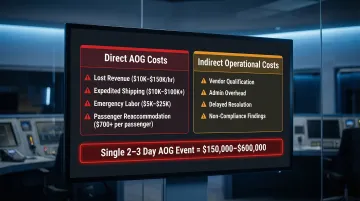
Beyond direct battery costs, charter operators absorb significant AOG-related expenses across two categories.
Direct costs per AOG incident include:
- Lost revenue: $10,000–$150,000 per hour depending on aircraft size
- Expedited shipping: $10,000–$100,000+ for emergency logistics
- Emergency labor and overtime: $5,000–$25,000 per incident
- Passenger reaccommodation: up to $700+ per passenger
Indirect operational costs add up separately:
- Vendor qualification and audit expenses
- Administrative overhead for multiple purchase orders
- Delayed AOG resolution due to unfamiliar vendor processes
- Potential non-compliance findings during FAA inspections
Industry estimates put a single 2–3 day AOG event at $150,000–$600,000 in combined costs, making vendor consolidation one of the more straightforward financial levers available to fleet operators.
What FAA-PMA Approval Actually Means for Your Fleet
Understanding Parts Manufacturer Approval
FAA-PMA (Parts Manufacturer Approval) is a combined design and production authorization under 14 CFR Part 21 Subpart K. It allows a manufacturer to produce and sell replacement aviation parts that are legally interchangeable with OEM components for specific aircraft models.
PMA approval is a separate authorization from a Part 145 repair station certificate. Part 145 covers maintenance, overhaul, and return-to-service — it does not grant authority to manufacture or sell replacement parts. FAA Advisory Circular 43-18 states that repair stations wanting to sell fabricated parts separately must obtain PMA approval under 14 CFR 21.303(a).
Aircraft-Specific Coverage
PMA coverage is not universal—it's aircraft-specific. A supplier may hold PMA for a King Air 200 battery but not for a Citation XLS. The breadth of a supplier's PMA portfolio directly determines how many aircraft in your mixed fleet they can legally serve.
Verification requirements:
- Request the specific PMA certificate for each aircraft model
- Review the Approved Model List (AML) listing exact make, model, and battery part numbers
- Retain PMA documentation in aircraft maintenance records
- Verify coverage before each installation, not just at initial vendor qualification
The Regulatory Compliance Advantage
Wide PMA coverage across aircraft types is what makes single-supplier sourcing viable for mixed fleets. Installing PMA-approved batteries eliminates the need for one-off STCs or field approvals — a meaningful time and cost reduction when you're managing multiple airframes. For Part 135 operators under FAA principal inspector oversight, PMA-backed documentation simplifies:
- Airworthiness sign-off procedures
- Audit preparation and compliance demonstrations
- Maintenance record organization
- Regulatory reporting requirements
Why Voltage Match Alone Doesn't Satisfy FAA Requirements
Many operators mistakenly believe any battery matching the correct voltage and amp-hour rating can be installed as a replacement. FAA regulations require more than electrical compatibility. Installing non-approved parts:
- Compromises aircraft airworthiness certification
- Creates insurance coverage gaps
- Triggers potential FAA enforcement actions
- Results in Suspected Unapproved Parts (SUP) violations
The FAA actively investigates SUP incidents and notifies operators when unapproved parts are discovered, requiring immediate deactivation, removal, or quarantine.
Quality Oversight Built Into PMA
The FAA's PMA process requires applicants to demonstrate that replacement parts meet or exceed original design standards. This means:
- Comprehensive design data submission (drawings, specifications, materials)
- Test reports and computations validating airworthiness
- Quality system meeting 14 CFR 21.137 requirements
- FAA-approved quality manual and oversight
For charter operators managing multiple airframes, this federal validation means you're not evaluating each supplier's quality claims on faith — the FAA has already done that work. A supplier holding 30+ PMAs across aircraft types has cleared that bar repeatedly.
How One Supplier Can Realistically Cover a Mixed Fleet
The Math of PMA Breadth
A supplier holding 30+ FAA-PMA approvals across NiCd and lead-acid battery types can cover a substantial portion of turbine and piston aircraft used in charter operations—turboprops, light jets, midsize jets, and large-cabin aircraft.
Example mixed fleet coverage scenario:
A charter operator running six aircraft across four types could be entirely served by a single supplier with broad PMA coverage:
- Citation 560XL — FAA-PMA approved emergency battery replacement
- Falcon 900EX — PMA-approved main battery system
- Hawker 800A — PMA replacements specific to the Hawker series
- King Air 350 — NiCd or lead-acid STC conversion options available
- Gulfstream G200 — Temperature sensors and battery components covered
- Cessna 560 — Battery pack, sensor, and receptacle approvals on file
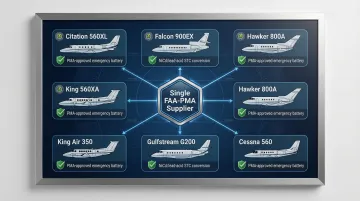
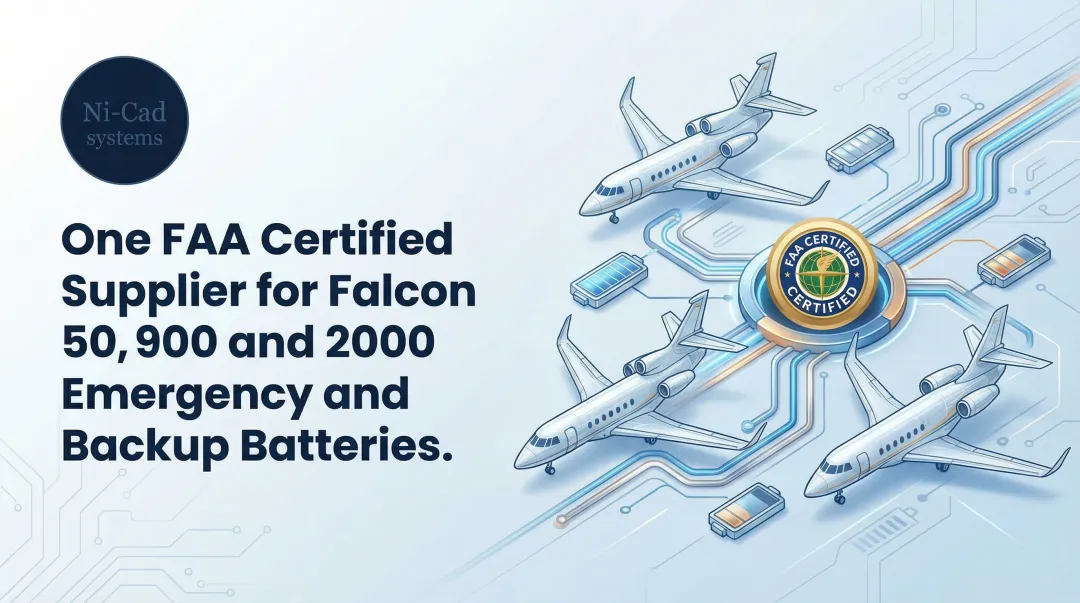
Ni-Cad Systems exemplifies this capability, holding 30+ FAA-PMAs covering Citation, Falcon, Hawker, Gulfstream, Cessna, and various commercial aircraft models—providing genuine single-source coverage for diverse charter fleets.
The Dual-Chemistry Advantage
Fleets mixing older aircraft (typically NiCd) with newer models (often lead-acid) need a supplier capable of servicing both chemistries under one roof. A supplier handling only one chemistry type forces operators back into multi-vendor arrangements.
Chemistry coverage requirements:
- NiCd batteries for legacy turbine aircraft (high discharge capability)
- Lead-acid batteries for newer aircraft (reduced maintenance)
- STC-approved chemistry conversions (NiCd to VRLA lead-acid)
- Temperature sensors compatible with both chemistries
- Receptacles supporting multiple battery manufacturers
Ni-Cad Systems operates a Part 145 repair station servicing both NiCd and lead-acid batteries while manufacturing FAA-PMA approved replacements for both types—eliminating the service/supply split that drives up cost and complexity in multi-vendor arrangements.
Service and Supply Integration
When sales and service run through the same Part 145 repair station, operational friction drops across the board:
- Operators send batteries for scheduled overhaul to the same entity supplying replacements
- Rental units come from the same inventory pool as service returns
- Documentation flows through a single chain of custody
- Technical support covers both service and supply questions
- AOG situations are handled by personnel familiar with your entire battery inventory
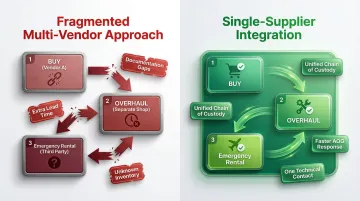
The fragmented alternative is familiar: buying from one vendor, shipping to a separate overhaul shop, then tracking down a third party for emergency rentals when an AOG hits. Each handoff adds time and documentation gaps.
Documentation and Traceability Advantages
Single-supplier consolidation delivers:
- One set of FAA Form 8130-3 tags across the fleet
- Unified chain of custody for airworthiness documentation
- Single vendor contact during FAA audits
- Consistent documentation formatting and record-keeping
- Simplified aircraft records organization
For fleet managers maintaining organized aircraft records systems, consolidating battery documentation to one source significantly reduces administrative burden and audit preparation time.
The Operational Benefits Charter Operators Actually Feel
AOG Recovery Speed
When an aircraft goes AOG on a battery, the difference between a 2-hour fix and a 2-day wait often depends on rental battery availability. A supplier stocking rental batteries across nickel-cadmium and lead-acid types — covering the range of aircraft in a mixed charter fleet — can get an aircraft back in service far faster than routing the search through an unfamiliar vendor.
The revenue impact: Charter operations are revenue-generating assets. Every hour on the ground is lost income that can never be recovered. Industry estimates place AOG costs between $10,000 and $150,000 per hour, with 2-3 day incidents reaching $150,000-$600,000 in total costs.
Ni-Cad Systems maintains rental battery inventory and provides 24/7 AOG support at +1 510 501-9391, enabling emergency battery swaps that return aircraft to revenue service while permanent repairs proceed.
Simplified Vendor Audit Requirements
Recovering quickly from an AOG event is only part of the operational picture. The compliance side — managing the vendors behind those recoveries — carries its own overhead. Under 14 CFR 135.427, Part 135 operators must maintain manuals detailing persons arranged for maintenance and inspections, which creates ongoing vendor qualification obligations.
Consolidating to one battery supplier means:
- One vendor qualification process instead of three or four
- One quality audit cycle instead of multiple annual reviews
- One set of continuous monitoring requirements
- Reduced audit preparation and documentation overhead
For operators, sourcing from an accredited distributor also carries direct enforcement protection. The FAA's AC 00-56B identifies use of its Voluntary Industry Distributor Accreditation Program as a "sound safety practice" — and explicitly cites it as a mitigating circumstance in potential enforcement actions.
Predictable Pricing and Procurement Terms
Beyond compliance, single-supplier relationships change the economics of procurement. Volume pricing can be negotiated across the full fleet rather than aircraft type by aircraft type, and standing purchase orders cut transaction overhead on every reorder cycle.
Other practical gains include:
- Consolidated invoicing and payment processing
- Predictable lead times built on an established relationship
- Priority treatment during supply constraints
MRO case studies demonstrate that reducing the supplier base directly lowers procurement costs, improves on-time fill rates, and reduces freight and handling fees—delivering compounding savings beyond unit price reductions.
What to Look for in an FAA Battery Supplier for Mixed Fleets
PMA Breadth and Aircraft-Specific Verification
Start by confirming the supplier holds FAA-PMA for each aircraft type in your fleet. Don't accept general claims—request documentation by aircraft model and battery part number.
Request PMA certificates for each aircraft model, review the Approved Model List (AML) for exact coverage, and confirm part numbers match your maintenance manuals. Verify coverage includes battery packs, sensors, and receptacles—then retain all documentation in aircraft records.
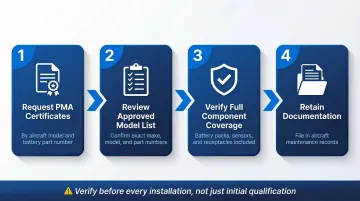
A supplier holding 30+ approvals across turboprops, light jets, midsize jets, and large-cabin aircraft has demonstrably done this work across fleet types similar to yours—not just claimed it.
Part 145 Repair Station Status
Confirm the supplier is an FAA-approved Part 145 repair station, not just a parts reseller. This ensures:
- Battery overhauls carry legally valid FAA Form 8130-3 documentation
- Repair work meets federal regulatory standards
- The facility undergoes regular FAA oversight and inspection
- Technicians hold appropriate certifications
- Quality systems meet 14 CFR Part 145 requirements
Critical clarification: FAA Order 8130.21J explicitly states that Form 8130-3 "does not constitute approval to install the item on a particular aircraft" but helps determine airworthiness approval status. Installation approval comes from PMA coverage, not the 8130-3 tag alone.
Rental Availability and AOG Response
Ask specifically whether the supplier maintains rental batteries for the aircraft types in your fleet. Not all suppliers stock rentals for all aircraft models they theoretically support.
- Which specific aircraft types have rental batteries available?
- What is the rental agreement structure (daily/weekly rates, deposit requirements)?
- Is after-hours AOG support available, and what's the contact number?
- What's the typical response time for AOG situations?
- Are rental batteries located near major charter hubs or at a single facility?
For charter operations where aircraft utilization directly drives revenue, downtime cost should factor heavily into supplier evaluation—not just unit price.
Dual-Chemistry Capability
Mixed fleets rarely run a single battery chemistry. If your supplier only handles NiCd or only handles lead-acid, you're back to managing multiple vendors the moment your fleet expands.
Confirm the supplier covers both chemistries across the full service range:
- NiCd battery service and PMA replacements
- Lead-acid battery service and PMA replacements
- STC-approved chemistry conversion kits
- Temperature sensors for both battery types
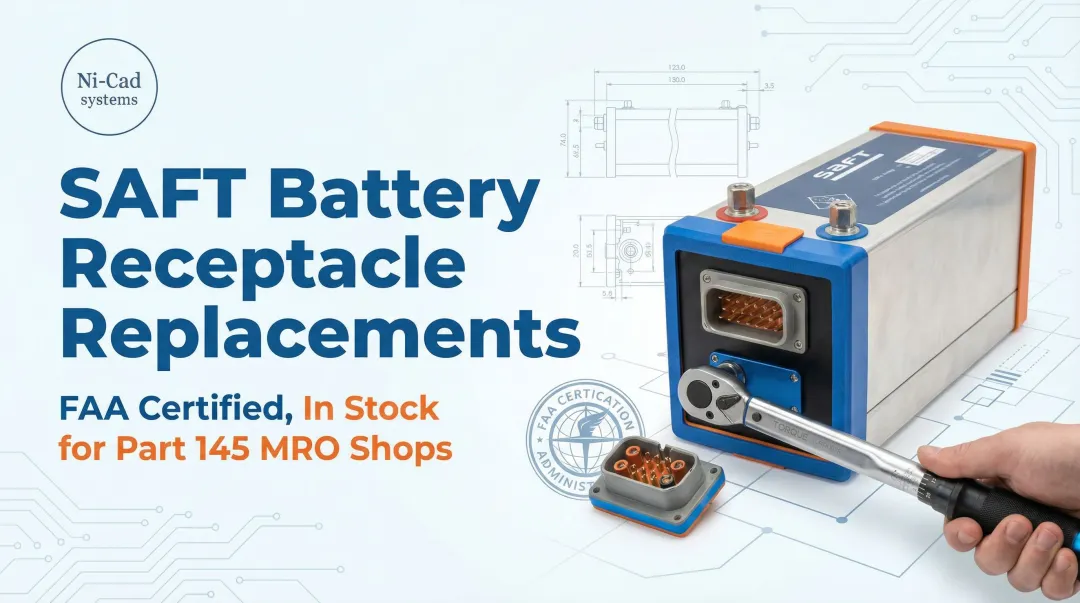
- Receptacles compatible with multiple manufacturers (SAFT, Marathon, Concorde, Gill)
Frequently Asked Questions
Who supplies the batteries for the 787?
Boeing 787 main batteries were originally supplied by GS Yuasa under OEM contract — a lithium-ion chemistry outside the NiCd and lead-acid scope most charter fleets manage. The 2013 battery incidents and subsequent Emergency Airworthiness Directive 2013-02-51 are what drove the FAA to substantially tighten battery certification standards across the industry.
What is FAA-PMA approval and why does it matter for aircraft batteries?
FAA-PMA (Parts Manufacturer Approval) is federal authorization allowing a company to manufacture and sell replacement aviation parts that are legally approved for installation on specific aircraft models. For batteries, PMA means the part has been validated against the original design standard and can be installed without a separate STC or field approval, simplifying compliance and airworthiness sign-off.
Can one supplier really service all the batteries in a mixed charter fleet?
It depends on the breadth of the supplier's PMA portfolio and supported battery chemistries. A supplier holding 30+ FAA-PMAs across both NiCd and lead-acid battery types can realistically cover most mixed turbine fleets. Operators should request a coverage review against their specific aircraft model list before committing to verify complete fleet compatibility.
What happens if an aircraft battery fails while on charter—is AOG support available?
FAA-approved suppliers with rental battery inventories can often provide a loaner unit to return the aircraft to service while the original battery undergoes service. Operators should confirm rental availability for their specific aircraft types and verify the supplier offers 24/7 AOG contact before an incident occurs—downtime costs can reach $150,000+ per day.
How do I verify that a battery supplier's PMA covers my specific aircraft model?
Request the FAA-PMA certificate and associated Approved Model List (AML) for each applicable battery part number. The PMA will specify exact aircraft make, model, and part number covered — retain this documentation in maintenance records and verify it before every installation.
What is the difference between a Part 145 repair station and a regular battery vendor?
A Part 145 repair station is federally authorized to overhaul, test, and return aircraft components to service, issuing FAA Form 8130-3 airworthiness release tags. A non-certified vendor can only sell parts — they cannot legally perform the overhaul work required before reinstallation.
For Part 135 operators running diverse aircraft, a single qualified battery supplier with broad FAA-PMA coverage, dual-chemistry capability, and integrated service operations cuts compliance burden, reduces AOG recovery time, and eliminates the hidden costs of vendor fragmentation.
Ni-Cad Systems has been servicing aircraft batteries since 1974, with over 47,000 units serviced across corporate, airline, and military customers. With 30+ FAA-PMA approvals covering Citation, Falcon, Hawker, Gulfstream, Cessna, and commercial aircraft models, plus rental battery inventory and 24/7 AOG support, they represent the kind of single-source capability that simplifies operations for mixed charter fleets. Contact their technical team at +1 510 785-9391 or 24/7 AOG support at +1 510 501-9391 to request a coverage review for your specific aircraft.