Introduction
Picture this: a supplier quotes you a 100-piece MOQ on a certified battery receptacle, but your annual consumption is 8 units. You can tie up capital in 92 units you won't use for a decade, or leave a compliance gap in your parts catalog. Neither option works.
Battery receptacle replacements illustrate this challenge well. These FAA-certified structural and electrical interfaces rarely fail — yet when they do, a stockout isn't acceptable. OEM pricing structures compound the problem, built around airline consumption volumes that corporate aviation and regional operators will never match.
This guide shows you how to sidestep MOQ risk without sacrificing airworthiness compliance. You'll learn to:
- Identify certified second-source receptacle options with no minimum quantity requirements
- Qualify suppliers using FAA-verifiable criteria
- Structure inventory so you're not locking up capital in parts that sit for years
Key Takeaways
- Battery receptacles must carry FAA-PMA or equivalent airworthiness certification before installation on type-certificated aircraft
- PMA second-source suppliers carry the same regulatory approval as OEMs and typically offer flexible quantity arrangements
- Qualify suppliers by verifying PMA documentation, traceability records, and Part 145 repair authority
- One-unit safety stock paired with rental or exchange programs eliminates AOG exposure without overstocking
Why Battery Receptacle Replacements Create Unique MRO Inventory Challenges
What Battery Receptacles Are and Why They Matter
In aviation maintenance, the battery receptacle is the structural and electrical interface connecting the aircraft battery to the airframe, separate from the battery cell assembly itself. It's tracked as a distinct certified part because it performs a critical electrical function and must meet specific airworthiness standards.
Unlike consumables, receptacles are classified as condition-monitored rotables with defined inspection intervals.
The Low-Turn, High-Stakes Problem
Battery receptacles create an inventory paradox: they fail infrequently but are safety-critical when they do. This makes them difficult to justify in high-MOQ purchases while simultaneously making stockouts unacceptable. According to Oliver Wyman's 2025 Global Fleet and MRO Market Forecast, airlines have increased spares inventory by an average of 8%, with some reporting increases exceeding 15% above historical norms—driving $1.4 billion in excess inventory holding costs across the industry.
The financial burden breaks down to:
- $44,000 annually per narrowbody aircraft
- $69,000 annually per widebody aircraft
For corporate aviation and regional operators working with smaller fleets, these holding costs become even more prohibitive relative to operational budgets.

OEM Pricing Structures Built for Airlines, Not Operators
OEM pricing and MOQ structures for receptacles target high-volume airline customers. A 50-piece minimum makes sense when you're managing 100+ aircraft of the same type with standardized battery systems. It makes zero sense when you operate three corporate jets with annual receptacle consumption of two units.
The result? You either:
- Lock up $15,000–$30,000 in parts that will sit in inventory for 5+ years
- Accept a compliance gap and hope you never face an unscheduled receptacle failure
- Pay expedited freight premiums when failures inevitably occur
The MOQ trap isn't the only structural problem. Obsolescence adds a second layer of risk.
Obsolescence Compounds the Problem
OEMs sometimes discontinue receptacle part numbers when battery models are superseded. Aircraft operators are then left needing a certified replacement pathway even when original parts are no longer available through traditional channels. Aviation makes this especially unforgiving: the FAA has documented the structural gap between commercial technology cycles (2–7 years) and aircraft service lives that routinely exceed 20 years. A receptacle sourced today may have no OEM successor when you need it next decade.
What FAA-PMA Certification Actually Means for Battery Receptacle Parts
The Official Definition
FAA-PMA (Parts Manufacturer Approval) is the FAA's mechanism for approving a non-OEM manufacturer to produce a specific replacement article for a type-certificated aircraft. A PMA part is legally airworthy and interchangeable with its OEM counterpart for the specified aircraft models. It represents a combined design and production approval, meaning the FAA has verified both the engineering and manufacturing processes.
Two Approval Pathways That Matter
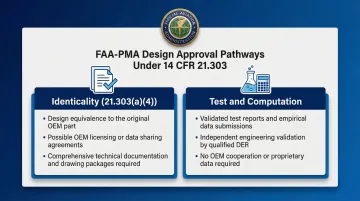
14 CFR 21.303 outlines two primary pathways for PMA design approval:
Identicality (14 CFR 21.303(a)(4)):
- The applicant demonstrates the design is identical to the design of an article covered under a type certificate
- May or may not involve a licensing agreement with the OEM
- Requires comprehensive documentation proving design equivalence
Test and Computation:
- The applicant provides test reports and computations showing the design meets airworthiness requirements
- Independent engineering analysis validates performance standards
- Does not require OEM cooperation or licensing
Both pathways require documented FAA review and auditing. The distinction matters when evaluating supplier documentation: identicality approvals establish design equivalence, while test and computation approvals prove functional equivalence through independent validation.
Required Documentation for Parts Acceptance
Every PMA-approved battery receptacle must come with specific documentation:
- FAA-PMA Tag or Form 8130-3: Identifies airworthiness approval status. FAA Order 8130.21H makes this optional for domestic shipments, but it remains the industry standard for conformity documentation — and is required for export under bilateral agreements
- Part Number Cross-Reference: Shows which OEM part number the PMA part replaces, so maintenance personnel can confirm applicability at receiving
- Aircraft Applicability List: Specifies make, model, and serial number ranges covered by the approval — essential for confirming your specific tail number qualifies
Part 145 Certification Signals Quality Systems
When a supplier holds both PMA manufacturing authority and Part 145 repair station certification, it confirms an FAA-audited quality system that goes beyond basic production approval. Part 145 requires:
- Documented quality control procedures at every stage
- Receiving inspection protocols with traceable recordkeeping
- Maintenance documentation standards that exceed manufacturing requirements alone
How to Evaluate and Qualify a Certified Second-Source Supplier
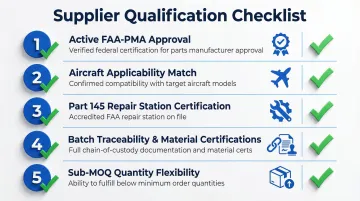
The Five-Point Qualification Checklist
Before adding a PMA battery receptacle supplier to your approved vendor list, verify:
- Active FAA-PMA approval for your specific part numbers – Not just general battery products
- Documented aircraft applicability matching your fleet – Confirm your tail numbers fall within approved serial number ranges
- Part 145 repair station certification (if they also service assemblies) – Indicates FAA-audited quality systems
- Batch traceability and material certifications – Essential for maintenance records and regulatory compliance
- Willingness to supply in sub-MOQ quantities – Without requiring long-term purchase commitments
Verify PMA Approvals Independently
Never rely solely on a supplier's claims. The FAA's Dynamic Regulatory System (DRS) is the official repository for verifying PMA credentials. Cross-check these exact fields before placing a first order:
- PMA Holder Name – Confirms the supplier holds the actual approval
- Part Name & PMA Part Number – Verifies the specific receptacle hardware
- Approved Replacement for Part Number – Validates cross-reference to OEM part
- Make / Model – Confirms aircraft eligibility
- FAA Approval Basis – Indicates Identicality or Test and Computation pathway
This independent verification protects against Suspected Unapproved Parts (SUPs). The FAA actively polices unapproved electrical components, as demonstrated when they issued an emergency cease-and-desist order against Ameri-King for manufacturing and distributing parts that didn't conform to approved designs.
Years in Service and Units-Serviced Data
Once you've confirmed PMA credentials, evaluate how long a supplier has been operating and at what volume. A supplier that has processed tens of thousands of units has real-world data on fit, form, and function that newer entrants cannot match. That track record reveals how parts perform across diverse installation environments and maintenance practices.
Ni-Cad Systems, Inc. is a Part 145 FAA-approved repair facility with 30+ FAA-PMA approvals and over 47,000 units serviced since 1974. It meets all five criteria above for NiCd and lead-acid aircraft batteries and related components.
Technical Support Accessibility
A qualified second-source supplier should answer applicability questions specific to your aircraft model and provide installation guidance—not just ship a box. To assess technical support quality before committing:
- Submit a technical inquiry about a specific aircraft model and serial number
- Evaluate response quality and technical accuracy
- Assess response speed (same day vs. multiple days)
- Verify the responder understands aircraft-specific requirements
Ni-Cad Systems offers 24/7 technical support at +1 510 501-9391 for AOG situations, with standard technical support available at +1 510 785-9391 during business hours. This accessibility ensures you can resolve applicability questions before placing orders and get immediate support during unscheduled maintenance events.
Building a No-MOQ-Risk Inventory Strategy for Low-Turn Certified Parts
The Min/Max Model Adapted for Certified Parts
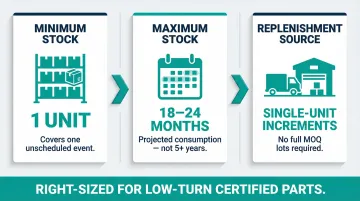
Standard min/max models assume predictable consumption and steady replenishment. Low-turn certified parts don't fit that mold, so the parameters need to shift:
- Minimum stock: One unit — enough to cover one unscheduled maintenance event
- Maximum stock: 18–24 months of projected consumption, not 5+ years
- Replenishment source: Suppliers who ship in single-unit increments, not full MOQ lots
When your annual consumption is 2–3 receptacles, carrying one unit on the shelf and sourcing from a supplier who ships singles eliminates any reason to purchase 50-piece minimums.
Consignment and Stock-on-Demand Arrangements
Some second-source PMA suppliers offer consignment or "stock-on-demand" arrangements where:
- The supplier holds bonded inventory at their facility
- You maintain contractual access to parts without purchasing upfront
- You only pay when you pull from inventory
- The supplier manages obsolescence risk and capital investment
IATA's MRO SmartHub platform actively supports consignment strategies with dedicated modules for handling consignment projects with full traceability. Satair notes that vendor-managed inventory (VMI) is widely implemented with service parts and MRO supplies.
These arrangements work especially well for parts with unpredictable failure intervals — you get guaranteed access without the cash outlay.
Fleet Standardization Creates Internal MOQ
When you operate multiple aircraft with the same battery system, pooled demand can justify slightly larger purchases without overstocking. Three aircraft each consuming one receptacle every two years produces an effective annual demand of 1.5 units. A coordinated three-unit order may qualify for volume pricing, and you still clear inventory within a reasonable window.
Calculate pooled demand across:
- All tail numbers using the same battery receptacle part number
- Sister aircraft in your fleet with interchangeable components
- Partner operators willing to coordinate procurement
Rental Programs as AOG Buffer
Small-quantity stock covers planned consumption. A rental program covers the gap when a receptacle fails unexpectedly. The sequence is straightforward:
- Install a rental battery assembly to restore aircraft to service immediately
- Order the certified receptacle replacement (single unit)
- Install the PMA receptacle when it arrives
- Return the rental assembly
Ni-Cad Systems maintains a rental battery program specifically designed to keep operators flying while certified replacement parts are sourced or installed, with immediate AOG support available 24/7.
Documentation and Traceability Requirements for PMA Battery Parts
Receiving Inspection Process
When a PMA battery receptacle enters your MRO inventory, conduct a structured receiving inspection:
Step 1: Verify Documentation
- Confirm FAA Form 8130-3 or PMA approval tag is present
- Validate part number cross-reference to OEM part
- Check aircraft applicability list includes your tail numbers
Step 2: Log Traceability Data
- Record batch or lot number in your parts management system
- Photograph documentation for digital records
- File physical documentation in a way that travels with the part
Step 3: Physical Inspection
- Verify permanent part marking per 14 CFR 45.15 (PMA holder name, part number, "FAA-PMA")
- Check for shipping damage or packaging defects
- Confirm quantity and configuration match purchase order
CMMS Flagging for PMA Parts
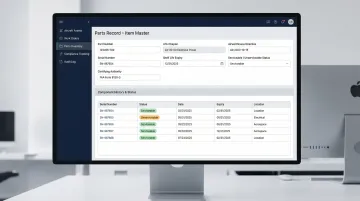
Configure your computerized maintenance management system (CMMS) or parts management system to flag PMA parts as requiring specific documentation review at receiving. This prevents an uncertified or improperly documented part from reaching the maintenance bench.
Recommended CMMS fields for PMA parts:
- PMA approval number issued by the FAA
- OEM part number this PMA part replaces
- Aircraft applicability by make, model, and serial number range
- Batch/lot number for shelf-life and recall traceability
- Form 8130-3 number, if one was issued with the shipment
- Supplier name and PMA holder name, when they differ
Installation Recordkeeping
When installing a PMA battery receptacle, 14 CFR 43.9 requires a maintenance record entry that includes:
- Description of work performed
- Date work was completed
- PMA part number and approval basis
- Signature and certificate number of person approving return to service
No separate STC is required. Per 14 CFR 21.113, an STC applies only to a "major change in type design" — PMA parts are approved replacements that carry their own FAA authorization.
AOG Scenarios Require Speed and Documentation
In an AOG event, documentation requirements don't disappear — they just have to move faster. A supplier who ships a single unit same-day with a complete Form 8130-3 package beats a lower-cost option with a 5-business-day lead time and a 25-piece MOQ every time.
Critical AOG supplier capabilities:
- Same-day shipping for in-stock items
- Ships with full documentation (Form 8130-3 and traceability records included)
- Technical support to confirm applicability before shipment
- Rental or loaner options to restore aircraft to service immediately
According to an Aviation Week/Naveo survey, 94% of aftermarket executives cite long OEM lead times as at least moderately important in driving their shift to PMA alternatives, with 50% labeling it as "very important." In those moments, a supplier already holding single-unit stock with airworthiness paperwork ready to ship is the one you'll call back.
Frequently Asked Questions
What is an FAA-PMA approved battery receptacle replacement?
An FAA-PMA approved battery receptacle replacement is a non-OEM part that the FAA has specifically approved for production and installation on type-certificated aircraft. It is legally airworthy and interchangeable with the original manufacturer's part for all aircraft listed in the PMA's applicability documentation.
Do PMA-approved battery receptacle parts require additional airworthiness documentation at installation?
The part must be accompanied by FAA Form 8130-3 or a PMA approval tag. The installing mechanic should record the PMA part number and approval basis in the aircraft maintenance records per 14 CFR 43.9. No separate STC is required for an approved PMA part.
How is a battery receptacle classified in an MRO inventory system—as a consumable or a rotable?
Battery receptacles are typically classified as life-limited or condition-monitored rotables rather than consumables. They are tracked individually, have defined inspection intervals, and may be repaired rather than automatically discarded at each removal, unlike expendable consumables.
Can PMA-approved battery receptacles be used interchangeably with OEM parts without an additional STC?
Yes. A properly issued FAA-PMA approval already establishes interchangeability with the specified OEM part number for the listed aircraft—no separate STC is needed. However, operators must verify the applicability list covers their specific aircraft model and serial number range before installation.
How can operators manage lead time risk for certified battery receptacle parts without overstocking?
Three practices cover most scenarios:
- Keep one-unit safety stock on hand for routine failures
- Source from a qualified second-source supplier able to ship single units with full documentation
- Use a rental or loaner program as an AOG buffer when timing is critical
Together, these eliminate excess inventory without leaving you exposed when a part fails.