Introduction
An unapproved or counterfeit aviation battery is an airworthiness risk — one that can ground an aircraft or, worse, go undetected until it fails in service. The aviation parts market includes both legitimate FAA-PMA approved second-source batteries and look-alike parts that lack proper certification.
Under 14 CFR Part 21, Subpart K, the FAA defines a Parts Manufacturer Approval (PMA) as a combined design and production approval. It authorizes a manufacturer to produce replacement articles for specific type-certificated aircraft.
This article walks through how to verify FAA-PMA status before purchase, what valid documentation looks like, and the red flags that signal an unapproved part — so maintenance technicians, fleet managers, and operators can make the call before a part ever reaches the aircraft.
Key Takeaways
- FAA-PMA approval authorizes a manufacturer to produce replacement battery parts for specific type-certificated aircraft
- Verify approval three ways: search the FAA's DRS database, inspect physical labeling, or request trace documentation
- Valid PMA labels must show manufacturer name, part number, "FAA-PMA" marking, and aircraft eligibility
- Walk away if eligibility data is missing, assurances are verbal-only, or part numbers don't appear in FAA records
- Contact the manufacturer directly or consult a Part 145 repair station if anything is unclear
What FAA-PMA Certification Actually Means for an Aviation Battery
FAA-PMA (Parts Manufacturer Approval) is a formal FAA authorization under 14 CFR § 21.303 allowing a company to produce and sell a specific replacement or modification part for installation on a type-certificated aircraft. The approval covers both the design and the production process—not just the part itself. Applicants must provide design data, test reports, computations, and identify the specific aircraft products on which the article will be installed.
PMA vs. Similar Approvals
Understanding the difference between FAA-PMA and similar-sounding approvals is critical:
- PMA (Parts Manufacturer Approval): Combined design and production approval for replacement articles, with installation authority for specific aircraft listed in the approval
- TSO (Technical Standard Order): Approves design and production to a minimum performance standard, but does not authorize installation on a specific aircraft by itself
- TC/PC (Type Certificate/Production Certificate): Original design approval from the aircraft manufacturer; establishes baseline approved design
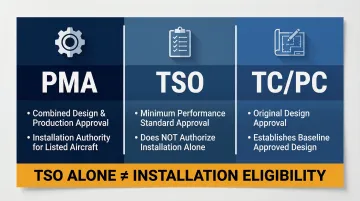
Critical point: A TSO marking alone does not confer installation eligibility. FAA Advisory Circular 21-40A explicitly states that TSO articles require separate approval for installation.
That distinction matters when you're tracing approval lineage on a battery purchase. PMA holders must demonstrate full compliance with applicable airworthiness standards — design data, test reports, and production controls — before the FAA grants approval. A company like Ni-Cad Systems, which holds 30+ individual FAA-PMA approvals and operates as a Part 145 repair facility, has gone through that process for each specific part number. Knowing what that process requires makes it easier to spot suppliers who haven't.
What You Need Before You Start Verification
Before verifying PMA status, gather these essential items:
Required Information:
- Exact manufacturer part number (printed on the battery or in the component maintenance manual)
- Aircraft make/model/series for eligibility confirmation
- Internet access or phone to contact the FAA or manufacturer
With those items in hand, two things need to be confirmed before you run any database lookup: whether the PMA covers your aircraft type, and whether your part number matches the approved article.
Understanding Aircraft Eligibility
A PMA is not a blanket approval. 14 CFR § 21.303 requires applicants to identify the specific aircraft on which the article may be installed — so a battery approved for a Cessna Citation 550 is not automatically approved for a Citation 560.
Locating the Original Part Number
Find the approved part number in:
- Aircraft component maintenance manual
- Type Certificate Data Sheet (TCDS)
- Existing battery's data plate
The part number from one of these sources is what you'll enter into the FAA's PMA database — a mismatched number will return no results, even if a valid approval exists under a related designation.
How to Verify FAA-PMA Certification: Three Practical Methods
Verification should never rely on a single source. Use at least two of the three methods below to cross-confirm approval status before committing to a purchase.
Method 1: Search the FAA DRS Database
The FAA's Dynamic Regulatory System (DRS) is the authoritative public database of all active PMA approvals, replacing the legacy RGL system. It is searchable by PMA holder name, part number, or aircraft eligibility.
Step-by-Step Process:
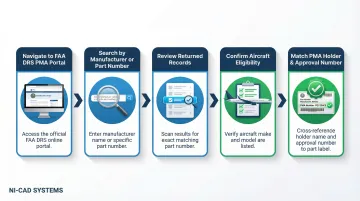
- Navigate to the FAA DRS PMA portal
- Search by battery manufacturer name or specific part number from the label
- Review returned records for the exact part number
- Confirm the entry lists your aircraft make and model as eligible
- Note the PMA holder's name and approval number—these must match the physical battery label exactly
Key Fields to Verify:
| DRS Field | Verification Action |
|---|---|
| PMA Holder Name | Must match physical part marking and shipping documentation |
| PMA Part Number | Ensure exact alphanumeric match with battery label |
| Approved Replacement for Part Number | Cross-reference with aircraft's Illustrated Parts Catalog |
| Make/Model | Verify your exact aircraft model is listed |
Pros: Most authoritative method—goes directly to FAA records.
Cons: Requires exact part number formatting; slight variations can cause missed results. If you cannot locate the desired PMA data, contact the FAA Certificate Management Branch in the geographical area of the PMA holder.
Method 2: Inspect the Physical Battery Label and Packaging
Every FAA-PMA approved part must be physically marked per 14 CFR § 45.15. For batteries, this means specific required markings on the battery case or data plate.
Step-by-Step Process:
- Locate the data plate or permanent label on the battery housing
- Confirm it includes three elements: manufacturer's name, part number, and the explicit marking "FAA-PMA"
- Check packaging and paperwork for an aircraft eligibility statement listing approved make/model/series
- Inspect for FAA Form 8130-3 (Airworthiness Approval Tag) if the battery comes from a distributor or repair station
Pros: Fast and requires no internet access.
Cons: Cannot catch counterfeit labels that visually replicate legitimate markings. Must always be used alongside Method 1 or Method 3.
Method 3: Request Trace Documentation and Contact the PMA Holder
For any battery purchase, especially through a distributor or broker, request full traceability paperwork. AC 20-154A warns that a generic "Certificate of Compliance" stating traceability is available upon request does not establish traceability to the Production Approval Holder (PAH).
Step-by-Step Process:
Request documentation:
- Manufacturer's Certificate of Conformance (C of C) stating the part was produced in conformance with the approved PMA design
- Purchase order records or shipping documentation from the PMA holder
- FAA Form 8130-3 with Block 12 remarks identifying the PAH
Contact the PMA holder directly:
- Call or email with the part number
- Ask them to confirm the approval is current and the specific part number is covered under their PMA
- Clarify specific aircraft eligibility
Verify repair station certificates:
- For batteries sourced through a Part 145 repair station, verify the certificate number at the FAA repair station database
Ni-Cad Systems holds 30+ individual FAA-PMA approvals and can confirm approval status, part number coverage, and aircraft eligibility directly. Reach their technical support team at +1 510 785-9391, or +1 510 501-9391 for 24/7 AOG support.
Acceptable Traceability Documents:
- Shipping tickets from PAH
- Invoices showing PAH as source
- Parts markings (PMA, TSOA)
- Maintenance records
- FAA Form 8130-3
Pros: Most thorough method, especially for parts purchased through secondary channels.
Cons: Time-intensive — direct manufacturer contact and documentation review can take additional days. For AOG situations, Methods 1 and 2 together give you a working answer in under 30 minutes.
How to Interpret What You Find
Each verification result falls into one of four categories. Here's what each outcome means and what to do next:
Valid/Approved
Indicators:
- FAA database shows active PMA for exact part number
- Physical label carries "FAA-PMA" marking with matching manufacturer name
- Aircraft eligibility covers your specific aircraft
- Certificate of Conformance from manufacturer is present
Action: The battery may be purchased and installed per the manufacturer's installation instructions and applicable maintenance manual.
Partial or Ambiguous
Indicators:
- Part number in database differs slightly from label (suffix variation)
- Aircraft eligibility list is unclear for your specific series
- Seller cannot produce Certificate of Conformance
- Documentation shows only distributor, not original PMA holder
Action: Do not install. Contact the FAA-PMA holder directly to resolve the discrepancy before proceeding. Do not accept the seller's verbal assurance as sufficient.
Not Found/Invalid
Indicators:
- No FAA database record exists for the part number and manufacturer combination
- Label lacks "FAA-PMA" marking
- Seller refuses to provide documentation
- Part number does not match any current PMA record
Action: Reject the part. Installing a non-PMA approved battery on a type-certificated aircraft violates 14 CFR and renders the aircraft unairworthy. Report suspected counterfeit or unapproved parts to the FAA through the Suspected Unapproved Parts (SUP) program using FAA Form 8120-11.
Note on TSO-Only Batteries
Some batteries carry a TSO marking but no PMA. A TSO authorization covers the article's design to a minimum performance standard — it does not, by itself, authorize installation on a specific aircraft. Installation eligibility must still be established through PMA, TC, or other approval.
Do not accept "it has a TSO" as a substitute for PMA verification.
Common Mistakes to Avoid When Verifying PMA Status
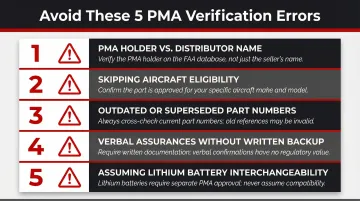
Even buyers who know to check the FAA database make avoidable errors during verification. These five mistakes are the most common—and the most likely to result in a non-airworthy installation.
PMA holder vs. distributor name — The "FAA-PMA" marking must reference the actual manufacturer holding the approval, not a reseller. Always trace documentation back to the original PMA holder, not just the seller listed on the invoice.
Skipping aircraft eligibility — Confirming a part number exists in the FAA database isn't enough. Verify your specific aircraft model appears in the eligibility section. Approval for one series within a manufacturer's product line does not carry over automatically to another.
Outdated or superseded part numbers — PMA approvals can be amended, and old part numbers may no longer be active. For example, Ni-Cad Systems part number NCS804750 supersedes earlier numbers 20 VRED and 804750; using outdated documentation against these numbers causes unnecessary confusion. Always confirm the number on the unit matches a currently active record.
Verbal assurances without written backup — Never accept a seller's claim that a battery is "FAA approved" without written documentation and independent verification through the FAA database.
Assuming lithium batteries are interchangeable — PMA lithium batteries must meet specific standards in AC 20-184, which references RTCA DO-311/DO-311A for rechargeable types and DO-227A for non-rechargeable. Confirm compliance documentation before accepting any lithium unit.
Frequently Asked Questions
What is the difference between an FAA-PMA battery and an OEM battery?
An OEM battery is produced by the original equipment manufacturer under a type or production certificate, while an FAA-PMA battery is produced by a different manufacturer who has obtained FAA approval to produce a functionally equivalent replacement part. Both are legally airworthy when properly approved and installed on eligible aircraft.
How do I find FAA-PMA approvals for aviation batteries online?
Navigate to the FAA Dynamic Regulatory System (DRS) PMA portal and search by manufacturer name or part number. The search result must show the specific aircraft models for which the part is eligible.
Can PMA battery cells be mixed with OEM cells in the same battery?
Intermixing OEM and PMA-approved cells is FAA-sanctioned as safe, provided each cell carries individual FAA approval and the installation falls within the applicable PMA's parameters.
What documentation should I ask for when buying a PMA aviation battery?
Request the manufacturer's Certificate of Conformance, verify the "FAA-PMA" marking on the battery label, obtain the aircraft eligibility statement, and—where applicable—request an FAA Form 8130-3 Airworthiness Approval Tag for traceability.
Can I fly with an expired ELT battery?
No. 14 CFR § 91.207(c) mandates ELT battery replacement after one cumulative hour of use or when 50 percent of useful life has expired. The new replacement battery must be an approved part for that ELT model.
What should I do if I discover a battery installed on my aircraft has no valid FAA-PMA?
Remove the battery before further flight, document the discrepancy in the aircraft maintenance records, and report the unapproved part via the FAA Suspected Unapproved Parts (SUP) program. Then have an authorized technician source and install a replacement battery with confirmed PMA approval for your aircraft.
Need expert assistance verifying FAA-PMA battery approvals? Ni-Cad Systems operates as a Part 145 FAA-approved repair facility with 30+ FAA-PMA approvals and over 50 years of aircraft battery experience. Contact their technical support team at +1 510 785-9391 or their 24/7 AOG hotline at +1 510 501-9391 for immediate verification assistance and expert guidance on battery eligibility for your specific aircraft.