The battery itself wasn't the problem. The sourcing chain was.
For Falcon 50, 900, and 2000 operators, emergency and backup batteries aren't commodity parts you can grab from any distributor. They're safety-critical components with specific OEM specifications and strict FAA compliance requirements. One wrong sourcing decision can mean extended downtime, an airworthiness violation, or—in the worst case—an uncertified failure point during an in-flight emergency.
This post covers what these batteries actually do, why FAA-PMA certification is non-negotiable, how second-source options work, and who to call when you need a certified, experienced supplier who won't leave you grounded.
Key Takeaways
- Falcon emergency and backup batteries power critical safety systems — FAA intervals require service every 3 months or 100 flight hours
- Only FAA-PMA approved suppliers can legally provide replacement batteries for your specific Falcon airframe
- Second-source PMA batteries cut costs 30–70% while maintaining full airworthiness compliance
- Verify suppliers hold Part 145 certification, PMA approvals for your exact model, and offer fast-turn or rental options
- Ni-Cad Systems holds 30+ FAA-PMA approvals and has serviced 47,000+ aircraft batteries since 1974
The Critical Role of Emergency and Backup Batteries on Falcon 50, 900, and 2000 Jets
Emergency batteries on Falcon aircraft aren't just backup power—they're the last line of defense when everything else fails. During a complete main bus failure, these batteries keep critical systems running:
- Emergency lighting
- Fire suppression systems
- Flight control computers
- Cockpit instrument displays
If primary electrical generation is lost at altitude, those systems are the only thing standing between the crew and a catastrophic outcome.
Backup (standby) batteries serve a different function. They support essential avionics and cockpit instruments during engine start sequences and transition phases, or when main generation is temporarily interrupted. Different load profiles mean different service requirements and inspection intervals compared to emergency batteries.
The service cycle these batteries endure is punishing. According to FAA AC 00-33A, NiCd batteries undergo temporary capacity loss during normal duty cycles and require periodic reconditioning. For Falcon jets in corporate or charter operations, that means capacity checks and service every 3 months or 100 flight hours—maintenance departments are managing these components constantly, under real time pressure.
When an emergency battery doesn't deliver rated capacity on demand, it may not sustain the systems it's designed to support long enough for a safe landing. Under 14 CFR 25.1353, batteries must maintain safe cell temperatures and pressures under any probable charging or discharging condition—and that compliance must be documented.
The most common maintenance error? Batteries left idle, deep discharged, or replaced without verifying the replacement part's compliance with the aircraft's type certificate data sheet (TCDS). That's why the FAA certification status of your battery supplier—and the PMA approvals behind every replacement part—aren't administrative details. They're airworthiness requirements.
Understanding the Difference: Emergency Batteries vs. Backup Batteries in Falcon Aircraft
While operators often use the terms interchangeably, emergency batteries and backup batteries serve distinct functions in Falcon 50, 900, and 2000 systems. Each has its own part number, capacity requirement, and inspection interval under the Aircraft Maintenance Manual (AMM).
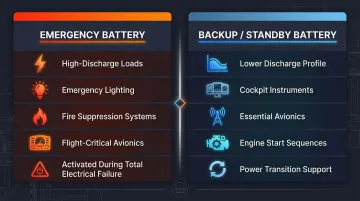
The two types differ in both design and duty:
- Emergency batteries handle high-discharge loads — lighting, fire systems, and flight-critical avionics during total electrical failure
- Backup batteries support cockpit instruments and essential avionics during engine start and power transitions, with lower discharge profiles and different cycling requirements
Falcon 50, 900, and 2000 series aircraft use NiCd (nickel-cadmium) chemistry for both applications. NiCd batteries deliver high current rapidly, hold performance across extreme temperature ranges (critical in unpressurized battery compartments), and offer long cycle life when properly maintained.
Not all battery shops can service them correctly. Deep-cycle reconditioning requires specialized equipment and NiCd-specific chemistry knowledge that general repair facilities don't carry.
Maintenance teams should always reference the specific AMM chapter for their Falcon variant when confirming battery type, service interval, and acceptable replacement part numbers. Ni-Cad Systems holds 30+ FAA-PMA approvals and operates as a Part 145 certified repair facility — meaning they can cross-reference part numbers, verify compliance, and supply tested second-source replacements from a single source.
Why FAA-PMA Certification Is Non-Negotiable for Falcon Battery Sourcing
What FAA-PMA Actually Means
A Parts Manufacturer Approval (PMA) is the FAA's approval for a manufacturer to produce and sell a replacement part for a specific aircraft make, model, and series. Governed by 14 CFR Part 21 Subpart K, PMA allows manufacturers to produce replacement parts for type-certificated aircraft—but only after demonstrating that the part's design complies with airworthiness requirements through rigorous testing and FAA review.
Without PMA approval, a battery cannot legally be installed as a replacement on a certificated aircraft in U.S. registry.
PMA Approval Holder vs. OEM-Authorized Distributor
There's a critical difference between buying from an OEM-authorized distributor and buying from a PMA approval holder. A PMA holder has independently demonstrated to the FAA that their part meets the airworthiness standards of the original—through engineering analysis, physical testing, or identicality demonstration. That design and manufacturing accountability stays with the approval holder — not the distributor.
According to FAA Order 8110.42D, PMA approvals are strictly model-specific. A PMA for a Falcon 50 battery does not automatically cover a Falcon 900 or 2000 battery unless those specific models are explicitly listed on the manufacturer's FAA-approved eligibility list.
Installing a battery without verifying exact model eligibility constitutes an unapproved parts violation.
The Compliance Risk of Non-PMA Parts
Installing a non-approved replacement battery on a Falcon 50, 900, or 2000 can:
- Render the aircraft unairworthy
- Expose the operator to FAA enforcement action
- Create an uncertified safety-critical failure point
The FAA actively polices this through the Suspected Unapproved Parts (SUP) program. FAA Unapproved Parts Notification 96-186 documented a case where improperly repaired NiCd battery cells caused "leaking battery cells, internal plate trimming, high internal resistance, and low cell capacity"—conditions that "may lead to uncontrollable thermal runaway of a battery."
The Part 145 Repair Station Requirement
A Part 145 certified repair station is approved to service, test, and return aircraft batteries to service with FAA Form 8130-3 (Authorized Release Certificate). This documentation establishes a verified, traceable maintenance record for the battery.
According to FAA Order 8130.21H, issuing Form 8130-3 is technically optional for domestic return-to-service — but the FAA strongly recommends it for complete traceability.
For international operations, it's mandatory. EASA and other authorities require dual-release 8130-3 forms from Part 145 facilities.
What to Ask Any Potential Supplier
Before you buy or send a battery out for service, ask:
- Do you hold PMA approval for Falcon 50, 900, and 2000 battery part numbers specifically?
- Are you a Part 145 approved repair station?
- Can you provide 8130-3 documentation with every battery?
- What is your eligibility list for my exact aircraft model?
If the answers are unclear or the supplier can't produce specific eligibility documentation, treat that as a disqualifying compliance risk. Ni-Cad Systems holds PMA approvals specifically covering Falcon 50, 900, and 2000 battery part numbers and operates as an FAA Part 145 certified repair station — with 8130-3 documentation provided on every unit.
The Advantage of FAA-PMA Second-Source Batteries for Falcon Operators
What "Second-Source" Actually Means
A second-source battery is an FAA-PMA approved battery manufactured by a company other than the original OEM, designed and tested to meet or exceed the original part's performance specifications. It is a legal, airworthy alternative—not a knock-off, not a grey-market part.
PMA approval requires manufacturers to demonstrate equivalency to the OEM part through engineering analysis and/or testing reviewed by the FAA. The approval is model-specific, which is why the number of distinct PMA approvals a supplier holds matters.
Cost and Availability Benefits
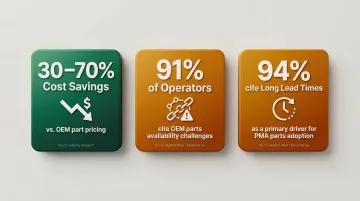
According to industry research, FAA-PMA parts routinely offer 30% to 70% cost savings compared to OEM equivalents. For aging Falcon 50 fleets where OEM support may be diminishing, this isn't just about saving money—it's about parts availability.
An Aviation Week/Naveo survey found that 91% of operators cite challenges getting OEM parts, and 94% cite long lead times as primary drivers for adopting PMA alternatives. When your Falcon is grounded and the OEM battery has a six-week lead time, a second-source PMA battery that ships tomorrow isn't just cost-effective—it's operationally essential.
PMA Quality Standards: What the FAA Actually Requires
PMA approval isn't a rubber stamp. The FAA requires manufacturers to prove their part meets the same airworthiness standards as the original through:
- Detailed engineering analysis
- Physical testing (capacity, discharge rates, thermal performance)
- Manufacturing process controls
- Ongoing quality oversight
A PMA battery approved for a Falcon 900 has been tested and certified to the same standards as the OEM part. The only difference is the manufacturer's name on the label—and often, the price tag.
The Single-Source Accountability Advantage
Having a supplier who both holds PMA approvals and operates a Part 145 repair station means the same organization can sell you a compliant second-source replacement and service your existing battery. That consolidation matters: one set of documentation, one point of contact, and no ambiguity about responsibility if a question arises.
What Makes Ni-Cad Systems the Go-To Supplier for Falcon 50, 900, and 2000 Batteries
Ni-Cad Systems isn't a general MRO with a battery shop tucked in the back. It's a specialized, FAA-approved battery supplier with over 50 years focused exclusively on aircraft batteries—NiCd and lead-acid battery expertise built from day one in 1974.
That specialization runs deep. Stephen Andrues, VP/GM, holds 30+ FAA-PMA approvals, brings 40 years of NiCd aircraft battery experience, and carries credentials as an FAA Designated Engineering Representative (DER), A&P mechanic, and pilot. The person who signs off on the PMAs also knows what it takes to keep an aircraft flying.
Specific Falcon Coverage
Ni-Cad Systems holds FAA-PMA approvals covering emergency and backup battery applications for the Falcon 50, 900, and 2000 series. Operators can source compliant, second-source replacements or have their existing batteries serviced and returned with full Part 145 documentation—all from one supplier.
Specific products include:
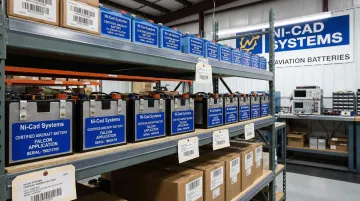
- NCS804750 — replaces SAFT 20 VRED and 804750 for Falcon 900, 900EX, 2000, and 2000EX
- SAFT battery inserts covering part numbers 135687, 783543, and 785229
- Emergency power supply replacements for Falcon 50, 900, and 2000 systems
- Temperature sensors and modification kits for battery system upgrades
The Fast-Turn and AOG Advantage
When an AOG event costs $50,000 to $150,000+ per day, parts availability matters more than unit price. Ni-Cad Systems offers rental batteries to keep aircraft operational while batteries are in service, plus immediate AOG support via the 24/7 technical line at +1 510 501 9391.
With 47,000+ units serviced since 1974 (including NiCd, lead-acid, and emergency power supplies), the team has the depth and inventory to move fast without cutting corners. For flight departments on tight schedules, that combination of rental coverage and same-day AOG response means a battery issue doesn't ground the aircraft.
Frequently Asked Questions
What is the difference between an emergency battery and a backup battery on a Falcon jet?
Emergency batteries power safety-critical systems like lighting, fire suppression, and flight controls during total electrical failure. Backup/standby batteries support essential avionics and cockpit instruments during start sequences or power interruptions. They have different part numbers, capacities, and service intervals in the Falcon AMM.
What does FAA-PMA approval mean for an aircraft battery?
FAA-PMA (Parts Manufacturer Approval) means the FAA has approved a specific manufacturer to produce that replacement part for a specific aircraft model, verifying the part meets airworthiness standards. It is required for any replacement battery to be legally installed on a U.S.-registered certificated aircraft.
Can I use a second-source battery instead of the OEM battery on my Falcon 50, 900, or 2000?
Yes, as long as the replacement battery carries FAA-PMA approval for your specific Falcon model and application. A properly approved second-source battery is fully airworthy, legally installable, and typically 30–70% less expensive than OEM pricing with better parts availability.
How often do emergency and backup batteries on Falcon jets need to be serviced?
Service intervals vary by aircraft variant and utilization, but NiCd aircraft batteries typically require capacity checks and service every 3 months or 100 flight hours. Operators should reference the specific AMM chapter for their Falcon model and track service dates carefully to maintain compliance.
What documentation should I expect when my Falcon battery is returned from a Part 145 repair station?
Expect an FAA Form 8130-3 (Authorized Release Certificate) confirming the battery was inspected, tested, and returned to airworthy condition per applicable maintenance data. International operations may also require dual-release documentation.
Does Ni-Cad Systems offer rental batteries for Falcon operators to avoid AOG situations?
Yes. Ni-Cad Systems provides rental batteries to keep your aircraft operational while your unit is in service. For AOG support, email Sales@NiCadSystems.com, call +1 510 785 9391 (business hours), or +1 510 501 9391 (24/7).