This article explains why FAA-PMA certification matters for the SAAB 3340D battery, what fleet operators must verify before procurement, and how Ni-Cad Systems' in-stock, FAA-approved solution addresses the problem directly.
Key Takeaways
- The SAAB 3340D is a nickel-cadmium battery for SAAB 340 turboprops, requiring strict FAA airworthiness compliance before installation
- FAA-PMA approved replacements are legally equivalent to OEM parts, cutting procurement delays and cost
- Battery sourcing delays represent a real AOG risk—in-stock availability is critical for regional operators
- Ni-Cad Systems stocks SAAB 3340D replacements ready for immediate shipment
- 30+ FAA-PMA approvals and a Part 145 certified repair facility back every unit
The SAAB 340 Battery Sourcing Problem Regional Operators Know Too Well
The SAAB 340 Battery Sourcing Problem Regional Operators Know Too Well
The Operational Reality
Approximately 160 SAAB 340 aircraft remain in active commercial service globally, operating with regional airlines, charter operators, and cargo carriers including Ameriflight, Pacific Coastal, and Cayman Airways. While the platform delivers reliable regional connectivity, its aging profile creates severe supply chain vulnerabilities.
The Core Sourcing Challenge
As aircraft age beyond primary OEM support cycles, sourcing compliant replacement parts—especially batteries—becomes slower, more expensive, and increasingly dependent on secondary suppliers who may lack proper FAA approvals. 80% of MRO industry respondents cite piece-part availability as the top issue causing increased turnaround times, fundamentally altering regional aircraft maintenance economics.
The AOG Risk Dimension
When a battery fails inspection or reaches end-of-life, it cannot legally return to service without a certified replacement. The financial impact is immediate:
Estimated AOG Event Costs:
- 1 Day: $50,000–$150,000 (lost revenue, passenger compensation, expedited shipping)
- 2-3 Days: $150,000–$600,000 (schedule disruptions, crew displacement, replacement aircraft leasing)
- 3+ Days: $600,000–$2,000,000+ (reputational damage, network capacity constraints)
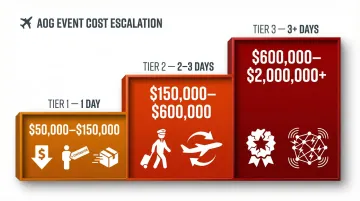
For a regional operator running thin margins on short-haul routes, even the low end of that range can wipe out weeks of operating profit.
The Compliance Trap
When legacy parts are hard to find, some operators source outside approved channels — a shortcut that creates significant compliance and safety exposure. Under 14 CFR 21.9, it is illegal to produce or represent a replacement article as suitable for a type-certificated product without FAA approval.
The FAA actively prosecutes Suspected Unapproved Parts (SUP) violations, with civil penalties reaching six figures. In 2019, the FAA proposed a $203,100 civil penalty against GEE-BEE Aeroproducts for manufacturing unapproved seals. Installing a non-approved battery can result in:
- Airworthiness certificate issues
- FAA enforcement exposure
- Insurance complications
- Certificate action against maintenance personnel
The Regional Carrier Disadvantage
These compliance risks hit regional carriers hardest. Unlike major airlines with dedicated procurement teams and OEM relationships, smaller operators typically rely on spot-market sourcing — which means longer lead times, less vetting, and higher exposure to both supply disruptions and unapproved parts.
What Is the SAAB 3340D Battery and Why It's Critical to Aircraft Operations
Technical Description
The SAAB 3340D is a nickel-cadmium (NiCd) aircraft battery designed for the SAAB 340 turboprop, which operates under Type Certificate Data Sheet (TCDS) A52EU. NiCd chemistry remains the standard for this platform because of its reliable cold-cranking output, tolerance for deep discharge cycles, and stable performance across the altitude and temperature ranges the SAAB 340 routinely operates in.
Primary Functions:
- Engine starting power
- Emergency backup power for essential systems
- APU (Auxiliary Power Unit) support
- Standby power during electrical system failures
NiCd-Specific Maintenance Requirements
NiCd batteries demand specialized maintenance protocols that make replacement quality operationally significant:
Critical Maintenance Procedures:
- FAA Advisory Circular 43.13-2B mandates discharge testing at the C1 rate — batteries are airworthy only at ≥80% rated capacity (85% recommended)
- Monitor for deep discharge events to prevent irreversible cell damage and shortened service life
- Perform cell equalization regularly to maintain balanced output across all cells
- Follow strict charging temperature limits: AC 43.13-1B warns improper charging can trigger thermal runaway, chemical fires, or explosions above 160°F
The Storage Degradation Threat
EASA Safety Information Bulletin 2020-18 warns that disconnected NiCd batteries self-discharge during parking or storage, causing progressive capacity loss that standard aircraft charging systems cannot reverse — and that ground crews cannot detect without professional capacity testing.
This is why replacement battery quality matters as much as maintenance discipline. A battery that has degraded in storage and hasn't been properly tested before installation is an undetected liability.
Key Specification Parameters
When evaluating any SAAB 3340D replacement battery, maintenance teams must verify:
- Voltage rating: Matches aircraft electrical system requirements
- Amp-hour (Ah) capacity: Meets or exceeds OEM specifications
- Physical dimensions/form factor: Ensures proper fit in battery compartment
- Terminal configuration: Compatible with aircraft wiring harness
- TSO/PMA documentation: Confirms FAA airworthiness approval
For detailed specifications on Ni-Cad Systems' SAAB 3340D replacement, contact the technical team at +1 510 785-9391.
FAA-PMA Certification: What It Means and Why It's Non-Negotiable
Understanding FAA-PMA
Parts Manufacturer Approval (PMA) is the FAA's combined design and production authorization for a manufacturer to produce and sell a specific replacement part that meets the airworthiness standards of the original design.
Under FAR 43 and FAR 21, only approved parts may be installed on type-certificated aircraft. A PMA part has been evaluated by the FAA and is considered an airworthy substitute for the OEM part—not a lower standard, but the same standard through an alternate manufacturer.
The Legal Framework
Regulatory Requirements:
- 14 CFR Part 21 Subpart K (Sections 21.301-21.320) governs PMA holders
- 14 CFR 43.13 requires maintenance work to ensure aircraft condition is "at least equal to its original or properly altered condition"
- Only FAA-approved parts may be installed on certificated aircraft — no exceptions
Three Paths to PMA Approval
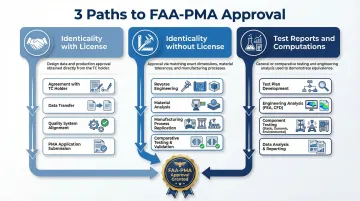
FAA Advisory Circular 21.303-4 outlines acceptable methods for PMA approval:
- Identicality with license agreement: Design data and licensing from the original Type Certificate holder
- Identicality without license agreement: Proof that the replacement is identical in dimensions, tolerances, and processes
- Test reports and computations: General or comparative analysis supported by testing to prove airworthiness
Dispelling the "OEM = Better" Myth
A persistent misconception holds that PMA parts are inferior to OEM parts. The FAA explicitly refutes this. FAA Order 8110.42C states that comparative test and analysis substantiates that a PMA part is "at least equal to the approved original part," meaning it "meets the same airworthiness standards as the original part."
Reality Check:
- PMA holders often maintain equal or superior manufacturing controls
- For legacy aircraft with diminishing OEM support, PMA parts are frequently the only route to compliant, timely supply
- Airlines and MROs increasingly embrace FAA-approved PMA parts to achieve cost savings and reduce parts lead times
What "30+ FAA-PMA Approvals" Means
When a supplier like Ni-Cad Systems holds 30+ FAA-PMA approvals, it reflects a sustained, multi-decade relationship with the FAA certification process, not a one-time approval. That depth of portfolio is a meaningful differentiator when evaluating a battery supplier for fleet use.
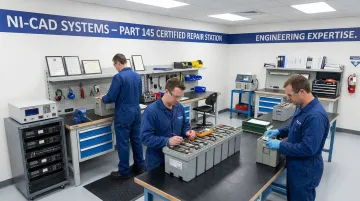
Ni-Cad Systems is also a Part 145 FAA approved repair facility, meaning they can manufacture certified replacement batteries and service and inspect the units they sell. For fleet operators, that combination matters: one qualified source for both supply and ongoing maintenance support.
Ni-Cad Systems' FAA-PMA Approved SAAB 3340D Replacement Battery
The Product
Ni-Cad Systems offers an FAA-PMA approved replacement battery for the SAAB 340, designated as Part Number 3340D. The battery is in stock and available for immediate procurement, addressing the critical lead-time challenges facing regional operators.
The 3340D supports multiple battery types including SAFT nickel cadmium, Marathon nickel cadmium, Varta nickel cadmium, Concorde lead-acid, and Gill (Teledyne) lead-acid batteries.
Engineering Pedigree
Ni-Cad Systems has serviced NiCd aircraft batteries since 1974—over 50 years—with more than 47,000 units serviced. Vice President Stephen Andrues brings 40 years of hands-on NiCd battery experience, DER (Designated Engineering Representative) status, and A&P mechanic certification.
Documentation and Traceability
Each SAAB 3340D replacement ships with comprehensive documentation to simplify receiving inspection:
- FAA-PMA approval documentation
- Airworthiness tags
- Traceability records
- Conformity documentation
The airworthiness tag satisfies receiving inspection on arrival, so documentation review doesn't hold up your maintenance queue.
Procurement Advantages
OEM vs. FAA-PMA Comparison:
| Factor | OEM Legacy Battery | FAA-PMA (3340D) |
|---|---|---|
| Airworthiness Standard | Original Type Certificate | 14 CFR 21.303 (Identical) |
| Lead Times | Often months | Typically in-stock/days |
| Cost Profile | Premium pricing | Highly competitive |
| AOG Support | Limited for legacy types | Rental pools & 24/7 support |
Ni-Cad Systems sells direct to operators, which keeps the cost profile competitive — no distributor layers between the facility and your procurement team.
For current pricing and volume discounts, contact Sales@NiCadSystems.com or call +1 510 785-9391.
In-Stock Availability, Fast Turns, and AOG Support for Regional Fleets
Why In-Stock Availability Changes the Equation
Airlines spent $1.4 billion globally in 2025 on excess inventory just to buffer against extended OEM lead times. For turboprop operators, that holding cost runs roughly $750,000 per aircraft — a significant drag for what is essentially a consumable component.
For regional operators running tight rotation schedules, a battery shipping same-day or next-day from Hayward, CA versus a 4–6 week OEM queue is the difference between a scheduled swap and an AOG event.
Current Availability: Ni-Cad Systems maintains inventory of SAAB 3340D replacement batteries for immediate shipment. Contact their sales team at Sales@NiCadSystems.com or +1 510 785-9391 to confirm current stock levels and shipping timelines for your specific requirements.
Rental Battery Program
For operators who can't carry spare battery inventory, Ni-Cad Systems offers a rental program that keeps aircraft flying while the primary unit is out for service — particularly useful for single-aircraft operators or small fleets where any downtime has direct revenue impact.
How It Works:
- Rental battery ships immediately — no waiting on service to begin
- Your aircraft stays operational throughout the service period
- Primary battery goes through capacity testing, deep-cycle testing, or full replacement
- Return the rental once your primary battery is back in service
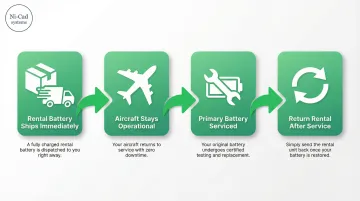
The result: no spare battery purchase required, no gap in aircraft availability.
24/7 AOG Support
For urgent situations, Ni-Cad Systems provides round-the-clock technical support at +1 510 501-9391. This dedicated AOG hotline ensures immediate assistance when aircraft are grounded due to battery issues, with access to rental batteries, expedited shipping, and technical troubleshooting.
Fleet Procurement Options
- Reach the sales team directly: Sales@NiCadSystems.com or +1 510 785-9391
- Volume orders: fleet-specific pricing and coordinated delivery schedules available
- Service agreements: combine replacement batteries with ongoing maintenance under a single relationship
- Recurring procurement: flexible arrangements for operators with predictable replacement cycles
With 30+ FAA-PMA approvals and Part 145 certification, Ni-Cad Systems supports the full battery lifecycle — from initial supply through testing, service, and eventual replacement.
Frequently Asked Questions
What aircraft uses the SAAB 3340D battery?
The SAAB 3340D battery is used in the SAAB 340 regional turboprop aircraft, a 30–40-seat platform operated by regional airlines, charter operators, and cargo carriers worldwide. Approximately 160 SAAB 340 aircraft remain in active commercial service.
Is an FAA-PMA approved battery legally airworthy on a type-certificated aircraft?
Yes. FAA-PMA approved parts meet FAA airworthiness standards under FAR Part 21 and are legally installable on certificated aircraft as a direct substitute for OEM parts. No additional engineering approval or field authorization is required for installation.
How do I know when my SAAB 340 battery needs to be replaced?
Replace your battery when any of these conditions are present:
- Fails capacity testing (below 80% of rated capacity)
- Shows cell imbalance during testing
- Has physical findings: corrosion, leakage, or case damage
- Reaches the service interval in the aircraft maintenance manual
What is the lead time for a replacement SAAB 3340D battery from Ni-Cad Systems?
Ni-Cad Systems stocks replacement batteries for immediate shipment. Contact their sales team at +1 510 785-9391 or Sales@NiCadSystems.com for current availability and shipping timelines specific to your location and requirements.
Can Ni-Cad Systems service my existing SAAB 3340D battery rather than replace it?
Yes. As a Part 145 FAA approved repair facility, Ni-Cad Systems can service and inspect existing NiCd batteries, including capacity testing and deep-cycle testing. Rental units are available to keep your aircraft flying during the service turnaround.