This scenario plays out more often than most operators realize. The SAFT 804750 is a known AOG risk on Dassault Falcon 900 and 2000 series aircraft, and its failure creates an immediate no-go condition with no MEL relief. This article explains why the SAFT 804750 is critical, what a certified replacement looks like, and why proactive shelf provisioning is the only reliable fix to avoid costly groundings.
TLDR: Key Takeaways for Busy Maintenance Directors
- The SAFT 804750 is the primary 24V, 36Ah NiCd main aircraft battery on Falcon 900 and 2000 series jets—its failure grounds the aircraft immediately
- AOG events cost business jet operators $10,000–$150,000 per hour once crew standby, charter disruption, and repositioning are factored in
- FAA-PMA approved replacements meet the same airworthiness standards as OEM SAFT batteries—with only standard logbook entries required
- Keeping a certified spare on-shelf or securing a rental battery contract compresses AOG resolution from days to hours
- High-utilization Falcon fleets stock certified spares in advance—sourcing during an AOG adds hours you can't recover
What Is the SAFT 804750 and Why Does It Matter on the Falcon 900/2000?
The 36Ah NiCd Powerhouse Driving ATA 24
The SAFT 804750 (also identified by Dassault P/N AD-804750) is the qualified main aircraft Nickel-Cadmium battery specified for Falcon 900 and 2000 series aircraft. These aircraft run on two 24V, 36Ah NiCd batteries as the primary source of DC power prior to APU starting.
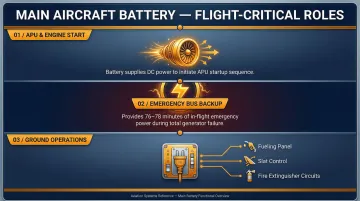
The main battery plays several flight-critical roles within the Falcon's electrical architecture:
- APU and engine start: Battery 1 supplies direct electrical power required for starting the Auxiliary Power Unit—without it, the APU cannot be started
- Emergency bus backup: In the event of total generator failure, the batteries provide emergency in-flight power for approximately 76 to 78 minutes with maximum load shedding
- Ground operations: The batteries power the battery bus, which directly supplies the fueling panel, emergency slat control circuits, and engine fire extinguisher secondary discharge systems
Strict MMEL "No-Go" Status
Because the main batteries are the sole source of emergency power and are required for APU starting, their failure constitutes a non-deferrable AOG condition. The Master Minimum Equipment List (MMEL) for the Falcon 2000 and 900 series shows no dispatch relief for the main aircraft batteries. If a battery fails capacity testing or triggers a "HOT BAT" warning (temperature exceeding 71.1°C/160°F), the aircraft is grounded until the unit is replaced.
Certification Requirements for Replacement
The SAFT 804750 is a 24-volt, 36 ampere-hour nickel-cadmium battery with a specific cell configuration designed to meet the Falcon's electrical system demands. Under FAR/EASA rules, only batteries meeting the original type-certificated specifications or holding FAA-PMA approval are legally installable. Any other substitution is a non-starter.
OEM Supply Chain Constraints
SAFT's OEM supply chain routinely struggles with lead times and stock constraints. Same-day or next-day sourcing is rarely guaranteed — and at remote locations or outside business hours, operators are often looking at multi-day delays while waiting for parts to ship. That gap is exactly where a certified shelf-stock replacement changes the outcome.
The Real Cost of a Falcon 900 or 2000 AOG Event
The $10,000 to $150,000 Hourly Bleed
When a Falcon 900 or 2000 is grounded due to a failed battery, the costs start accumulating immediately. Reported estimates put AOG costs between $10,000 and $150,000 per hour, depending on aircraft size, route, and operational context.
For mid-to-large cabin business jets like the Falcon series, the costs are particularly severe. The hourly charter rate for a Falcon 900EX ranges from $6,500 to $11,000. Every hour the aircraft sits waiting for a sourced part is an hour of lost revenue or lost executive productivity.
Cascading Cost Drivers
The hidden costs operators underestimate add up quickly:
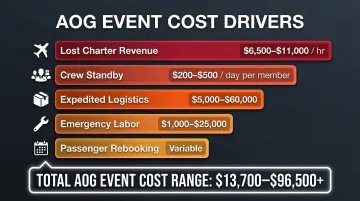
- Lost charter revenue: $6,500–$11,000 per hour for Part 135 operators
- Crew standby and per diem: $200–$500 per day, per crew member, with duty-time limits potentially forcing costly crew swaps
- Expedited parts logistics: $5,000–$60,000 per event for same-day air freight, couriers, and customs broker fees
- Emergency maintenance labor: $1,000–$25,000 per event for technicians dispatched to remote locations at overtime rates
- Passenger rebooking: Airline tickets, hotel costs, and reputational damage to the flight department
The Compounding Time Effect
If a part isn't on-shelf and must be sourced, every hour in the supply chain adds to downtime. Consider a realistic worst-case timeline: a Friday afternoon AOG at a remote FBO means vendor contact after business hours, shipping delays over the weekend, receiving inspection Monday morning, and installation by midday—a total of 72+ hours of downtime.
A certified spare battery typically costs less than two hours of AOG downtime. Stocking one on-shelf eliminates that 72-hour exposure entirely.
Small Operators Bear Disproportionate Risk
That 72-hour scenario hits hardest for smaller operations. Small operators managing 1-3 aircraft typically lack the 24/7 AOG desks and parts pooling that large fractional operators rely on. A large operator can swap tails and absorb the delay. A small operator faces immediate schedule collapse with no fallback.
Why Battery Failures Catch Falcon Operators Off Guard
The 80% Airworthiness Threshold
Aircraft batteries are not run to complete failure—they are strictly governed by capacity thresholds. EASA CS-25 Acceptable Means of Compliance (AMC 25.1351) dictates that for calculating emergency alternate power source duration, a battery capacity of 80% of the nameplate rated capacity must be assumed. When a NiCd battery's capacity drops below 80% during routine testing, it is deemed unserviceable and must be replaced or reconditioned.
Thermal Runaway and High-Temperature Degradation
NiCd batteries degrade non-linearly due to environmental factors, making calendar-based maintenance insufficient to prevent sudden AOGs. FAA Advisory Circular 00-33A explicitly warns that NiCd batteries are highly temperature-sensitive. Operating or charging the battery in ambient temperatures exceeding 100°F can lead to "thermal runaway"—an uncontrollable rise in battery temperature that destroys the cells. Even below thermal runaway thresholds, high temperatures accelerate capacity fade and cause cell case distortion.
Common Failure Scenarios That Lead to AOG
The most common failure scenarios include:
- Passes voltage checks at a remote base, then fails capacity testing during the scheduled maintenance event
- Appears fully charged on ground power but cannot deliver sufficient current for APU start
- A charger fault triggers investigation that uncovers hidden cell imbalance or degradation
The "It Passed Last Inspection" Misconception
NiCd batteries can degrade rapidly between service intervals, particularly in high-cycle or high-temperature environments. EASA SIB 2020-18 identifies a specific risk during aircraft parking: a disconnected NiCd battery self-discharges through an electrochemical phenomenon and does not fully recover when the aircraft recharges it. Each cycle compounds the loss.
The result is progressive capacity reduction that standard voltage checks cannot detect — which is exactly why a verified replacement on the shelf matters before the battery fails, not after.
What "FAA-PMA Certified" Actually Means for a SAFT 804750 Replacement
The Legal Basis of PMA (14 CFR 21.303)
When OEM supply chains falter—as noted by the 2025 Oliver Wyman MRO survey where 80% of respondents cited piece-part availability as the top cause of delays—operators can turn to FAA-PMA (Parts Manufacturer Approval) components.
Governed by 14 CFR Part 21, Subpart K (specifically § 21.303), a PMA is a combined design and production approval issued by the FAA. To obtain a PMA, the applicant must provide test reports and computations proving the part meets all airworthiness requirements of the original type-certificated product, or prove the design is identical to the OEM part.
Seamless Installation Eligibility
A common misconception is that PMA parts require complex approval processes to install. According to FAA Advisory Circular 20-62E, properly approved PMA parts are fully eligible for installation on type-certificated products. Because the FAA has already approved the design and manufacturing quality, installing a PMA battery requires no Supplemental Type Certificate (STC) or additional field approvals.
Installation simply requires a standard maintenance record entry (logbook sign-off) by an authorized mechanic per 14 CFR 43.9. No extra paperwork, no field approval delays.
PMA vs. Suspected Unapproved Parts (SUPs)
Not all non-OEM parts carry the same legal standing. The distinction matters during an AOG event when time pressure can push operators toward unverified sources.
| FAA-PMA Part | Suspected Unapproved Part (SUP) | |
|---|---|---|
| Legal Status | Full FAA design and production approval | Fails criteria of 14 CFR 21.8 or 21.9 |
| Traceability | Documented test reports and FAA approval on file | No verified approval chain |
| Installation | Airworthy — standard logbook entry | Not legally installable on type-certificated aircraft |
| Risk | None — equivalent airworthiness to OEM | Potential certificate action, safety exposure |
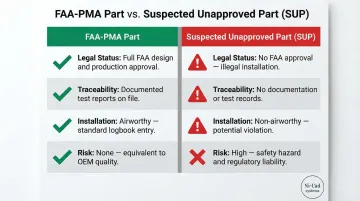
FAA AC 21-29D defines a SUP as any part that fails the 14 CFR 21.8 or 21.9 criteria, including counterfeit parts or components shipped without proper authorization. A legitimate FAA-PMA part meets the same airworthiness requirements as the OEM original — and carries documentation to prove it.
Ni-Cad Systems: A Trusted PMA Provider
For Falcon 900, 900EX, 2000, and 2000EX operators, Ni-Cad Systems offers a direct answer to the SAFT 804750 supply gap. Their PMA-approved replacement, designated NCS804750, is shelf-ready — no waiting on OEM lead times when an AOG clock is running.
The credentials behind that part number:
- 30+ FAA-PMA approvals across NiCd aircraft battery applications
- Part 145 FAA-approved repair facility — same organization that services and replaces
- 47,000+ units serviced since founding in 1974
- FAA Designated Engineering Representative (DER) on staff with 40 years of NiCd battery experience
That combination of regulatory standing and operational depth is what makes the NCS804750 a viable second-source option rather than just an alternative.
Building a Proactive SAFT 804750 Provisioning Plan for Your Falcon Fleet
A Simple Provisioning Framework
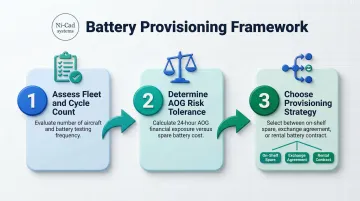
Maintenance directors should follow this framework to assess their battery provisioning strategy:
- Assess fleet size and annual cycle count — determine how many Falcon 900/2000 aircraft are in your fleet and how frequently batteries undergo capacity testing
- Determine AOG risk tolerance — calculate the financial exposure of a single 24-hour AOG event versus the cost of maintaining a spare battery
- Choose your provisioning strategy — decide between purchasing an on-shelf spare, establishing an exchange agreement, or securing a rental battery contract with a certified supplier
The Rental/Exchange Battery Option
An FAA-PMA approved rental battery from a certified supplier can be shipped overnight to the AOG location, installed legally, and returned when the operator's battery completes service. For operators without a fleet spare on-shelf, this is the fastest legal recovery path available.
Ni-Cad Systems stocks rental batteries specifically for this scenario. With 24/7 emergency technical support at +1 510 501-9391, operators can request a rental battery at any time and get fast turnaround — whether they're grounded now or building a contingency plan before a failure occurs.
Integrate Battery Health Monitoring Into Routine Maintenance
Integrating battery health monitoring and capacity test scheduling into the aircraft's routine maintenance program is the most cost-effective way to stay ahead of failures. A battery that fails at home base is an inconvenience; the same failure at a remote field triggers the full AOG cost spiral — crew hotels, ferry flights, and schedule disruption.
Shifting from calendar-only intervals to condition-based monitoring lets operators act on actual battery health data — and replace a pack on their terms, not the battery's.
Frequently Asked Questions
How long does it take to replace a Falcon 900 aircraft battery?
The physical replacement is typically a short task, often under an hour for a qualified A&P mechanic. The real time-killer is sourcing a certified spare when one isn't on-shelf, which can take 24-72+ hours depending on location and supply chain constraints.
What is the SAFT 804750 battery used for?
The SAFT 804750 is the primary NiCd battery on Falcon 900 and 2000 series jets, covering engine starting, emergency electrical bus backup, and ground power operations. Without it, the aircraft cannot be dispatched.
Is an FAA-PMA approved battery the same as the OEM SAFT battery?
Yes. FAA-PMA approved replacements meet the same airworthiness standards as the OEM part, are legally interchangeable, and can be installed with standard maintenance documentation. No STC is required.
How much does a business jet AOG event typically cost?
A single 24-hour AOG event can cost an operator between $50,000 and $150,000+, accounting for lost charter revenue (averaging $6,500 to $11,000 per hour for a Falcon 900/2000), expedited logistics, emergency maintenance labor, and crew standby costs.
What is the service life of a NiCd aircraft battery like the SAFT 804750?
NiCd battery life depends on cycle count, operating temperature, and maintenance history. Batteries may remain in service up to 10 years under ideal conditions, but capacity testing is required at regular intervals, and any unit that drops below 80% capacity must be replaced.
Can I use a rental battery to clear an AOG while my battery is being serviced?
Yes. An FAA-PMA approved rental battery from a certified Part 145 facility is a legal and practical solution for clearing an AOG while the operator's battery undergoes service or overhaul. Ni-Cad Systems offers rental batteries with fast turnaround and 24/7 AOG support.