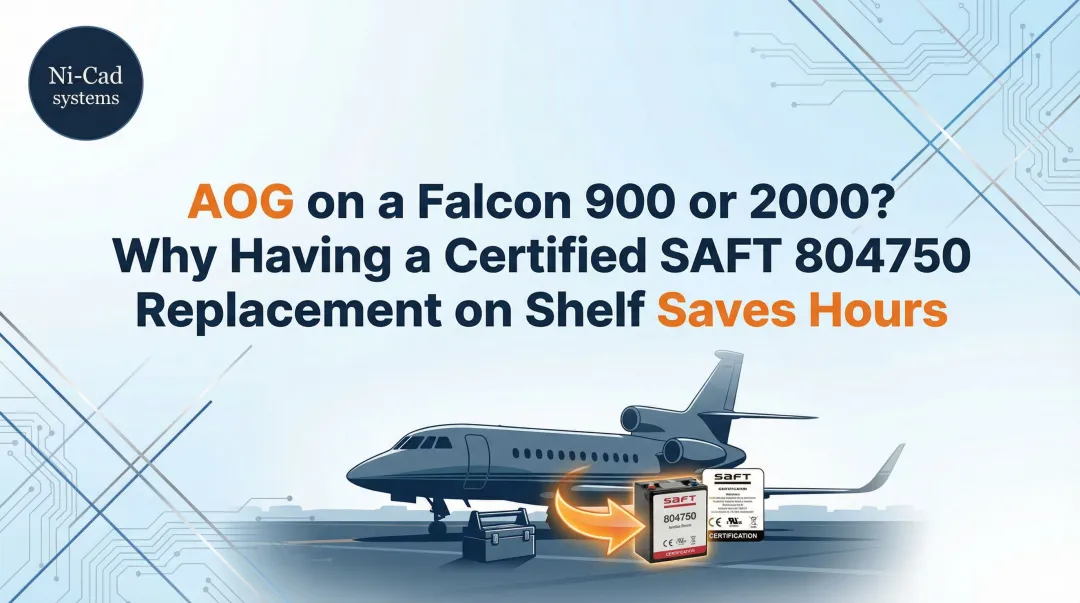
When an aircraft battery reaches end-of-service life and no replacement is available, the result is an Aircraft on Ground (AOG) event. AOG situations carry severe financial consequences, with industry estimates ranging from $10,000 to over $100,000 per hour depending on aircraft type and operational disruption. A discontinued or scarce battery shouldn't be what grounds your fleet.
The solution exists: a fully FAA-PMA approved, drop-in replacement from Ni-Cad Systems, a U.S.-based specialist with over 50 years in aviation battery manufacturing. This article walks through exactly what that means for your operation—from regulatory standing to procurement process.
Key Takeaways
- The SAFT 804750 is increasingly difficult to source due to supply chain constraints and aging platform support
- AOG events cost airlines $10,000–$100,000+ per hour, making battery scarcity a genuine operational risk
- FAA-PMA approved parts are legal, direct replacements requiring no additional STC or field approval
- Ni-Cad Systems' NCS804750 is an FAA-PMA approved drop-in replacement with identical form, fit, and function
- 24/7 AOG support and rental batteries available: +1 510 501 9391
What Is the SAFT 804750 and Which Aircraft Does It Power?
The SAFT 804750 is a nickel-cadmium (NiCd) battery used primarily in business aviation power supply systems. According to Boeing Distribution capability lists, the part is associated with the 20VRED system and classified under ATA chapter 24-30-17 (Electrical Power).
Aircraft Applications:
The SAFT 804750 and its direct replacement serve multiple aircraft platforms:
- Dassault Falcon 900, 900EX, 2000, 2000EX
- McDonnell Douglas DC-9, DC-10
- Lockheed L-1011
- Cessna Citation series (425, 441, 500, 550, S550, 552, 560, 650)
System Role:
This battery functions as a power supply battery, not an engine-start battery. It provides critical electrical power for aircraft systems, including emergency lighting and backup power during electrical system failures. The battery's role in emergency power systems makes it non-optional—aircraft cannot legally fly without a serviceable unit installed.
Why Lock-In Creates Vulnerability:
That system-critical role also makes supply disruptions unusually costly. When operators have maintained fleets for decades around a single OEM part number, any sourcing gap hits maintenance planning, inventory systems, and technical documentation simultaneously.
Switching to an unfamiliar part isn't straightforward. Certification paperwork, approved data references, and procurement workflows all point back to the original part number — which is why a certified, direct replacement matters far more than a generic alternative.
Why the SAFT 804750 Has Become Difficult to Source
No public SAFT discontinuation notice exists for part 804750, but absence of an official EOL announcement doesn't mean the part is readily available. Several converging pressures have made sourcing it genuinely difficult.
Aviation manufacturers routinely consolidate production lines for mature platforms. As older aircraft age out of front-line service, OEMs shift priorities toward newer platforms — without always issuing formal EOL notices. Parts quietly move to "available upon request" status, with lead times that stretch from days into weeks or months.
Broader supply chain stress compounds the problem. An Oliver Wyman analysis for IATA found that airlines paid approximately $3.1 billion in additional maintenance costs tied to supply chain constraints in 2025, with carriers spending an additional $1.4 billion in excess inventory just to buffer against parts shortages. Meanwhile, the global fleet average age reached 13.4 years in 2024 — meaning more aircraft needing more frequent component replacement, competing for parts OEMs no longer prioritize.
What "Hard to Source" Looks Like in Practice:
- Extended lead times: Weeks to months instead of days
- Inflated pricing: Secondary market brokers charging premiums of 50–200% over historical pricing
- Counterfeit risk: Gray market suppliers offering "equivalent" parts without proper documentation
- Shelf life uncertainty: Older stock from distributors with unclear storage history and remaining service life
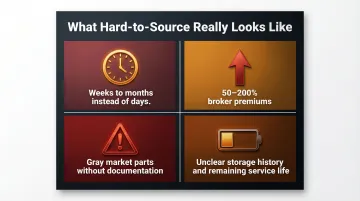
Part scarcity on mature platforms isn't a one-off supply hiccup — it's a structural feature of the MRO market. FAA-PMA approved second-source parts exist precisely to give operators a certified, traceable alternative when OEM supply becomes unreliable.
What's at Stake When a Critical Battery Part Goes Hard to Find
The AOG Scenario
When an aircraft battery fails inspection or reaches end-of-service life and no replacement is immediately available, the aircraft cannot fly. The financial impact is immediate and severe.
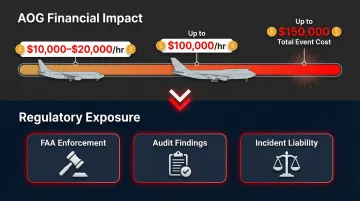
Aviation Week cites Boeing estimates that an AOG event costs an airline $10,000 to $20,000 per hour, with costs reaching $100,000 per hour for widebody aircraft during peak travel periods. These figures include:
- Lost revenue from cancelled flights
- Passenger compensation and rebooking costs
- Crew repositioning expenses
- Aircraft repositioning when the part finally arrives
Older Boeing estimates placed actual AOG costs as high as $150,000 depending on aircraft model and operational context.
Maintenance Scheduling Risk
Relying on a single-source OEM part with unpredictable availability makes proactive maintenance planning impossible. Instead of scheduling battery replacements during planned downtime, operators are forced into reactive maintenance—replacing batteries only when they fail, often at the worst possible time.
That reactive posture drives up costs across the board: emergency procurement, expedited shipping, and overtime labor. It also creates downstream disruptions—unplanned aircraft unavailability and schedule delays that compound quickly. Those operational risks don't exist in isolation; they carry regulatory consequences too.
Compliance and Regulatory Exposure
Using unapproved or improperly documented parts to avoid downtime creates significant regulatory exposure:
- FAA enforcement: Airworthiness violations can result in civil penalties
- Audit findings: Unapproved parts trigger findings during FAA surveillance audits
- Incident liability: If something goes wrong, unapproved parts create both regulatory and legal exposure
The Gray Market Danger
Broker-sourced "equivalent" batteries without proper documentation present real safety risks. Between FY2011 and FY2015, Department of Defense agencies submitted 526 suspect counterfeit parts reports to the Government-Industry Data Exchange Program.
Red flags for unapproved parts:
- Missing or suspicious FAA Form 8130-3 airworthiness tags
- Incomplete traceability records
- Pricing significantly below market rates
- Vague seller responses about part origin
- Reluctance to provide manufacturer documentation
FAA Advisory Circular AC 21-29D provides the official framework for identifying and reporting suspected unapproved parts (SUPs). Operators who unknowingly install SUPs face regulatory action even if they acted in good faith.
A FAA-PMA approved second-source part threads this needle—it's a documented, traceable, drop-in replacement that removes both the supply risk and the compliance exposure at once.
Understanding FAA-PMA: The Legal and Technical Standard for Replacement Parts
Parts Manufacturer Approval (PMA) is often misunderstood. It's not a "generic" or "aftermarket" part in the consumer sense—it's a federally regulated approval requiring rigorous engineering evidence of design equivalency.
What FAA-PMA Actually Means
Per 14 CFR Part 21 Subpart K, a PMA is a combined design and production approval that allows a manufacturer other than the OEM to produce a replacement article. The FAA must review and approve the design data before issuing the PMA.
Two Primary Approval Methods:
- Identicality — The part matches the OEM design exactly, with or without a licensing agreement
- Test and Computation — Engineering analysis and physical testing demonstrate the part meets or exceeds the OEM's design standard
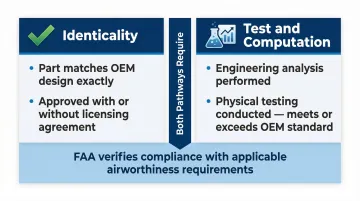
Both pathways require the FAA to verify that the part complies with applicable airworthiness requirements.
Legal Standing of PMA Parts
An FAA-PMA approved part is a direct, legal replacement for the OEM part on a certificated aircraft. No additional Supplemental Type Certificate (STC) or field approval is required for installation.
It installs under the same maintenance procedures and technical documentation as the original OEM part — with identical regulatory status.
Addressing the "OEM is Always Better" Myth
Some operators assume OEM parts are safer or higher quality than PMA parts. PMA approval requires demonstrating the replacement meets or exceeds the OEM's design standard — the FAA oversees both OEM and PMA production quality through ongoing surveillance. A PMA holder operating under Part 145 certification (like Ni-Cad Systems) is subject to continuous FAA oversight—not a one-time approval, but an ongoing audit process.
What to Verify When Accepting a PMA Part
When receiving a PMA part, confirm three things:
- Physical marking: Per 14 CFR §45.15, the part must carry a permanent "FAA-PMA" mark, the manufacturer's name or symbol, and the part number
- FAA Form 8130-3: This airworthiness approval tag confirms the part's certification status and traceability chain
- DRS database entry: Cross-check the PMA holder's authorization on the FAA Dynamic Regulatory System
These three checks confirm you're receiving a legitimate, FAA-approved replacement part.
Ni-Cad Systems' FAA-PMA Approved Drop-In Alternative to the SAFT 804750
Ni-Cad Systems manufactures the NCS804750, an FAA-PMA approved direct replacement for the SAFT 804750 and 20VRED part numbers.
Technical Specifications
The NCS804750 is a nickel-cadmium (NiCd) battery designed for the following aircraft:
- Dassault Falcon 900, 900EX, 2000, 2000EX
- McDonnell Douglas DC-9, DC-10
- Lockheed L-1011
- Cessna 425, 441, 500, 550, S550, 552, 560, 650
Drop-In Compatibility:
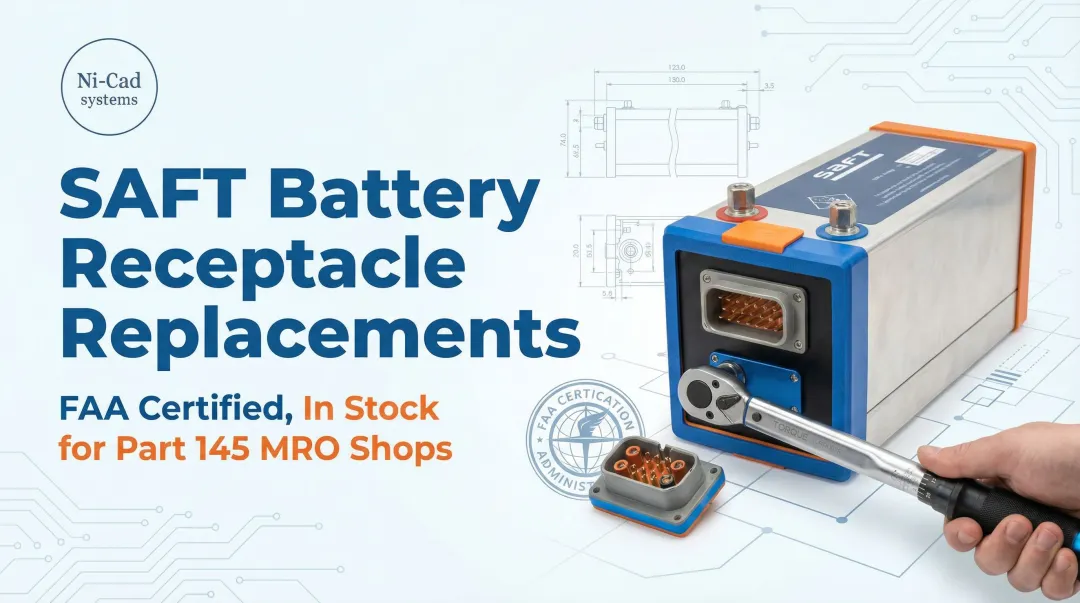
The NCS804750 matches the SAFT 804750 in physical dimensions, mounting interface, and electrical output. It installs in the same location using existing brackets and hardware — no wiring changes, no re-qualification.
No bracket modifications, no wiring changes, no aircraft system re-qualification required. The NCS804750 installs using the same maintenance procedures as the original SAFT 804750.
Company Credentials and Quality Assurance
Ni-Cad Systems has built its entire operation around aviation battery systems since 1974:
- 30+ FAA-PMA approvals across aviation battery products
- FAA Part 145 certified repair facility since 1974
- Over 47,000 units serviced since founding
- 50+ years of continuous operation in aviation battery systems
Vice President Stephen Andrues leads technical operations with credentials that matter in this context:
- FAA Designated Engineering Representative (DER)
- A&P mechanic certification
- Licensed pilot
- 40 years of experience specifically in NiCd aircraft batteries
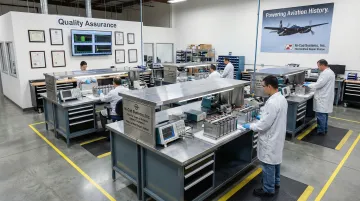
Part 145 certification means Ni-Cad Systems' manufacturing and service processes are subject to ongoing FAA oversight—not a one-time certification, but continuous surveillance and audit. That means quality systems stay in place for every unit produced, not just at initial approval.
What Comes With the Part
Every NCS804750 ships fully documented and ready for installation:
- FAA Form 8130-3 airworthiness approval tag
- Full traceability documentation
- Capacity testing and quality assurance performed at the Part 145 facility
- Technical support from a team with over 100 years of combined engineering experience
The Availability Advantage
For procurement teams and maintenance shops dealing with SAFT sourcing gaps, that's where a domestic PMA holder changes the calculus.
As the PMA holder and domestic manufacturer, Ni-Cad Systems maintains control over production and inventory. When OEM channels face scarcity or extended lead times, a second-source manufacturer can fulfill orders on timelines the OEM cannot match.
The company offers rental batteries to keep aircraft flying while orders are processed, and provides 24/7 AOG technical support for emergency situations.
How to Procure the Replacement and What to Expect
Ordering Process
To order the NCS804750 replacement for the SAFT 804750:
Primary Contact:
- Email: Sales@NiCadSystems.com
- Phone: +1 510 785 9391
- Business Hours: Monday–Friday, 8:00 AM – 6:00 PM
AOG Emergency Support:
- 24/7 Hotline: +1 510 501 9391
Specify your aircraft type and part number requirement. The sales team can confirm compatibility, provide pricing, and advise on lead times based on current inventory.
Lead Times and Operational Support
Ni-Cad Systems stocks the NCS804750 to support fast fulfillment. Lead times depend on current inventory — contact the sales team directly for availability when timing is critical.
Support options include:
- Rental batteries — available for Falcon and other platforms using the SAFT 804750, keeping aircraft operational while your permanent replacement ships
- 24/7 technical support — covers installation questions, troubleshooting, and operational issues, staffed by FAA DER-certified engineers with four decades of NiCd battery experience
Receiving Inspection Checklist
When the NCS804750 arrives, perform these verification steps:
- Confirm FAA-PMA marking: Check for permanent "FAA-PMA" marking on the battery housing
- Verify FAA Form 8130-3 tag: Ensure the airworthiness tag is present and matches the part number
- Check part number: Confirm the part number (NCS804750) matches your order and approved data
- Retain documentation: File the 8130-3 tag and traceability records with your aircraft maintenance records
Per 14 CFR 43.9, your logbook entry must include a description of the work performed, date of completion, and the signature and certificate number of the person approving the return to service.
Frequently Asked Questions
Is the SAFT 804750 officially discontinued, or just hard to source?
No public discontinuation notice exists from SAFT for part 804750. However, supply chain constraints and aging platform support have made the part increasingly difficult to source through traditional OEM channels. Either way, an FAA-PMA approved alternative eliminates reliance on OEM supply.
Is it legal to install an FAA-PMA approved battery instead of the original SAFT 804750?
Yes. FAA-PMA approved parts are legally authorized direct replacements for OEM parts on certificated aircraft under FAA regulations. No additional STC or field approval is required. The part installs under existing maintenance procedures and type certificate authority.
What does "drop-in replacement" actually mean for the SAFT 804750 alternative?
Drop-in means identical form, fit, and function. The NCS804750 installs in the same physical location, connects to the same mounting brackets and electrical interfaces, and performs the same system function as the SAFT 804750—without any aircraft modification or re-qualification required.
How do I verify that a PMA part is legitimate and FAA-approved?
Confirm all three of the following:
- FAA-PMA marking permanently affixed to the part
- FAA Form 8130-3 airworthiness tag included with shipment
- PMA holder authorization confirmed in the FAA's Dynamic Regulatory System at drs.faa.gov
What documentation should I retain when installing the Ni-Cad Systems replacement battery?
Retain the FAA Form 8130-3 airworthiness tag and all traceability records shipped with the part. Make a logbook entry per 14 CFR Part 43: description of work, date, and the certifying mechanic's signature and certificate number.
Does Ni-Cad Systems offer support if I have a technical question about the replacement battery?
Yes. Ni-Cad Systems provides 24/7 technical support via their AOG hotline at +1 510 501 9391. Their team includes an FAA DER with 40 years of NiCd battery expertise, A&P mechanics, and engineers with over 100 years of combined experience in aviation battery systems.