Introduction
Aviation procurement teams face intense budget scrutiny. Battery line items look like easy targets for cost-cutting—but aviation batteries are not commodity items where price alone should drive the decision.
Traceability records are often treated as paperwork formality rather than a meaningful quality signal. Yet they are the single most reliable indicator of whether a battery is airworthy, legally installable, and safe. Without them, operators face FAA enforcement, grounded aircraft, and serious liability exposure. Those consequences far exceed any upfront savings.
This article explains what traceability records actually are, why they outweigh price across every dimension, and what goes wrong when they are missing.
Key Takeaways
- Traceability records are legally required for installation on certificated aircraft, covering origin, certification, and maintenance history
- Buying cheaper batteries without verified traceability exposes operators to FAA enforcement, grounded aircraft, and significant liability
- Documented batteries carry lower total cost of ownership despite higher upfront price
- Audit failures and forced AOG removals from missing records routinely cost far more than any price difference
- Source from FAA-PMA approved, Part 145 certified suppliers to ensure complete, verifiable documentation
What Are Traceability Records?
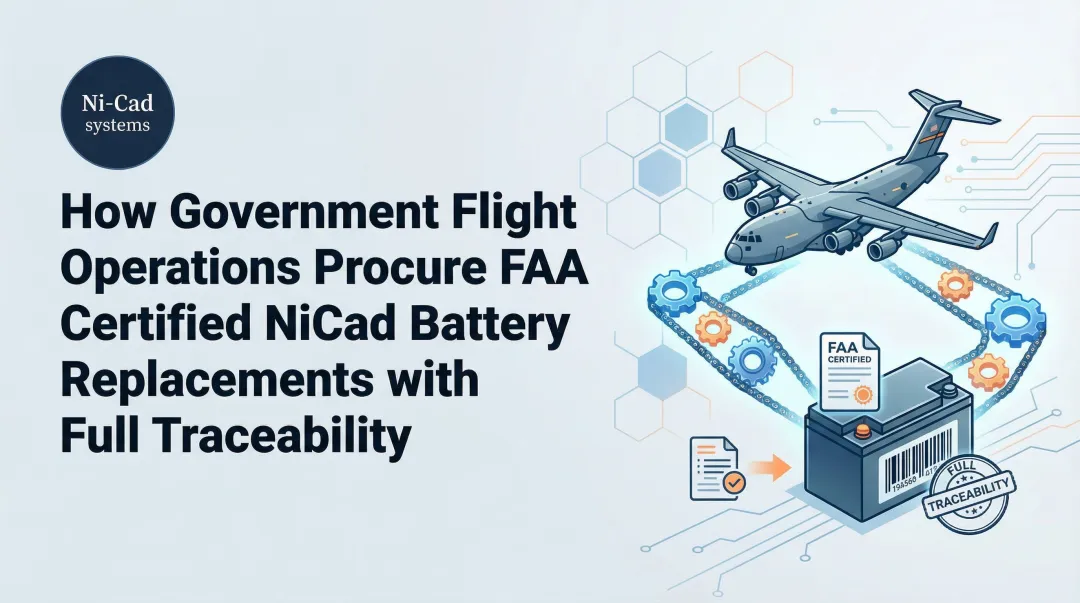
Traceability records are the complete, auditable paper trail that follows a battery from manufacturer to installation. They confirm that the part is what the seller claims it to be, that it was made to approved standards, and that it carries a documented service history.
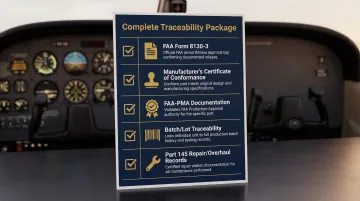
A full traceability package typically includes:
- FAA Form 8130-3 (Authorized Release Certificate / Airworthiness Approval Tag)
- Manufacturer's Certificate of Conformance
- FAA-PMA documentation (if applicable)
- Batch/lot traceability to original production
- Repair or overhaul records from a Part 145-approved facility
These documents aren't administrative formalities — they're the evidence base behind every downstream decision, from installation sign-off to insurance coverage to audit defense. FAA Order 8130.21J explicitly requires Form 8130-3 to support identification and traceability of aviation products throughout the global supply chain.
Key Advantages of Traceability Records When Sourcing Aviation Batteries
The three advantages below are operational and regulatory in nature—they affect airworthiness compliance, flight safety, and total lifecycle cost, not just paperwork hygiene.
Advantage 1: Legal Installability and Regulatory Compliance
Under FAA regulations (specifically 14 CFR Part 43 and Part 21), only approved parts with proper documentation may be installed on certificated aircraft. A battery sold without an 8130-3 or equivalent documentation is legally an unapproved part, regardless of its apparent physical quality.
How traceability creates compliance:
The paperwork confirms the part's approval basis (TSO, PMA, or OEM), links it to an approved design, and provides the documentation an A&P mechanic or inspector needs to make a legal logbook entry at installation.
The Compliance Risk:
Without proper documentation, the installation itself is non-compliant. Operators face FAA enforcement action, certificate suspension, or an aircraft being deemed unairworthy during a ramp check or audit.
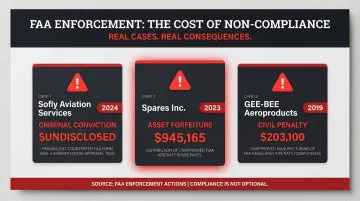
The FAA aggressively pursues companies and operators that bypass traceability requirements:
| Entity | Year | Penalty | Violation |
|---|---|---|---|
| Sofly Aviation Services | 2024 | Criminal Conviction | Executives pled guilty to selling parts with counterfeit 8130-3 tags |
| Spares, Inc. | 2023 | $945,165 Forfeiture | Produced unapproved parts without PMA |
| GEE-BEE Aeroproducts | 2019 | $203,100 Civil Penalty | Manufactured and advertised unapproved parts |
A battery that saves $300 upfront but triggers an unairworthy finding costs multiples of that in grounding time, re-inspection, and potential fines.
KPIs impacted:
- Regulatory compliance rate
- Audit pass/fail rate
- Aircraft airworthiness status
- Documentation completeness score
- A&P sign-off validity
When this advantage matters most:
Compliance risk is highest during FAA audits, ITAR reviews, insurance renewals, aircraft sales/resale evaluations, and any DOD contract inspection for military operators.
Advantage 2: Safety Risk Reduction Through Verified Battery History
Traceability records allow maintenance professionals to confirm a battery's full history: its original cell chemistry and design approval, how many charge/discharge cycles it has seen, whether it has been serviced by an approved facility, and whether it has ever experienced a thermal or electrical event.
How traceability reduces safety risk:
A battery with no documented history cannot be verified for cycle count, cell integrity, or whether it was ever repaired outside of an approved facility—all of which are safety-critical factors for NiCd and lead-acid aviation batteries.
The Safety Exposure:
Undocumented or counterfeit aviation batteries are a recognized industry safety hazard. The FAA's Suspected Unapproved Parts (SUP) program exists specifically because improperly documented parts enter the supply chain through gray markets and unverified distributors.
Aviation batteries that fail in service—particularly during engine start or emergency power scenarios—can result in complete loss of aircraft electrical systems at critical moments. Two NTSB cases illustrate the stakes:
| Incident | Year | Component | NTSB Findings |
|---|---|---|---|
| FedEx Truck Fire | 2016 | Lithium-Ion Battery | Unapproved Braille batteries lacked UN 38.3 testing; thermal runaway ignited fire |
| Japan Airlines 787 | 2013 | APU Lithium Battery | Internal short circuit led to cascading thermal runaway; fleet grounded |
KPIs impacted:
- In-service failure rate
- Battery removal rate before scheduled life
- Incident/event reporting rate
- Warranty claim validity
- Thermal event risk profile
When this advantage matters most:
This advantage is most critical for emergency power supply batteries, APU batteries, and main aircraft batteries—where failure directly affects flight safety rather than convenience systems.
Advantage 3: Lower Total Cost of Ownership and Operational Continuity
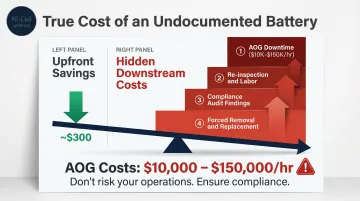
The apparent savings from a lower-priced, undocumented battery disappear once downstream costs are calculated: forced removal if found non-compliant, AOG delays while a compliant replacement is sourced, re-inspection labor costs, and liability exposure if an incident occurs.
How traceability creates long-term cost control:
A battery purchased from a documented, FAA-approved source comes with a known service life baseline, clear maintenance intervals, and warranty terms that are enforceable—allowing maintenance teams to plan ahead rather than react.
The Hidden Cost:
Total cost of ownership for an aviation battery extends well beyond purchase price. Every undocumented battery carries exposure across:
- Acquisition price and installation labor
- In-service failure risk and unplanned removal
- Compliance audit findings and re-inspection costs
- End-of-life traceability for disposal or return-to-service
Boeing estimates that AOG costs range from $10,000 to $150,000 per hour. For corporate aviation and airline operators, even a few hours of AOG time can cost more than the entire battery budget for a year.
IATA projects that supply chain challenges will cost the airline industry more than $11 billion in 2025, driven largely by unpredictable part availability and documentation failures that trigger unplanned removals.
KPIs impacted:
- Total cost of ownership per battery
- AOG event frequency
- Unplanned maintenance cost rate
- Battery service life achieved vs. rated
- Parts warranty claim success rate
When this advantage matters most:
This advantage compounds at scale—for airline and military operators managing large fleets, every undocumented battery is a potential audit finding or forced removal event multiplied across hundreds of aircraft.
What Happens When Traceability Records Are Missing or Ignored
The consequences rarely stay contained to a paperwork problem. They cascade into grounded aircraft, personal liability, and costs that dwarf any initial savings:
- Aircraft get grounded during routine FAA inspections or insurance audits when documentation is missing — with no quick resolution if the supplier can't produce records retroactively
- The A&P or inspector who signed off on an undocumented part carries personal certificate risk if the FAA later reviews the installation
- Counterfeit or gray-market batteries may appear functional initially but have unknown cycle histories, inconsistent cell quality, and no warranty recourse if they fail in service
- Removal, re-sourcing, re-inspection, and re-installation of a compliant replacement often costs several times the original "savings"
AC 43-9C explicitly warns that insufficient or nonexistent aircraft records may render the Standard Airworthiness Certificate invalid.
How to Source Aviation Batteries With Verified Traceability
When evaluating an aviation battery supplier for traceability reliability, confirm:
- Verify Part 145 FAA approval status through the FAA's online repair station database
- Confirm PMA approvals are current and specific to the battery model required via the FAA DRS PMA database
- Request the full documentation package (8130-3, Certificate of Conformance, lot traceability) before purchase—not after delivery
FAA-PMA approved second-source batteries from a certified repair facility can be a cost-effective and fully compliant alternative to OEM pricing—provided they come with the same documentation standards as an OEM part. The key is that the PMA approval itself is the traceability anchor, confirming the battery was manufactured to an FAA-approved design.
Ni-Cad Systems, Inc. is one facility that meets all three criteria above. A Part 145 FAA-approved repair station with 30+ PMA approvals and over 47,000 units serviced, they supply NiCd and lead-acid aviation batteries and emergency power supplies with complete documentation packages—giving corporate aviation, airline, and military maintenance teams a compliant replacement path that doesn't trade documentation integrity for cost savings. Reach their 24/7 AOG support line at +1 510 501-9391 or call +1 510 785-9391 for standard inquiries.
Conclusion
The core issue is not whether a battery looks right or is priced attractively—it is whether someone can verify its history, install it legally, and trust it in service. Every one of those questions has the same answer: complete traceability records, or it does not fly.
Operators who build procurement practices around documentation standards rather than price alone see compounding returns over time:
- Fewer unplanned maintenance events from undocumented or out-of-spec parts
- Cleaner audit outcomes with no last-minute scramble to reconstruct records
- Lower safety and liability exposure across the fleet
Facilities like Ni-Cad Systems — a Part 145 repair station holding 30+ FAA-PMA approvals — supply replacement batteries with full traceability documentation as a baseline, not an add-on. That standard is what separates a defensible procurement decision from a gamble on price.
Frequently Asked Questions
What documents should be included with a replacement aviation battery?
A compliant battery shipment should include FAA Form 8130-3 (airworthiness approval tag), the manufacturer's Certificate of Conformance, and (where applicable) FAA-PMA approval documentation and repair/overhaul records from a Part 145 facility. These documents establish legal installability and traceability.
What is FAA Form 8130-3 and why does it matter for battery purchases?
FAA Form 8130-3 is the airworthiness approval tag that certifies a part meets FAA-approved design standards and is legally installable on a certificated aircraft. Without it, a battery cannot be legally documented in maintenance records, and the installation becomes non-compliant under 14 CFR Part 43.
What is an FAA-PMA approved battery and is it as reliable as an OEM battery?
FAA-PMA (Parts Manufacturer Approval) means the FAA has independently approved the part's design and manufacturing process. An FAA-PMA battery is equivalent in both legality and airworthiness to an OEM battery when installed with proper documentation, making it a cost-effective alternative without compromising safety or compliance.
Can I install an aviation battery that was purchased without traceability records?
Installing a battery without proper documentation is non-compliant under 14 CFR Part 43. The part is considered unapproved, the logbook entry fails regulatory standards, and the aircraft's airworthiness status is at risk — exposing operators to FAA enforcement and potential certificate action.
How do I verify that a supplier's traceability documentation is legitimate?
Three steps help confirm documentation is genuine:
- Confirm Part 145 status through the FAA's online repair station database
- Verify PMA approval numbers against the FAA's PMA database
- Request original documents (not photocopies) and cross-check certificate numbers against the FAA Dynamic Regulatory System
What is the difference between a Part 145 repair station and an uncertified battery supplier?
A Part 145 FAA-approved repair station operates under FAA oversight with documented quality systems, approved procedures, and the authority to issue 8130-3 tags. An uncertified supplier has none of these controls and cannot legally certify a battery as airworthy, making their documentation legally questionable.