Introduction
One wrong part — with no paper trail — can ground an aircraft, trigger an airworthiness directive, or expose a procurement office to federal liability. For government flight operations, sourcing FAA-certified NiCad battery replacements isn't just a purchasing task. It's a compliance workflow where documentation gaps carry real operational consequences.
Procurement officers, military aviation logistics managers, and contracting officers all face the same challenge: verifying that replacement batteries meet airworthiness standards and carry documented proof of origin at every handoff.
The stakes are high. A GAO investigation identified 526 suspect counterfeit parts in the DoD supply chain between 2011 and 2015 — a direct signal that government aviation is a target for unapproved parts infiltration.
This article breaks down how compliant procurement actually works: what traceability requires at each stage, what factors complicate it, and where government teams most often go wrong.
Key Takeaways
- Government flight operations must source NiCad battery replacements only from FAA-approved sources (Part 145 repair stations or FAA-PMA holders) to maintain aircraft airworthiness
- Full traceability means every battery must arrive with verifiable documentation—including FAA Form 8130-3—tracking its history from manufacture through service
- The procurement process spans vendor qualification, solicitation, inspection, documentation verification, and installation sign-off
- Government contracting rules (FAR/DFARS) layer additional requirements on top of FAA airworthiness standards—a compliance burden commercial operators don't face
- AOG situations do not suspend traceability requirements; pre-qualifying vendors who can supply compliant, documented parts quickly is essential
What Is the FAA-Certified NiCad Battery Procurement Process?
For government flight operations, procuring a NiCad battery replacement isn't a simple purchase order. It's a documented, end-to-end workflow that must satisfy FAA airworthiness standards and federal acquisition regulations simultaneously — two frameworks that don't always point in the same direction.
Understanding "FAA-Certified" in Context
"FAA-certified" means batteries must come from either the original equipment manufacturer (OEM) or from an FAA-PMA (Parts Manufacturer Approval) holder who has demonstrated that their part meets or exceeds OEM specifications. Repairs must be performed by a Part 145-certified repair station.
Critical distinction: FAA Form 8130-3 does not constitute approval to install the battery on a specific aircraft. Procurement officers must separately verify installation eligibility by checking the battery part number against the aircraft's Type Certificate Data Sheet (TCDS) or the applicable PMA supplement.
How Government Procurement Differs
Government buyers face additional regulatory layers that do not apply to commercial operators:
- FAR Part 12 for commercial products acquisition
- DFARS provisions including counterfeit part detection requirements
- Military-specific specifications like MIL-PRF standards
- Mandatory competition or sole-source justification even for aviation parts
This dual regulatory burden means a part that clears FAA airworthiness review can still fail government acquisition standards — and vice versa. Procurement officers must satisfy both frameworks before a battery ever reaches the aircraft.
Why Government Flight Operations Have Distinct Procurement Requirements
The Dual Regulatory Burden
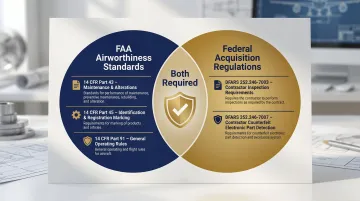
Government aviation assets must comply with FAA airworthiness standards (14 CFR Parts 43, 45, 91, and applicable maintenance regulations) AND federal acquisition regulations simultaneously. This combination creates stricter sourcing, documentation, and approval requirements than either framework alone.
Key regulatory intersections:
| Regulation | Requirement |
|---|---|
| 14 CFR Part 43 | Prescribes maintenance, preventive maintenance, rebuilding, and alteration rules; requires specific maintenance record entries |
| 14 CFR Part 45 | Governs marking and identification of life-limited parts |
| 14 CFR Part 91 | Establishes owner/operator responsibility for maintaining airworthiness and AD compliance |
| DFARS 252.246-7003 | Requires 72-hour notification of potential safety issues in critical safety items |
| DFARS 252.246-7007 | Mandates counterfeit electronic part detection and avoidance systems |
Safety and Mission-Readiness Stakes
For military and federal government aircraft, battery failure during critical operations—search and rescue, law enforcement interdiction, or classified transport missions—carries consequences that no procurement shortcut can justify. Mission failure and crew safety are not administrative trade-offs.
NiCad batteries are classified as life-limited, safety-critical components in most aircraft maintenance manuals. This classification triggers mandatory documentation requirements that cannot be waived for expedience. Under 14 CFR 43.10, life-limited parts must be permanently marked, segregated, or mutilated upon reaching their limit to prevent re-entry into the supply chain.
The Counterfeit Parts Threat
Those documentation requirements exist for a concrete reason. Between fiscal years 2011 and 2015, DoD agencies and contractors submitted 526 suspect counterfeit parts reports into the Government-Industry Data Exchange Program (GIDEP). The GAO noted that counterfeit parts have the potential to delay missions, affect system integrity, and ultimately endanger service members' lives.
Federal Procurement Documentation Requirements
Federal procurement rules require documented vendor qualification and typically mandate competition or justification for sole-source awards—even for aviation parts. Government buyers must document sourcing decisions, vendor qualifications, and traceability before a purchase order is issued. FAR 6.302-2 allows expedited acquisitions during AOG situations, but it does not waive safety and traceability documentation requirements.
How the Procurement Process Works: From Requirement to Approved Installation
The process moves through five sequential phases—requirement identification, vendor qualification, solicitation and award, receipt inspection, and installation documentation—with traceability records generated at each phase.
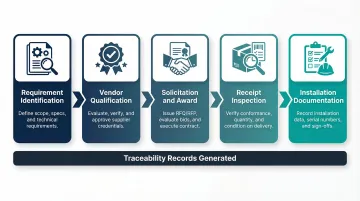
Requirement Identification and Technical Specification
Procurement starts with the aircraft's Type Certificate Data Sheet (TCDS) and maintenance manual, which specify the exact battery part number, capacity, and applicable technical standard. The procurement officer cannot deviate from these specifications without an engineering disposition or airworthiness approval.
The TCDS carries the same regulatory weight as the type design itself—it defines what the OEM produced and sets the legal baseline for any replacement component.
Vendor Qualification and Source Approval
Government buyers must verify that prospective vendors hold current FAA credentials before soliciting quotes:
Required vendor credentials:
- Part 145 repair station certificate with current scope of work authorization
- FAA-PMA holder status (for second-source parts)
- Documented quality system meeting 14 CFR § 21.137 requirements
- Active GIDEP monitoring and counterfeit part detection system (DFARS requirement)
AVL strategy: Establish Approved Vendor Lists with pre-qualified vendors before an AOG occurs. Ni-Cad Systems, Inc. is an example of a source that fits this model: a Part 145 certified repair facility with 30+ FAA-PMA approvals and over 47,000 units serviced since 1974. Their rental battery program keeps aircraft operational during service cycles, which matters when mission schedules can't flex.
Solicitation, Award, and Delivery
Solicitation documents (RFQ or purchase order) must reference:
- Specific battery part number and capacity
- Applicable FAA approvals (PMA number, TSO authorization)
- Required documentation package (8130-3, service records, AD compliance)
- DFARS clauses for counterfeit detection and safety notification
Upon delivery, receiving inspection must verify:
- Physical condition and absence of damage
- Part number conformance to purchase order
- Serial number legibility and proper marking
- Completeness of documentation package
- Match between physical serial number and paperwork
Even compliant vendors occasionally miss documentation requirements. The most frequent rejection causes are:
- Missing or unsigned FAA Form 8130-3
- Undated service records
- Serial number mismatches between battery and paperwork
- Incomplete AD compliance documentation
Full Traceability: The Documentation Chain Government Procurement Demands
Defining Full Traceability
Full traceability is the unbroken, verifiable record linking a specific battery (by serial number) from its manufacture or last major overhaul through every service event, ownership transfer, and storage period up to the point of installation. Any gap in this chain renders the part non-airworthy — physical condition alone does not determine airworthiness status.
FAA Form 8130-3: The Central Traceability Document
FAA Form 8130-3 (Authorized Release Certificate) must accompany every battery released from a Part 145 repair station and certifies that the work performed met FAA-approved maintenance data. Government procurement teams should never accept a NiCad battery without a current, properly completed 8130-3.
Critical limitation: The 8130-3 is not a delivery document and does not constitute approval to install the battery on a particular aircraft. It only assists the end user in determining airworthiness approval status.
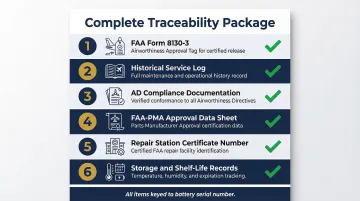
Complete Traceability Package Components
Minimum required documentation:
- FAA Form 8130-3 from the releasing Part 145 repair station
- Historical service log showing capacity test results, cell replacement history, and work performed
- AD compliance documentation for all applicable Airworthiness Directives
- FAA-PMA approval data sheet (if the battery is a second-source part)
- Repair Station Certificate number confirming authority to perform the work
- Storage and shelf-life records if applicable
Ni-Cad Systems provides complete service documentation packages with each battery — including capacity test records and 8130-3 release certificates — across more than 47,000 units serviced since 1974, giving government buyers audit-ready traceability files from the start.
Shelf Life and Storage Considerations
Complete documentation is only half the equation. Even a fully documented, newly serviced NiCad battery begins to degrade and may require re-inspection after a defined storage period. AC 00-33A warns that NiCad batteries are inherently temperature sensitive and overheating can lead to thermal runaway. Periodic reconditioning is required to restore a battery to its full rated capacity.
Storage life limits vary by specification:
- FAA does not prescribe universal calendar life — limits are defined by OEM manuals
- MIL-PRF-8565/20 strictly limits specific 24-volt NiCad batteries to exactly 3 years of service life from first installation
- Document re-certification events with a new 8130-3 referencing the original serial number
Procurement teams must account for storage degradation when stocking spare batteries, and documentation must reflect any re-certification events to maintain the traceability chain.
Key Factors That Affect the Process and Common Pitfalls
Critical Success Factors
Four factors consistently determine whether a procurement succeeds or stalls at receiving inspection:
- FAA-PMA status: Using a non-PMA source for a second-source part creates an unapproved parts installation — a federal airworthiness violation regardless of physical quality. PMA holders under 14 CFR Part 21 Subpart K must demonstrate compliance with airworthiness requirements and maintain quality systems meeting § 21.137.
- Documentation completeness at receipt: Missing or unsigned 8130-3 forms, undated service records, or serial number mismatches between battery and paperwork are the most common causes of parts rejection during receiving inspection.
- Lead time planning: Procurement teams that pre-qualify vendors and maintain AVLs can execute AOG orders in hours rather than days. Teams that wait until grounding to source parts often skip documentation verification under time pressure — a compliance risk that surfaces later.
- AD compliance verification: Both OEM and PMA batteries are subject to Airworthiness Directives. AD 2024-08-08, for example, targeted capacity reduction issues in Ni-Cd batteries during storage. Receiving inspections must verify AD compliance regardless of manufacturer.
The "FAA-Certified" vs. "FAA-Approved" Misconception
These two terms are not interchangeable — and confusing them creates compliance exposure. A Technical Standard Order Authorization (TSOA) is an FAA design and production authorization issued to a manufacturer, but it is NOT an installation approval. The installation must be approved as part of the type design or by a Supplemental Type Certificate (STC).
A battery can be FAA-certified to a TSO at the design level but still require installation by a Part 145 station and documentation on an 8130-3 to be legally installable on a specific aircraft.
Where Procurement Teams Oversimplify
Government organizations frequently route aviation parts through general contracting officers unfamiliar with FAA documentation requirements. The result: NiCad batteries sourced through commercial distributors without aviation credentials — treated as commodity purchases rather than regulated aircraft parts.
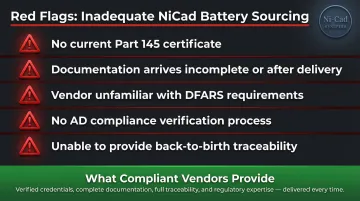
Warning signs of inadequate sourcing:
- Vendor cannot provide current Part 145 certificate
- Documentation package arrives incomplete or after delivery
- Vendor unfamiliar with DFARS counterfeit detection requirements
- No established process for AD compliance verification
- Inability to provide back-to-birth traceability
Frequently Asked Questions
What documentation must accompany an FAA-certified NiCad battery replacement for it to be accepted into government aviation inventory?
A minimum documentation package includes a completed FAA Form 8130-3 from the releasing Part 145 repair station, a service record showing work performed and test results, and the applicable FAA-PMA data sheet if the battery is a second-source part—all keyed to the battery's serial number.
Can government flight operations use FAA-PMA approved second-source NiCad batteries instead of OEM parts?
Yes. PMA holders must demonstrate their parts meet or exceed OEM specifications through FAA-approved testing, making them legally interchangeable for airworthiness purposes. Procurement officers should confirm the specific PMA approval covers the aircraft model and part number in question.
What is the difference between a Part 145 repair station and an OEM when procuring a serviced NiCad battery?
Both can legally return a serviced battery to service with an 8130-3. A Part 145 independent repair station can often service any NiCad battery regardless of OEM, offer faster turnaround, and may hold FAA-PMA approvals for second-source replacement cells. For government procurement, that combination of flexibility and compliance is worth evaluating.
How should a government procurement office handle an AOG situation when a NiCad battery replacement is needed immediately?
An AOG situation does not waive documentation requirements. Contact a pre-qualified Part 145 vendor on your Approved Vendor List, request expedited service with an 8130-3 release, and use a loaner battery from the vendor to return the aircraft to service while the replacement is processed.
What federal acquisition regulations specifically govern NiCad battery procurement for military aircraft?
DFARS 252.246-7003 (Notification of Potential Safety Issues) and DFARS 252.246-7007 (Contractor Counterfeit Electronic Part Detection and Avoidance) are relevant, alongside applicable military specifications and the requirement to source from FAA-approved or QPL-listed vendors. Contracting officers should also review the aircraft's technical order or maintenance manual for mandatory source requirements.
How does shelf life affect NiCad battery traceability and when must a stored battery be re-certified?
Most NiCad aircraft batteries have defined storage limits after which they must undergo capacity testing and re-inspection before installation. The re-certification event must be documented with a new 8130-3 referencing the original serial number, ensuring the traceability chain remains unbroken even for batteries that spent time in inventory.