Introduction
Citation jet operators and the Part 145 shops that maintain them face a recurring sourcing decision when the Avtech 1166-1 battery temperature sensor requires replacement: stay with the OEM part or switch to an FAA-PMA certified alternative. This choice extends beyond cost comparison: it involves regulatory compliance, documentation rigor, and operational continuity.
That documentation rigor is where Part 145 facilities feel the pressure most. Every part installation must be justified under their quality control system per §145.211, making the evaluation far more demanding than a basic price check.
Recent supply chain constraints and extended OEM lead times have pushed many shops to evaluate PMA alternatives. Industry data shows that 74% of airlines now use FAA-PMA parts to mitigate supply chain bottlenecks, with 82% citing part availability as a primary driver.
Key Takeaways
- The Avtech 1166-1 is the OEM temperature sensor for Cessna Citation battery systems — traceable, but often expensive and slow to source
- FAA-PMA certified replacements are legally airworthy under 14 CFR Part 21, Subpart K, and must meet or exceed OEM design standards
- Part 145 shops must verify PMA parts through their QC system using FAA-approved documentation and 8130-3 tags
- PMA alternatives typically deliver 25–45% cost savings, according to a MITRE engine sustainment study, with better AOG availability
- Evaluate suppliers on documentation quality and traceability — not just unit price
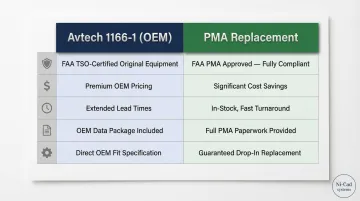
Avtech 1166-1 vs. Certified PMA Replacement: Quick Comparison
| Criteria | Avtech 1166-1 (OEM) | PMA Replacement |
|---|---|---|
| Regulatory Status | Type Certificate approval; straightforward Part 145 receiving | FAA-PMA under 14 CFR Part 21, Subpart K; legally equivalent when documented |
| Cost | Premium TransDigm OEM pricing | 25–45% savings vs. OEM |
| Availability | Subject to OEM schedules; 75% of MROs report longer lead times | Often stocked by specialized suppliers; faster AOG fulfillment |
| Documentation | OEM certification documents | FAA Form 8130-3, PMA approval data, conformity records |
| Technical Compatibility | Direct fit; no engineering review required | Form, fit, and function verified via FAA-accepted test methods |
Regulatory Status
Avtech 1166-1: Produced under the original Type Certificate, approved for applicable Citation airframes with straightforward Part 145 receiving inspection.
PMA Replacement: Approved under FAA-PMA (14 CFR Part 21, Subpart K) and legally equivalent in airworthiness status to the OEM part when properly documented with FAA Form 8130-3.
Cost
Avtech 1166-1: Carries premium OEM pricing typical of TransDigm-owned manufacturers. With material costs rising 7.6% in 2024, OEM pricing pressure continues to increase.
PMA Replacement: Industry data shows 25–45% savings compared to OEM equivalents — a direct per-unit cost reduction that compounds across a fleet.
Availability / Lead Time
Avtech 1166-1: Subject to OEM production schedules and distributor stock levels. Supply chain bottlenecks are estimated to cost the airline industry more than $11 billion in 2025, with 75% of MROs reporting longer component turnaround times.
PMA Replacement: Often stocked by specialized PMA suppliers with faster fulfillment for AOG situations. When aircraft downtime directly impacts revenue, shorter lead times are a practical operational advantage.
Documentation & Traceability
Avtech 1166-1: Comes with OEM certification documentation, making Part 145 receiving inspection straightforward.
PMA Replacement: Must include FAA Form 8130-3, PMA approval data, and conformity records. When sourced from a qualified supplier, traceability is equally robust.
Technical Compatibility
Avtech 1166-1: Direct fit by definition; no additional engineering review required for Citation battery systems.
PMA Replacement: FAA-accepted test and analysis methods confirm form, fit, and function equivalence. Shops must verify compatibility against applicable CMM and ICA data.
What Is the Avtech 1166-1?
The Avtech 1166-1 is the OEM battery temperature sensor used in the battery monitoring and protection system of specific Cessna Citation jet models. Its primary function is preventing thermal events by continuously monitoring battery temperature during charge and discharge cycles—a critical safety component in aircraft electrical systems.
As an OEM part produced under the original type design, the 1166-1 carries implicit FAA approval for those airframes, simplifying receiving inspection for Part 145 shops. The sensor is documented in maintenance records for Citation models including the S550 (Citation SII) and Citation V.
Technicians must verify applicability against the aircraft's current Illustrated Parts Catalog (IPC) or Component Maintenance Manual (CMM) per §145.109(d) requirements before installation.
The OEM manufacturer, AvtechTyee, operates as a subsidiary of TransDigm Group (acquired in 2007), producing electronic systems and power control products for aerospace applications. Pricing requires contact through an authorized distributor portal — lead times aren't published, which matters when an aircraft is on the ground.
Use Cases of the Avtech 1166-1
This sensor comes into play across scheduled battery service intervals, battery overhaul events, and AOG replacement scenarios. Its availability directly affects aircraft uptime, so procurement strategy matters well before a shop actually needs one.
OEM is the natural choice when:
- Aircraft still under manufacturer warranty with OEM-only requirements
- Operators maintain strict OEM-only maintenance policies
- Corporate flight departments haven't yet evaluated PMA alternatives
- OEM stock is readily available and urgency isn't a factor
Where those conditions don't apply, Part 145 shops increasingly evaluate FAA-PMA certified replacements — which is where the comparison in this article begins.
What Is a Certified PMA Replacement for the Avtech 1166-1?
FAA-PMA (Parts Manufacturer Approval) is granted under 14 CFR Part 21, Subpart K. The FAA reviews and approves the replacement part's design, manufacturing process, and quality system before issuing the PMA. A PMA part is not an unapproved "copy"—it's a separately approved article with its own airworthiness basis.
Two Primary FAA-Accepted Approval Methods
Test and Computation is the most common path for temperature sensors like the Avtech 1166-1 replacement. The manufacturer demonstrates through physical testing and engineering analysis that the part meets or exceeds OEM performance specs.
Identicality with Licensing applies when the manufacturer holds a licensing agreement with the OEM, confirming the design is identical.
Proper PMA Documentation Requirements
Under 14 CFR §45.15, PMA parts must be permanently marked with "FAA-PMA," the manufacturer's identification, and the part number. Each unit must arrive with:
- FAA Form 8130-3 (Authorized Release Certificate)
- PMA approval number marked on the part
- Conformity and traceability records
Part 145 receiving inspection will verify all documentation under §145.211.
Real-World Example: Ni-Cad Systems
Ni-Cad Systems is a Part 145 FAA-approved repair facility holding 30+ FAA-PMA approvals, including PMA-approved temperature sensors for aircraft battery systems. With over 50 years in aviation battery service and 47,000+ units serviced, parts arrive with complete airworthiness documentation — reducing receiving inspection time for installing shops.
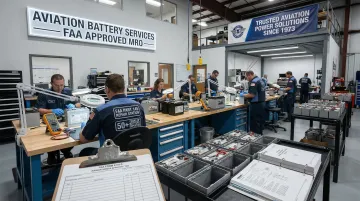
PMA-approved products available for Citation applications include:
- Battery temperature sensors for various Citation models
- Complete battery assemblies
- Modification kits that bundle temperature sensor replacement into broader overhaul solutions
How Part 145 Shops Evaluate the Switch
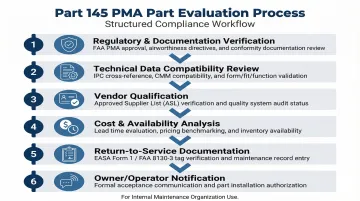
Step 1 — Regulatory and Documentation Verification
Under §145.211, your quality control system must include procedures for inspecting incoming materials. For a PMA part, this means:
- Confirming the FAA-PMA approval number
- Verifying the 8130-3 tag authenticity
- Cross-checking that the PMA covers the specific Citation model and serial number range in the aircraft's IPC or CMM
FAA Advisory Circular 20-62E explicitly classifies PMA parts as fully FAA-approved articles, carrying the same airworthiness standing as OEM parts — skipping this verification exposes your shop to compliance findings.
Step 2 — Technical Data Compatibility Review
The shop must confirm the PMA replacement is referenced or compatible with applicable Continued Airworthiness Instructions (ICA), Component Maintenance Manual (CMM), and any relevant Airworthiness Directives (ADs).
Under §145.109(d), shops must maintain current technical data and use only data acceptable to the FAA. Verify that the PMA part doesn't conflict with any open ADs on the Citation battery system.
Critical AD consideration: A 2016 FAA Legal Interpretation clarifies that ADs apply to the unsafe condition — an AD referencing an OEM part number can still apply to a PMA equivalent.
If the PMA part differs in a way that makes AD compliance impossible, request an Alternative Method of Compliance (AMOC) from the FAA before installing the part.
Step 3 — Vendor Qualification
Under §145.211 and §145.217, shops must qualify their suppliers. For a PMA supplier:
- Verify the supplier holds a Part 145 certificate, Part 21 production approval, or equivalent quality system
- Check the FAA's online registry for the supplier's PMA listing
- Confirm the supplier can provide documented quality assurance records on request
- Document the qualification in your shop's quality control system
Step 4 — Cost and Availability Analysis
Once compliance and vendor qualification are confirmed, the business case comes into focus. Evaluate total cost of ownership — not just unit price:
- Unit price differential (typically 25-45% savings for PMA)
- Lead time comparison
- AOG risk mitigation
- Shipping costs
- Administrative burden of qualifying a new vendor
With 82% of operators citing part availability as a primary driver for PMA adoption, availability often outweighs cost considerations.
Step 5 — Return-to-Service Documentation
Under §145.219, shops must retain records for at least two years. When installing a PMA part:
- Document the PMA part number (not the OEM P/N) on the maintenance release
- Log the 8130-3 tag reference in the work order
- Accurately reflect the PMA part installed to avoid discrepancies during future FAA inspections or aircraft sales
Step 6 — Owner/Operator Notification and Approval
Some corporate flight departments or Part 135 operators have internal maintenance policies restricting or requiring pre-approval for PMA parts. Shops working under a continuous airworthiness maintenance program (per §145.205) must follow that operator's PMA policy before substitution.
Check which operator types commonly impose these requirements:
- Part 121 airlines — often have fleet-wide PMA restriction lists
- Part 135 charter operators — policy varies by CAMO or DOM guidance
- Corporate flight departments — some require OEM-only on specific systems
Getting written approval before the swap is documented protects your shop during audits and aircraft sales transactions.
Making the Call: Avtech 1166-1 or PMA Replacement?
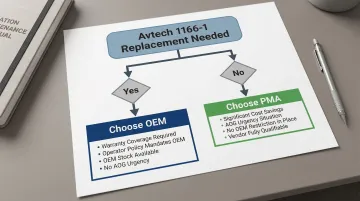
Choose the OEM Avtech 1166-1 When:
- Aircraft is under manufacturer warranty with OEM-only requirements
- Operator policy mandates OEM parts
- Urgency is not a factor and OEM stock is readily available
- Corporate flight department hasn't evaluated PMA alternatives
Choose the PMA Replacement When:
- Cost reduction is a priority (25-45% typical savings)
- Faster availability is critical for AOG situations
- Operator has no OEM-only restriction
- Your shop can complete vendor qualification without added delay
For most Part 145 shops performing routine Citation battery service, a properly documented PMA replacement from a qualified supplier is operationally equivalent to the OEM part. It's a compliant swap, not a regulatory gray area. What separates a clean installation from a compliance headache is supplier selection: choose a vendor who provides complete airworthiness documentation and can support cross-reference verification upfront.
Partner with an Experienced PMA Supplier
For shops looking to simplify the PMA qualification process, Ni-Cad Systems—a Part 145 facility with 30+ FAA-PMA approvals and over 50 years in aviation battery service—offers PMA-approved temperature sensors with complete airworthiness documentation and AOG support.
Contact Ni-Cad Systems:
- Technical Support: +1 510 785-9391 (M-F 8:00 AM - 6:00 PM)
- 24/7 AOG Hotline: +1 510 501-9391
- Email: Sales@NiCadSystems.com
Their engineering team can assist with cross-reference verification, applicability confirmation, and technical support for Citation jet battery systems.
Frequently Asked Questions
Is an FAA-PMA replacement for the Avtech 1166-1 considered legally airworthy?
Yes. FAA-PMA parts are approved by the FAA under 14 CFR Part 21, Subpart K and carry the same legal airworthiness status as the OEM part when installed per approved data and accompanied by an FAA Form 8130-3.
What documentation must a Part 145 shop retain when installing a PMA replacement temperature sensor on a Citation jet?
Under §145.219, shops must retain the FAA Form 8130-3, log the PMA part number (not the OEM number) on the maintenance release, and keep all records for at least two years from the date of return to service.
Can installing a PMA part affect a Citation jet's warranty or resale value?
PMA parts may affect OEM warranties if the manufacturer has an OEM-only warranty clause. Buyers should disclose PMA parts during aircraft transactions. However, a properly documented PMA installation with complete traceability does not affect FAA airworthiness status or an aircraft's market value.
How does the FAA-PMA process verify that a replacement temperature sensor meets OEM performance standards?
Under the test and computation method, the PMA applicant must demonstrate through physical testing, engineering analysis, and comparative data that the part meets or exceeds the original design's performance requirements. The FAA reviews this evidence before granting approval.
Does switching to a PMA part require a review of open Airworthiness Directives (ADs)?
Yes. The shop must confirm no open ADs reference the OEM part number in a way that would require OEM-specific compliance. ADs address unsafe conditions, so if the PMA part's design prevents AD compliance as written, an Alternative Method of Compliance (AMOC) must be obtained.
How should a Part 145 shop qualify a new PMA supplier for the first time?
Under §145.217, the qualification process should cover three steps:
- Verify the supplier's FAA approval status (Part 21 PMA listing or Part 145 certificate) through the FAA registry
- Request quality records and conformity documentation
- Document the qualification in your shop's quality control system