Introduction
In 2024, global aviation maintenance spend hit a record $104 billion, with an 8.3% surge in material cost inflation squeezing margins across the board. For Part 145 shops managing Citation fleets, battery replacement decisions are where these pressures hit hardest—reactive maintenance compounds costs well beyond the battery's purchase price.
Citation battery costs rarely show up as a single line item. They accumulate through:
- Premature replacements triggered by poor system diagnostics
- AOG downtime running $10,000 to $150,000 per hour
- Unnecessary capacity checks from inadequate service tracking
- Defaulting to OEM pricing when FAA-approved alternatives exist
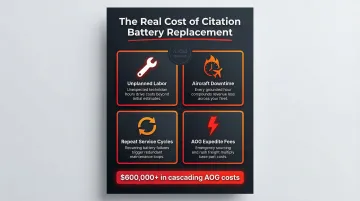
A multi-day grounding from a failed battery can easily exceed $600,000 in cascading costs.
This article is written specifically for Part 145 shop managers and directors of maintenance responsible for controlling Citation battery costs without compromising airworthiness. It covers procurement decisions, shop management practices, and the diagnostic gaps that drive premature battery failure—so you can cut costs where it counts without touching airworthiness standards.
Key Takeaways
- Procurement choices, service intervals, and charger condition all drive Citation battery costs—reactive decisions compound the damage
- FAA-PMA approved 2nd-source batteries are fully airworthy and cost 30–70% less than OEM pricing
- Part 145 reconditioning cuts annual failure rates from 45% to 5%—far cheaper than automatic replacement
- AOG groundings cost far more than the battery itself; rental programs and fast-turn service keep aircraft flying
- Faulty chargers and degraded temperature sensors cause premature failure—diagnose the system before replacing the battery
How Citation Battery Replacement Costs Build Up
Citation battery replacement costs are rarely a single, visible event. They accumulate over time through a chain of compounding decisions: choosing replacement over reconditioning, missing service interval windows, and triggering unplanned removals due to degraded charging systems or sensor failures.
Each of those decisions feeds the next. A battery pulled six months early due to conservative recordkeeping, or one that triggers an AOG event from a missed capacity check, creates a cost pattern — not a one-time expense. That pattern accelerates when shops lack reliable tracking across the fleet.
Shops often miss these costs until they surface as AOG groundings, warranty disputes, or audit findings. The battery's purchase price is the most visible line item. The harder costs are:
- Labor time on unplanned removals and reinstalls
- Aircraft downtime while a replacement is sourced
- Repeat service cycles from premature pulls or failed capacity checks
- Expedite fees when an AOG situation forces same-day sourcing
Key Cost Drivers Behind Citation Battery Replacements
Defaulting to OEM Pricing Without Evaluating Alternatives
The primary cost driver for most Part 145 shops is defaulting to OEM battery procurement without evaluating FAA-approved alternatives. OEM list prices for Citation NiCd batteries carry significant premiums—for example, MarathonNorco OEM batteries can range from $25,013 to $33,353, while PMA-approved sealed lead-acid alternatives from manufacturers like Teledyne Gill cost $3,950 to $4,779.
Shops that don't actively source PMA-approved alternatives absorb that cost by default. PMA parts must meet the same FAA airworthiness standards as OEM components under 14 CFR Part 21 Subpart K, making them fully compliant replacements.
Battery Chemistry Selection and Maintenance Intervals
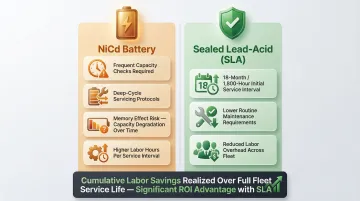
Battery chemistry directly determines how often a battery needs servicing — and those intervals add up fast. The cost difference between NiCd and sealed lead-acid becomes clearest when you compare maintenance requirements:
- NiCd batteries require frequent capacity checks and deep-cycle servicing to prevent memory effect (crystalline formation)
- Sealed lead-acid alternatives approved for Citations — such as the Teledyne Gill 7638-44T — carry 18-month or 1,800-hour initial capacity check intervals
That interval gap means fewer shop labor hours per battery over its service life. For high-utilization fleets, the cumulative labor savings can rival the unit price difference itself.
System-Level Conditions That Shorten Battery Life
Three system-level conditions routinely cause premature battery failure that gets misdiagnosed as end-of-life replacement:
- Incompatible or aging chargers — constant-voltage charging on NiCd batteries with imbalanced cells can trigger thermal runaway, per FAA Advisory Circular 43.13-1B
- Malfunctioning temperature sensors — unchecked overtemperature during charging degrades cell capacity faster than normal cycling
- Improper storage practices — deep self-discharge during long storage periods accelerates cell imbalance in NiCd packs
When these conditions go unaddressed, shops replace batteries that still had serviceable life remaining. Identifying the external cause first is what separates a one-time fix from a recurring cost.
Cost-Reduction Strategies for Citation Battery Replacements
Cost-reduction for Citation battery replacements depends on where costs are being generated. Some savings come from procurement decisions, others from how batteries are tracked and serviced, and others from addressing the aircraft systems that shorten battery life prematurely.
Strategies That Reduce Costs by Changing Decisions
These approaches target decisions made before or around the replacement event — sourcing, specification, and planning.
Evaluate FAA-PMA Approved 2nd-Source Batteries First
PMA batteries for Cessna Citations meet the same FAA airworthiness standards as OEM parts and are available at 30–70% lower cost. Shops that default to OEM without evaluating approved alternatives pass up meaningful cost reductions.
Ni-Cad Systems holds 30+ FAA-PMA approvals including 2nd-source batteries and temperature sensors specifically for aircraft battery applications, offering Part 145 shops a compliant, cost-effective sourcing option for Citation aircraft.
Treat Chemistry Selection as a Financial Decision
Transitioning from NiCd to sealed lead-acid batteries can reduce upfront capital expenditure by up to 85% and deliver $1,600 to $2,600 in annual maintenance savings per aircraft.
Sealed lead-acid batteries approved via STC or PMA for Citation models also offer longer initial capacity check intervals and lower routine maintenance requirements. The tradeoff between upfront cost, maintenance frequency, and application fit should be evaluated per Citation variant.
Fold Battery Work Into Scheduled Maintenance
Coordinate capacity checks and replacements to coincide with other airframe or avionics work. Standalone battery work orders add labor overhead, hangar time, and downtime that bundled scheduling eliminates.
Check for Approved Modification Kits Before Replacing
Certain FAA-PMA approved modification kits can update or extend the service life of existing battery assemblies. Research kit availability for the specific Citation model and battery configuration before committing to a full replacement purchase.
Strategies That Reduce Costs by Improving How Batteries Are Managed
Better tracking and smarter in-service decisions are some of the lowest-cost levers available — no capital outlay required.
Run Battery-Specific Tracking Logs
Record installation date, capacity check results, and service history per unit. Replacements should be driven by actual performance data — not conservative estimations or missing paperwork. Early replacement from poor recordkeeping is a significant, avoidable cost.
Use a Rental Battery Program to Limit AOG Exposure
AOG ground time costs corporate Citation operators thousands of dollars per day. Rental battery arrangements with a specialized repair facility eliminate the financial exposure of grounding an aircraft for routine service.
Ni-Cad Systems offers rental batteries to keep aircraft operational during planned and unplanned battery removals, with 24/7 AOG technical support available at +1 510 501-9391.
Partner With a Specialized Battery Repair Shop
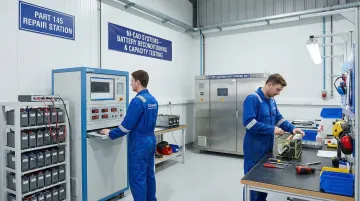
Not every battery that fails a capacity check requires replacement. A qualified shop can recondition and retest batteries that still have serviceable life — deep-cycle reconditioning can reduce annual failure rates from 45% down to 5%, extending service life by years.
Ni-Cad Systems has serviced over 47,000 units since 1974 and specializes in capacity testing and reconditioning for both NiCd and lead-acid batteries.
Standardize Capacity Testing Procedures
A battery tested under the wrong load conditions can produce a false failure result. Standardizing procedures across the shop reduces misdiagnosed replacements and eliminates the labor cost of repeat testing.
Strategies That Reduce Costs by Addressing the Context Around the Battery
These approaches fix the aircraft systems and operational conditions driving premature failures — the battery is rarely the actual problem.
Audit the Charging System Before Installing a New Battery
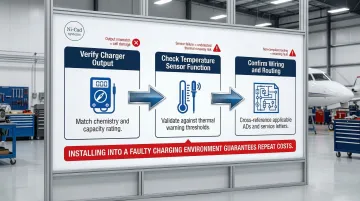
An overcharging or undercharging condition degrades a new battery as quickly as it degraded the old one. Verify charger output matches the installed battery chemistry and capacity rating for the Citation variant. Installing into a faulty charging environment guarantees repeat costs.
Validate Temperature Sensor Function
Malfunctioning temperature sensors can trigger false thermal warnings or fail to protect against actual overcharging. A degraded sensor that causes a premature removal is a hidden cost driver that precedes the battery work order.
FAA-PMA approved replacement temperature sensors are available at lower cost than OEM equivalents. Ni-Cad Systems manufactures PMA-approved sensors for multiple Citation models.
Cross-Reference Service Letters and ADs for the Specific Variant
Some Citation models have mandatory service documentation affecting battery wiring, routing, or charging configuration. FAA AD 2011-21-51, for example, was issued for the CJ4 following a battery fire and mandated replacement with NiCd or lead-acid batteries.
Compliance gaps shorten battery life and trigger inspections that overlap with service windows. Aligning battery management with applicable ADs and service letters reduces surprise labor costs.
Review Ground Power and Storage Practices
Leaving a Citation on an incompatible GPU for extended periods, or storing aircraft in extreme temperatures without monitoring, accelerates battery degradation. Standardizing ground handling procedures for battery preservation is a low-cost operational change that multiplies savings across a full fleet.
Conclusion
Cost control on Citation battery replacements starts with correctly diagnosing where the cost originates — procurement defaults, service management gaps, or system conditions shortening battery life ahead of schedule. Buying cheaper parts without that diagnosis just shifts the problem.
Each shop's cost profile is different, and the highest-return interventions vary accordingly:
- A shop with strong tracking but OEM-only procurement should evaluate PMA alternatives
- A shop with frequent AOG events needs rental battery programs and fast-turn service relationships
- A shop replacing batteries every 18 months likely has a charging system problem, not a battery problem
Long-term savings in this area require three consistent practices: procurement discipline around approved alternatives, tracking visibility across the fleet, and treating battery failures as diagnostic signals rather than automatic replacement triggers.
Frequently Asked Questions
Frequently Asked Questions
What are the FAA guidelines for batteries?
The FAA governs aircraft battery replacement through 14 CFR Part 43, applicable TSOs (including TSO-C173a for NiCd/lead-acid and TSO-C179b for lithium), and airworthiness directives. Replacement batteries must carry PMA or STC approval, and all work must be performed by rated personnel at a Part 145 facility.
Can a Part 145 shop install a PMA battery on a Cessna Citation without an STC?
Yes. A PMA battery is a direct like-for-like replacement and does not require a separate STC. An STC is only needed when installing a battery of a different chemistry or configuration—this qualifies as a major change in type design under 14 CFR 21.93.
How often do Citation NiCd batteries need to be replaced?
Replacement intervals depend on capacity check results rather than fixed calendar dates. FAA and manufacturer guidance require capacity checks at specified intervals (which vary by Citation model and battery type), and batteries are replaced when they can no longer meet minimum capacity thresholds—typically 85% of rated capacity per manufacturer specifications.
What is the difference between a PMA battery and an OEM battery for Cessna Citations?
PMA batteries are manufactured to FAA-approved design data and must meet the same airworthiness and performance standards as OEM parts under 14 CFR Part 21 Subpart K. The key difference is sourcing and price, not airworthiness status—making them a compliant, lower-cost option for Part 145 shops.
How does a battery rental program help reduce costs for Part 145 shops?
Rental or loaner batteries allow shops to send a Citation battery out for service without grounding the aircraft. AOG downtime can cost $10,000 to $150,000 per hour—far exceeding the battery cost itself—making rental programs especially valuable for operators with tight schedules.
Are sealed lead acid batteries an airworthy replacement for NiCd batteries on Cessna Citations?
Yes. Sealed lead acid batteries with FAA-PMA or STC approval are airworthy replacements for NiCd batteries on many Citation models. They typically offer longer maintenance intervals and lower routine service requirements, though shops must verify that the specific Citation variant and battery position are covered under the applicable approval.