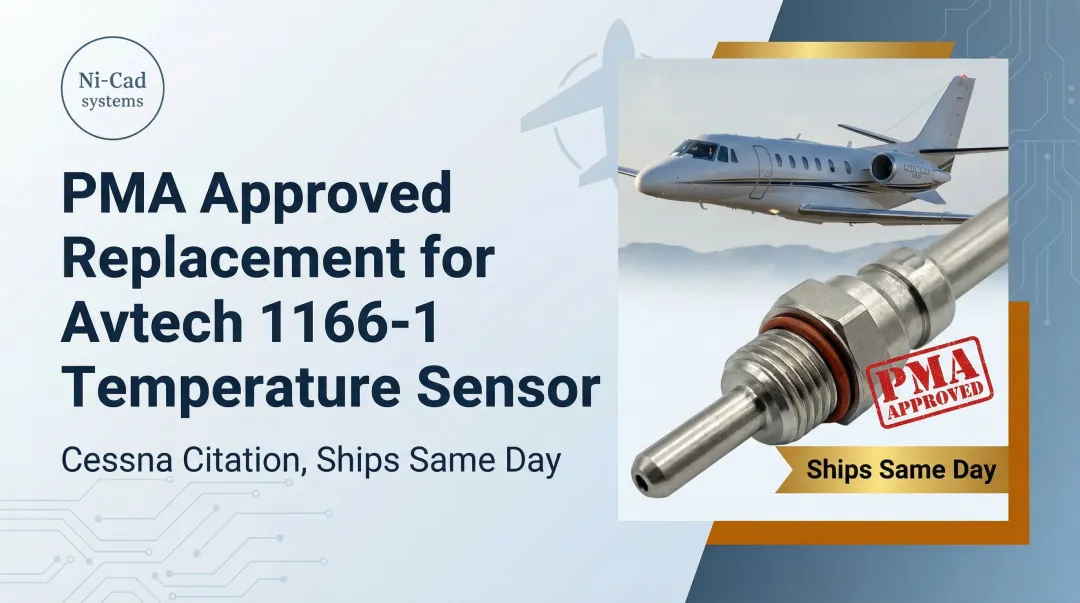
Supply chain disruptions, aging OEM inventory, and reduced support for legacy Citation variants have created a perfect storm. MRO technicians are increasingly turning to FAA-PMA (Parts Manufacturer Approval) certified second-source temperature sensors as a legally compliant, faster, and more cost-effective path forward. These alternatives maintain full airworthiness without sacrificing safety or regulatory compliance.
This article explains the core problem with Avtech supply, what PMA approval actually means, and what MRO shops should verify before installing a replacement sensor on Citation jets.
Key Takeaways
- FAA-PMA sensors are legally interchangeable with OEM Avtech sensors when approved for the specific aircraft and installation
- OEM supply shortages and aging inventory are pushing MRO shops toward qualified second-source parts
- PMA approval confirms identical airworthiness standards—not a lesser standard
- Established PMA suppliers can cut lead times and reduce per-unit costs without any compliance trade-off
- Before installation, verify the PMA data plate, approval basis, and aircraft applicability list
What Temperature Sensors Do on Citation Jets and Why They Get Replaced
Battery temperature sensors prevent thermal runaway
Citation jets rely on multiple temperature sensors to monitor critical systems during normal and emergency operations. The most safety-critical of these is the battery temperature sensor, which monitors nickel-cadmium (NiCd) battery conditions. According to FAA Advisory Circular 00-33A, NiCd batteries are highly susceptible to thermal runaway—a dangerous condition where high battery temperature combined with overcharging creates an uncontrollable feedback loop that can destroy the battery.
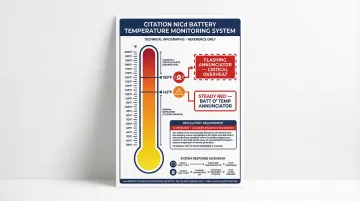
On Citation aircraft such as the 560 Ultra, the battery temperature sensor triggers a red "BATT O' TEMP" annunciator that illuminates steady at 145°F and flashes at 160°F. This sensor is distinct from the general battery temperature gauge and serves as a critical safety-of-flight component. Under 14 CFR 25.1353, NiCd battery installations must have a temperature sensing and over-temperature warning system with automatic disconnect capability.
Sensors are consumable components requiring periodic replacement
Battery temperature sensors degrade over time due to:
- Vibration loads sustained during normal flight operations
- Heat cycling from repeated charge and discharge cycles
- Corrosive off-gassing from NiCd cells
- Electrical stress from continuous monitoring circuits
Each of these stressors can compromise sensor calibration accuracy over time, which is why the FAA requires sensor accuracy testing during each battery reconditioning cycle. Specific replacement intervals vary by Component Maintenance Manual (CMM), but these sensors enter the MRO workflow regularly as wear items requiring periodic replacement or overhaul.
Avtech Corporation is a common OEM supplier for Citation sensors
Avtech Corporation (now AvtechTyee) has historically supplied sensors as either OEM or OEM-designated parts on several Citation models, making their part numbers the default specification for many Part 145 shops. Specific part numbers like Avtech 1529-1 and 1131-1 are widely called out for legacy Citation variants including the 500, 550, S550, and 560 series.
As these legacy fleets age and Avtech lead times stretch, MRO shops increasingly look for FAA-approved second-source alternatives that meet the same performance and regulatory requirements without the sourcing delays.
The Growing Problem with Avtech Sensor Availability and Support
OEM parts increasingly rely on salvage and used markets
Market data shows heavy reliance on the salvage and used parts market for Avtech sensors, with distributors frequently listing these sensors as "removed for upgrade" or "used." New Avtech parts are increasingly difficult to source, forcing MRO shops to compete for limited salvage inventory or face extended backorder delays.
The post-COVID aviation supply chain remains highly constrained. According to Oliver Wyman's 2025 MRO survey, material costs increased by an average of 7.7% annually, and turnaround times (TATs) have worsened across the board. Piece-part availability drives increased TATs, pushing the MRO industry to hold more inventory to compensate for supply chain performance.
AOG costs reach $150,000 per hour for Citation operators
When an aircraft is grounded due to component failure, the financial impact is severe and immediate. Industry data indicates that AOG events cost operators between $10,000 and $150,000 per hour, depending on aircraft size, route profitability, and demand. A single day on the ground can cost between $50,000 and $150,000, while a three-day grounding can easily exceed $600,000.
These figures encompass:
- Direct maintenance labor and expedited shipping
- Lost revenue from cancelled flights or charters
- Passenger compensation and contractual penalties
- Crew scheduling disruptions and hotel costs
For charter operators with contractual obligations, sensor unavailability can trigger cascade failures across fleet scheduling, making single-source OEM dependency an unacceptable business risk.

Legacy Citation fleets face diminishing OEM support
The Cessna Citation family includes over 1,180 Citation II/Bravo variants and 774 Citation V/Ultra/Encore variants delivered. As these fleets age, they require more maintenance and replacement parts. However, as OEMs shift focus to next-generation platforms, support for these legacy airframes shrinks — tightening parts availability further.
Thousands of legacy Citations remain in active service while the OEM parts pipeline contracts, leaving MRO shops to absorb the gap between rising demand and falling supply.
OEM shortages breed unapproved parts risks
That supply pressure has a direct consequence: when legitimate OEM inventory runs short, unapproved and counterfeit parts fill the void. The recent AOG Technics scandal, where a UK-based supplier distributed parts with forged FAA Form 8130-3 documents, highlights the severe vulnerabilities in the aviation supply chain.
The FAA's Suspected Unapproved Parts (SUP) program actively monitors this threat, warning that parts lacking proper traceability or offered at unusually low prices with short lead times present a significant risk to operational safety. For MRO shops, that risk profile makes traceable, FAA-PMA approved sourcing the only defensible path forward.
What FAA-PMA Certification Actually Means for Replacement Sensors
PMA is an FAA authorization, not a manufacturer claim
A Parts Manufacturer Approval (PMA) is a combined design and production approval issued by the FAA for modification and replacement articles. Under 14 CFR 21.311, the FAA issues a PMA only after confirming the applicant meets Subpart K requirements and that the design satisfies the airworthiness standards for the product it will be installed on.
The FAA approves both the design and production basis — not the manufacturer. A PMA part is a legally approved replacement that meets the same airworthiness standards as the original, not a knockoff or aftermarket substitute.
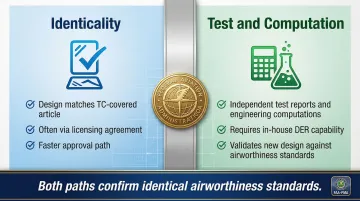
Two main approval bases: Identicality or Test and Computation
FAA Order 8110.42D and AC 21.303-4 define two primary methods for obtaining PMA approval:
- Identicality: Showing that the PMA article's design is identical to the design of an article covered under a Type Certificate (TC), often via a licensing agreement
- Test and Computation: Providing test reports and computations necessary to show that the design meets airworthiness requirements, using general or comparative analysis
Companies with in-house FAA Designated Engineering Representatives (DERs) can develop and validate new designs that meet the original airworthiness standard without requiring identicality to the OEM part. That's an important distinction: it takes real engineering capability, not just copying the original.
Ni-Cad Systems, a Hayward, CA-based FAA Part 145 facility, holds 30+ FAA-PMA approvals including for second-source temperature sensors. Their Vice President Stephen Andrues serves as an in-house FAA DER with over 40 years of NiCd battery servicing experience, enabling engineering-validated PMA designs rather than just copied parts.
PMA parts are legally approved and don't affect airworthiness certificates
The FAA has issued Special Airworthiness Information Bulletins explicitly stating that "A PMA or STC part, when FAA-approved for installation on a certificated product, is a valid replacement part to the TC/PC holder part according to 14 CFR." Furthermore, the installation of PMA parts does not change the FAA-approved life limits established for the TC/PC holder parts elsewhere within the assembly.
A common misconception in MRO shops is that using a non-OEM part triggers liability or voids airworthiness certificates. It doesn't. Manufacturer warranties are a commercial matter; FAA airworthiness approval is a regulatory one. The FAA — not the OEM — determines airworthiness.
Required documentation: Data plate, approval number, and applicability list
Under 14 CFR 45.15, the manufacturer must permanently and legibly mark each PMA article with:
- The PMA holder's name, trademark, or symbol
- The part number
- The letters "FAA-PMA"
FAA Order 8130.21H/J also governs the issuance of FAA Form 8130-3 (Authorized Release Certificate). This document confirms the airworthiness and traceability of new PMA articles produced under an FAA-approved quality system.
MRO verification steps:
- Check the PMA data plate or marking on the part
- Verify the FAA approval number matches the supplier's documentation
- Cross-reference the aircraft applicability list against your specific Citation model
- Confirm the supplier provides FAA Form 8130-3 with each shipment
Key Advantages MRO Shops Gain by Switching to PMA-Certified Alternatives
Dramatically reduced lead times and AOG costs
Aviation Week and Naveo's MRO survey reveals that 94% of respondents cited long OEM lead times as at least moderately important in prompting them to look at PMA alternatives, with 50% labeling it as "very important."
A qualified PMA supplier who maintains active stock of Citation-applicable temperature sensors can prevent $10,000 to $150,000 per hour in AOG costs. When Avtech parts are backordered for months, same-day or next-day shipping from a stocked PMA source is the difference between a grounded aircraft and one back in service.
Ni-Cad Systems offers 24/7 AOG technical support at +1 510 501-9391, with rental battery availability to keep aircraft operational during sensor replacement.
Cost savings of 30% to 70% compared to OEM pricing
PMA parts typically cost 30% to 70% less than OEM equivalents — a finding backed by a broad industry survey, with 88% of Aviation Week respondents rating price versus comparable OEM parts as a top priority.
PMA holders don't carry OEM overhead, royalties, or distribution markups — that's where the savings come from. For MROs servicing legacy Citations, using PMA battery temperature sensors directly lowers Direct Operating Costs (DOCs) without any compromise to airworthiness.
Complete traceability documentation simplifies Part 145 compliance
Under 14 CFR Part 145 and AC 145-9A, repair stations must maintain strict quality control and traceability records. AC 145-9A specifies that maintenance releases must include a record of the parts used, particularly if the maintenance involved substituting parts, such as PMA parts.
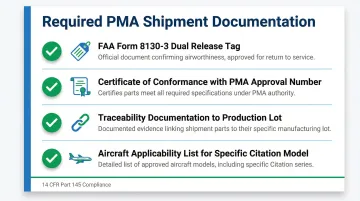
A qualified PMA supplier ships with complete documentation, including:
- Complete FAA paperwork with every shipment
- FAA Form 8130-3 airworthiness tag (dual release)
- Certificate of conformance referencing the PMA approval number
- Traceability documentation to the specific production lot
This simplifies the MRO shop's logbook entry and reduces audit risk under 14 CFR Part 145 quality control requirements.
What to Look for When Choosing a Replacement Sensor Supplier
Verify active FAA-PMA approval numbers and Part 145 certification
The non-negotiable credentials to verify include:
- Active FAA-PMA approval numbers specifically covering the Citation model(s) in question
- Part 145 repair station certification if the supplier also performs overhauls
- Verifiable track record in the Citation or NiCd battery ecosystem
Ni-Cad Systems holds 30+ FAA-PMA approvals covering second-source temperature sensors and battery components, and operates as a Part 145 approved repair facility with over 50 years of aviation battery experience. Their in-house FAA Designated Engineering Representative (DER) means PMA designs are independently validated to engineering standards before approval.
Confirm AOG support capability and technical availability
The right supplier should be able to:
- Ship same-day or next-day for AOG situations
- Offer rental or loan units to keep aircraft flying during repair
- Provide technical support for shops less familiar with sensor installation nuances on specific Citation variants
Ni-Cad Systems provides 24/7 AOG technical support at +1 510 501-9391, with rental batteries available to keep aircraft operational during sensor or battery service.
Demand complete traceability paperwork with every shipment
Every replacement sensor should ship with:
- FAA Form 8130-3 dual release tag documenting airworthiness
- Manufacturer's certificate of conformance referencing the PMA approval number
- Clear reference to the aircraft applicability list showing specific Citation model coverage
Any supplier unable or unwilling to provide this documentation should be disqualified outright. The FAA's Dynamic Regulatory System (DRS) allows users to search the database by PMA holder, article name, part number, and the specific make and model on which the PMA part can be installed.
Verify supplier credentials against AC 21-29D
To combat the rise of Suspected Unapproved Parts (SUPs), AC 21-29D advises purchasers to establish procedures for screening distributors. Red flags include:
- Quoted prices significantly lower than other distributors
- Unusually short delivery schedules when the market is exhausted
- Inability to provide substantiating documentation (like an 8130-3) proving the part was produced under an FAA approval
A supplier that clears all four checkpoints — valid PMA coverage, AOG capability, complete documentation, and clean AC 21-29D screening — is one you can confidently bring into your Citation maintenance program.
Frequently Asked Questions
Are FAA-PMA replacement sensors legally approved for use on certificated Citation jets?
Yes. FAA-PMA parts are legally approved under 14 CFR Part 21 Subpart K and are considered approved parts when installed by a certified technician. They do not compromise airworthiness as long as the PMA covers the specific aircraft and installation.
How is an FAA-PMA part different from a bogus or unapproved part?
A PMA part carries an FAA-issued approval number, is manufactured under FAA-approved production controls, and ships with an 8130-3 tag. Counterfeit or unapproved parts have none of these—they lack traceability, regulatory oversight, and legal authorization.
Does installing a PMA temperature sensor affect a Citation's airworthiness certificate?
No. Installing an FAA-approved PMA part does not affect airworthiness, provided the installation is performed by a certificated technician and properly documented in the maintenance record per FAR 43.
How do MRO shops verify that a PMA approval covers their specific Citation model?
Three steps confirm coverage:
- Review the supplier's PMA data sheet or aircraft applicability list
- Cross-reference the FAA's PMA database at drs.faa.gov
- Confirm the specific part number and aircraft type certificate number match
What documentation should accompany a PMA temperature sensor shipment?
A compliant shipment includes:
- FAA Form 8130-3 airworthiness approval tag (dual release)
- Certificate of conformance referencing the PMA approval number
- Traceability documentation to the specific production lot
Why are Avtech sensor lead times becoming a problem for Citation operators now?
A combination of post-pandemic supply chain disruptions, aging fleet parts attrition, and reduced OEM investment in legacy Citation variant support are the main drivers of extended Avtech sensor availability issues.