This scenario is increasingly common for operators of mature Citation fleets. Legacy OEM parts like the SCD390-3-1 are subject to supply chain constraints, production prioritization shifts, and obsolescence risk. But there's a solution: Ni-Cad Systems' NCS390-3-1, an FAA-PMA approved direct replacement that's in stock and ready to ship today.
This post is for A&P mechanics, MRO shops, corporate flight department maintenance managers, and parts procurement teams supporting Citation 560XL and Citation X (750) fleets who need a legally compliant, immediately available emergency lighting battery solution.
Key Takeaways (TLDR)
- NCS390-3-1 is a direct drop-in replacement for the Avtech SCD390-3-1 on Citation 560XL and Citation X (750) aircraft
- Ni-Cad Systems' NCS390-3-1 is FAA-PMA approved as a second-source replacement—currently in stock
- Units ship from Hayward, CA; call or email to confirm same-day availability before ordering
- Part 145 FAA repair facility; 50+ years of aviation battery experience behind every part
- 24/7 AOG support available at +1 510 501-9391
What Is the SCD390-3-1 Emergency Lighting Battery?
The SCD390-3-1 is an emergency lighting battery originally manufactured by Avtech Corporation, a legacy aerospace supplier now part of TransDigm Group. This battery pack is installed in the Cessna Citation 560XL and Citation X (750) to power cabin and exit emergency lighting systems during electrical failures.
Why Emergency Lighting Batteries Are Safety-Critical
Emergency lighting batteries aren't optional maintenance items—they're safety-of-flight components subject to strict FAA regulations. Under 14 CFR §25.812, transport category aircraft like the Citation 560XL and Citation X must have independent battery-powered emergency lighting that:
- Activates automatically upon loss of normal electrical power
- Operates independently from the main lighting system
- Provides required illumination for at least 10 minutes post-emergency
This 10-minute minimum is non-negotiable. Batteries are on mandatory inspection and replacement cycles, with capacity testing required to ensure they maintain at least 80% of rated capacity. Failure to comply can ground your aircraft and expose operators to FAA enforcement action.
The OEM Sourcing Challenge
Avtech merged with Tyee to form AvtechTyee, which was later acquired by TransDigm Group in 2014. Since the acquisition, TransDigm has deprioritized legacy part production, and sourcing the SCD390-3-1 has become increasingly unreliable. Parts databases frequently list it as subject to supersedure, limited availability, or requiring AOG expediting.
That sourcing gap has real consequences for operators:
- Extended Aircraft-On-Ground (AOG) time waiting on a single battery pack
- Costly delays from expedite fees and last-minute logistics
- AOG events cost business aviation operators between $10,000 and $150,000 per hour in lost revenue, charter replacements, and crew costs
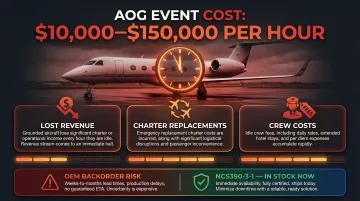
The NCS390-3-1 — an FAA-PMA approved, in-stock second-source replacement — eliminates that dependency entirely.
Why FAA-PMA Certification Is Non-Negotiable for Aircraft Battery Replacements
What Is FAA-PMA?
FAA-PMA (Parts Manufacturer Approval) is an FAA authorization that approves a manufacturer to produce a specific replacement aeronautical part or appliance. It confirms the part meets the same airworthiness design and production standards as the OEM part it replaces.
The Legal Requirement
Under 14 CFR §21.9, installing an unapproved part—even one that appears physically identical—can:
- Compromise aircraft airworthiness
- Void maintenance records
- Expose operators and mechanics to regulatory and liability consequences
The PMA framework is governed by 14 CFR Part 21, Subpart K. Under §21.303, applicants must prove their replacement part meets airworthiness requirements through test reports, computations, or demonstrated identicality to the original design.
Section 21.307 further requires PMA holders to maintain an FAA-approved quality system ensuring every part conforms to the approved design before it leaves the facility.
Why PMA Matters for Emergency Lighting Batteries
Emergency lighting batteries must perform on demand — there is no backup if they fail. The FAA holds them to strict performance and reliability standards, and only parts that have passed PMA evaluation qualify as airworthy replacements.
Installing an unapproved part in a safety-critical system violates FAA regulations and triggers enforcement under the Suspected Unapproved Parts (SUP) program (AC 21-29D). Consequences include:
- Revocation of airworthiness certificates
- Civil penalties up to $25,000 per violation
- Potential criminal liability for knowing violations
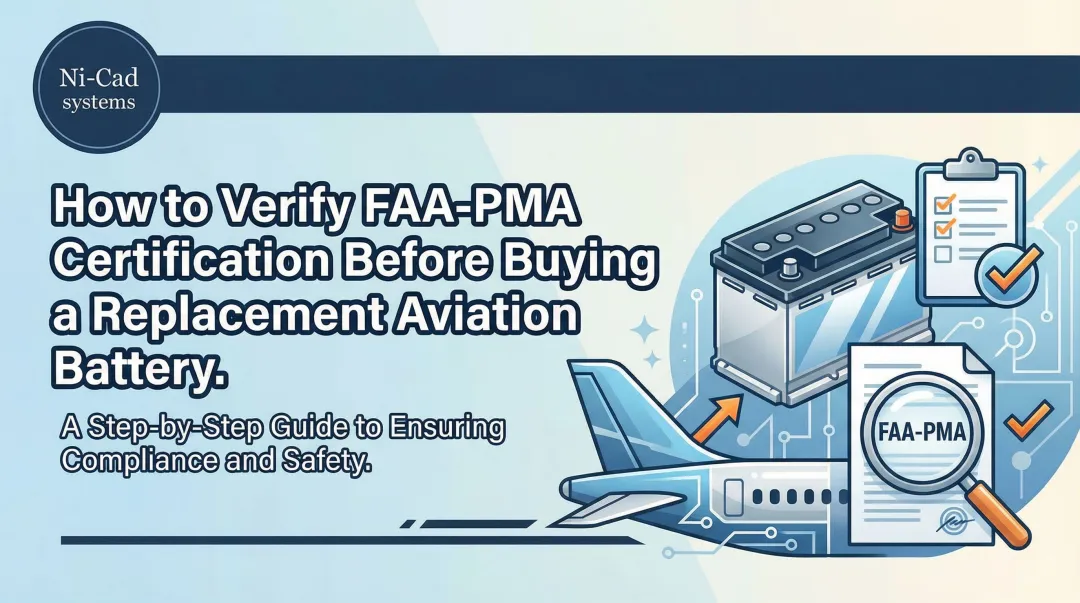
How to Verify PMA Status
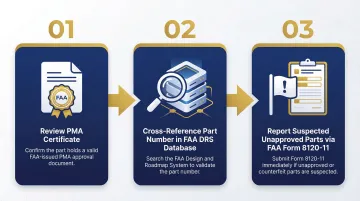
Mechanics and MRO shops can verify PMA status by:
- Checking the Parts Manufacturer Approval certificate that accompanies each FAA-PMA part
- Cross-referencing the part number (e.g., NCS390-3-1) in the FAA's PMA database via the Dynamic Regulatory System (DRS)
- Reporting any suspected unapproved parts using FAA Form 8120-11
Introducing the NCS390-3-1: FAA-PMA Approved Replacement for the SCD390-3-1, In Stock Now
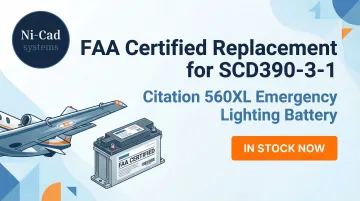
The NCS390-3-1 is Ni-Cad Systems' recently approved FAA-PMA second-source replacement for Avtech p/n SCD390-3-1, approved for installation on the Cessna Citation 560XL and Citation X (750). It's currently in stock.
What "Second-Source Replacement" Means
The NCS390-3-1 is designed and manufactured to fulfill the same form, fit, and function as the OEM SCD390-3-1, and has received FAA approval to be installed wherever the SCD390-3-1 is called for in the maintenance manual. This means:
- Direct interchangeability with the OEM part
- No modifications to aircraft systems required
- Full compliance with FAA airworthiness standards
- Legally acceptable for installation in certificated aircraft
Engineering Credentials Behind the Approval
Ni-Cad Systems' VP and General Manager Stephen Andrues is an FAA Designated Engineering Representative (DER), an A&P mechanic, and a pilot with 40 years of NiCd battery experience. The NCS390-3-1 was developed under direct DER oversight and tested to FAA-PMA standards — the same process behind Ni-Cad Systems' 30+ existing approvals. That track record carries into availability as well.
In-Stock Availability and AOG Readiness
Unlike OEM backorder situations, the NCS390-3-1 is available for immediate shipment. Ni-Cad Systems offers 24/7 AOG support for urgent orders, meaning a grounded Citation 560XL can get the part it needs without extended downtime.
To order the NCS390-3-1, check current stock, or speak with a technical expert:
- Email: Sales@NiCadSystems.com
- 24/7 AOG Hotline: +1 510 501-9391
- General Inquiries: +1 510 785-9391
Emergency Lighting System Requirements for the Citation 560XL and Citation X
The 10-Minute Regulatory Mandate
Because the Citation 560XL and Citation X are Part 25 transport category aircraft, their emergency lighting systems must adhere to 14 CFR §25.812. This regulation establishes non-negotiable survival standards:
- The system must be entirely independent of the main aircraft lighting system
- The energy supply must provide required illumination for at least 10 minutes at critical ambient conditions after emergency landing
- The system must feature automatic activation upon interruption of normal electric power
- All components, including batteries, must survive severe crash inertia forces per §25.561(b)
Inspection and Replacement Implications
Emergency lighting batteries have defined service life intervals and capacity test requirements. They must be tested and replaced per the aircraft's maintenance manual or Component Maintenance Manual (CMM). A battery is airworthy only if it retains at least 80% of its original rated capacity during timed discharge testing.
Nickel-Cadmium battery storage considerations:
- Ni-Cd batteries lose 10-15% capacity in the first 24 hours after charge
- They lose an additional 10% per month at room temperature
- Proper storage requires climate control (32°F to 50°F) and periodic boost charges
- Improperly stored spare batteries can be unairworthy right out of the box
No Legal Workarounds
Those storage and testing requirements make it tempting to shortcut the process—but using a non-PMA, non-approved part is not a legal option. Any discrepancy discovered during an FAA audit or incident investigation can ground the fleet and expose the operator to enforcement action. Having a certified, in-stock replacement like the NCS390-3-1 eliminates that risk without adding lead time.
Why Aviation Professionals Trust Ni-Cad Systems for Second-Source Battery Solutions
Ni-Cad Systems' credentials speak for themselves:
- Founded in 1974 with over 50 years of continuous operation
- FAA Part 145 approved repair station
- 30+ FAA-PMA approvals across multiple aircraft platforms
- Over 47,000 units serviced since inception
- 100+ years of combined team experience in aviation battery engineering and service
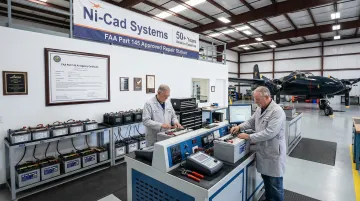
That depth of experience translates directly into a broad second-source product line.
Breadth of Second-Source Capabilities
Ni-Cad Systems holds PMA approvals for aircraft battery replacements across multiple platforms. The NCS804750, for example, is an FAA-PMA approved replacement for the SAFT 804750 and 20 VRED batteries used on the Dassault Falcon 900, 900EX, 2000, and 2000EX. The NCS390-3-1 for the Citation 560XL is one product in a growing PMA portfolio built on the same engineering rigor.
Service Advantages
- Fast turnaround times with rental batteries to keep aircraft flying during service
- 24/7 AOG support at +1 510 501-9391
- Ability to service any NiCd or lead-acid aircraft battery
- Capacity testing, deep-cycle testing, and storage services
- One-stop resource for Citation fleet operators and MRO shops
Frequently Asked Questions
Frequently Asked Questions
What is the replacement for the SCD390-3-1 battery?
The certified replacement is NCS390-3-1, Ni-Cad Systems' FAA-PMA approved second-source part. It is approved for use on the Cessna Citation 560XL and Citation X (750), and is currently available in stock.
Do aircraft parts have to be certified?
Yes. Under FAA regulations, all replacement aeronautical parts must be produced under an approved quality system and meet airworthiness standards. FAA-PMA is the specific certification required for manufacturer-produced replacement parts like the NCS390-3-1.
What does FAA-PMA mean for a replacement battery?
FAA-PMA (Parts Manufacturer Approval) is the FAA's authorization confirming a replacement part meets the same design and performance standards as the OEM part. That approval makes it legally and technically acceptable for installation in a certificated aircraft.
Is the NCS390-3-1 compatible with the Citation X (750) as well as the Citation 560XL?
Yes. The NCS390-3-1 is FAA-PMA approved for both the Cessna Citation 560XL and the Citation X (750).
How quickly can I receive the NCS390-3-1 in an AOG situation?
Ni-Cad Systems maintains the NCS390-3-1 in stock and offers 24/7 AOG support. Call the AOG line at +1 510 501-9391 or email Sales@NiCadSystems.com for immediate assistance and shipping arrangements.
Can Ni-Cad Systems also service or repair my existing SCD390-3-1 battery?
Yes. As a Part 145 FAA approved repair facility, Ni-Cad Systems can evaluate and service existing aircraft batteries. Contact the team at +1 510 785-9391 to discuss repair versus replacement options.