Introduction
The SAAB 340 remains a workhorse of regional aviation, with hundreds of airframes still in daily service across North America and Europe. At the heart of its electrical system sits the 3340D NiCd battery—the standard power source responsible for engine starts, emergency backup, and avionics continuity. A battery failure doesn't just ground a flight — it triggers airworthiness reviews, AOG delays, and unplanned maintenance costs that ripple through your dispatch schedule.
Regional MROs face a familiar set of pressures: OEM batteries are expensive, lead times stretch for months, and NiCd chemistry demands intensive upkeep — including:
- Scheduled deep cycling
- Electrolyte checks
- Capacity testing
- Hazmat handling and disposal
With supply chain delays costing the airline industry over $11 billion in 2025, more operators are evaluating certified alternatives. For most regional MROs, the real challenge is navigating the regulatory path to approved replacements — not deciding whether to look.
This guide covers when to replace your SAAB 340 battery, what certified alternatives exist, regulatory requirements for PMA and STC installations, failure indicators that trigger replacement, and maintenance schedule differences by battery type.
Key Takeaways
- The 3340D NiCd battery is the OEM standard but not the only FAA-compliant option for SAAB 340 operators
- Certified alternatives include FAA-PMA approved NiCd second-source batteries and SLA conversions approved via Supplemental Type Certificate
- PMA batteries are direct drop-ins — standard logbook entries only
- STC conversions require Form 337 and applicable program updates
- Replace batteries when capacity drops below 80%, excessive heat occurs during charging, or physical damage is visible
- NiCd batteries require 3-month electrolyte checks and 6-month deep cycles
- SLA batteries are sealed and maintenance-free for up to 18 months
Why Regional MROs Are Rethinking the OEM SAAB 340 Battery
Cost and Availability Pressures
OEM NiCd battery lead times have become a bottleneck for regional operators. According to IATA, unpredictable supply chain disruptions are forcing airlines to stock more spare parts, which increases surplus inventory holding costs. For MROs managing multiple SAAB 340 frames, this means tying up capital in backup batteries or risking aircraft-on-ground situations when batteries fail unexpectedly.
OEM batteries carry premium pricing — and that's before freight, hazmat surcharges, and administrative overhead. For thin-margin regional operations, those add-ons push the true cost well past the sticker price.
The Maintenance Burden of NiCd Chemistry
Nickel-cadmium batteries demand constant attention:
- Scheduled deep cycling every 6 months to prevent memory effect
- Electrolyte checks every 3 months with distilled water replenishment
- Capacity testing to verify the battery still delivers rated amp-hours
- Hazmat handling for shipping, storage, and disposal
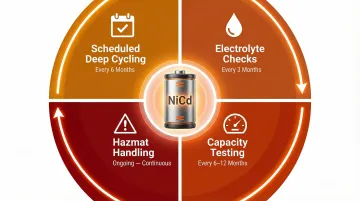
Across a fleet, these requirements add up fast. A Part 145 facility must maintain specialized tooling, trained technicians, and proper ventilation for NiCd servicing. Pull a battery for service and the aircraft sits idle unless a rental unit is available.
Growing Regulatory Acceptance of Certified Alternatives
The FAA has explicitly validated the use of certified aftermarket parts to alleviate supply chain pressures. FAA Special Airworthiness Information Bulletin NE-08-40 confirms that FAA-approved PMA and STC parts are fully interchangeable within the certificated product. MROs no longer need to default to OEM parts to remain compliant—provided they follow the correct approval pathways.
Certified Alternatives to the 3340D: What MROs Need to Know
Regional operators have two primary certified paths available: FAA-PMA approved NiCd second-source batteries and SLA chemistry batteries installed via Supplemental Type Certificate. Both are legal, but they differ significantly in process, cost, and maintenance profile.
FAA-PMA Approved NiCd Second-Source Batteries
What FAA-PMA Approval Means
Under 14 CFR Part 21 Subpart K, a Parts Manufacturer Approval is a combined design and production approval for replacement articles. The manufacturer has demonstrated that the part meets or exceeds OEM design standards through rigorous testing and documentation. Critically, no STC or aircraft logbook modification entry is required—this is the lowest-friction swap available to MROs.
Direct Drop-In Replacement
PMA NiCd batteries maintain the same chemistry, form factor, connector, and voltage/amp-hour rating as the 3340D. Installation requires only a standard maintenance record entry per 14 CFR §43.9, detailing the work performed, date, and technician signature. Because the replacement is functionally identical, technicians continue using existing NiCd servicing procedures with no retraining required.
Verified PMA Options for SAAB 340:
| OEM Part Number | PMA Second-Source | PMA Holder | Aircraft Eligibility |
|---|---|---|---|
| Saft 4078-7 | AD-4078-7 | Aero Design, Inc. | SAAB 340A, 340B |
| Marathon SP-400 | AD-4078-7 | Aero Design, Inc. | SAAB 340A, 340B |
Ni-Cad Systems holds 30+ FAA-PMA approvals covering NiCd aircraft batteries, including direct second-source replacements for the SAAB 340 (P/N 3340D). The company also provides capacity testing, deep-cycle testing, and rental battery programs to minimize ground time during service turnarounds.
For operators evaluating a chemistry change rather than a like-for-like swap, the STC path offers a different trade-off.
SLA Conversion via Supplemental Type Certificate
The STC Path
Changing battery chemistry from NiCd to Sealed Lead-Acid constitutes a major change in type design. Under 14 CFR Part 21 Subpart E, the MRO must reference or obtain an STC, file FAA Form 337, and enter the alteration in the aircraft logbook. The aircraft's MEL and AMM documentation may need updating to reflect the new battery type and maintenance intervals.
The upfront paperwork is heavier than a PMA swap, but for high-utilization operators, the reduced ongoing maintenance load changes the calculus.
Operational Advantages of SLA for SAAB 340
SLA batteries offer several operational advantages worth considering:
- No electrolyte checks or water replenishment — rated for up to 18 months or 5,500 flight hours
- Ships under UN2800 "Batteries, wet, non-spillable", eliminating hazmat freight surcharges
- Maintains stable performance across a wider temperature range than NiCd
- Recovers from deep discharge without the permanent capacity loss that degrades NiCd packs
Global STC Approvals for SAAB 340 SLA Conversion:
| Authority | STC Number | STC Holder | Applicable Models |
|---|---|---|---|
| FAA | ST02530SE | AeroMech Inc. / Securaplane | 340A, 340B |
| EASA | 10063263 | Securaplane Technologies | 340A, 340B |
| TCCA | ST02530SE | Securaplane Technologies | 340A, 340B |
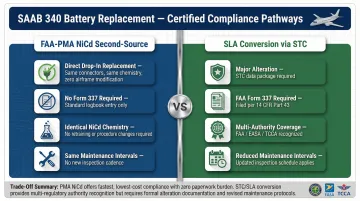
For operators running mixed international routes, the Securaplane STC kit covers all three jurisdictions under a single approval — one conversion decision, no authority-by-authority re-approval required.
Regulatory and Documentation Requirements for MROs
PMA vs. STC: Understanding the Regulatory Boundary
PMA Installation (14 CFR Part 21 Subpart K):
- Classified as a direct replacement, not an alteration
- Requires only standard logbook entry per 14 CFR §43.9
- No Form 337 required
- FAA Form 8130-3 (Airworthiness Approval Tag) accompanies the part for conformity verification
STC Installation (14 CFR Part 21 Subpart E):
- Classified as a major alteration per 14 CFR Part 43 Appendix A
- Requires completed Form 337 (Major Repair and Alteration)
- Requires detailed logbook entry documenting the alteration
- Requires retention of Form 337 per 14 CFR §91.417
Documentation Requirements by Path
For PMA NiCd Second-Source:
- PMA tag verifying manufacturer approval
- FAA Form 8130-3 (Airworthiness Approval Tag)
- Serviceable tag confirming the battery has been tested and approved for installation
- Standard maintenance record entry in aircraft logbook
For SLA Conversion via STC:
- Complete STC data package including installation instructions and wiring diagrams
- Completed FAA Form 337 with STC number referenced
- Airworthiness approval from authorized inspector or repair station
- Detailed logbook entry documenting the alteration
- Updated maintenance program reflecting new battery type and service intervals
Part 145 Repair Station Obligations
Battery servicing—whether NiCd capacity testing or SLA inspection—must be performed by an FAA-approved repair facility. Under 14 CFR §145.215, a certificated repair station may only perform maintenance or alterations on an article if it is listed on their current capability list.
MROs must verify:
- Their Part 145 certificate scope covers battery work
- Technicians are trained on the specific battery type
- Current Instructions for Continued Airworthiness are accessible
- Proper tooling and test equipment are available
Facilities without battery-specific approval on their capability list must source servicing from a qualified Part 145 repair station. Ni-Cad Systems holds FAA Part 145 certification and specializes in NiCd and lead-acid aircraft battery testing and repair for corporate, airline, and military operators.
Airworthiness Directive Review
When installing replacement or alternative parts, technicians cannot assume the new part is exempt from existing Airworthiness Directives. FAA AC 39-7D places responsibility on the person performing maintenance to verify that all applicable airworthiness requirements are met, including AD compliance.
Before installation, confirm:
- No open ADs apply to the 3340D installation that would affect alternative battery eligibility
- The replacement battery is compatible with the aircraft's existing MMEL
- Any battery-related service bulletins have been reviewed
International Fleet Considerations
Domestic AD compliance is only part of the picture. If your SAAB 340 fleet operates under EASA or TCCA jurisdiction, additional documentation requirements apply at the point of receiving inspection.
EASA Acceptance of FAA-PMA Parts:
Under the FAA-EASA Technical Implementation Procedures (TIP Rev 7), EASA directly accepts FAA PMA approvals for non-critical components. The FAA Form 8130-3 must contain this exact statement in the remarks block:
"This PMA part is not a critical component"
Without this verbiage, EASA-regulated MROs must reject the part. Receiving inspectors should check the remarks block before signing off acceptance.
TCCA and Other Authorities:
For TCCA-registered aircraft, confirm the alternative battery holds the corresponding foreign authority approval. The Securaplane SLA conversion (STC ST02530SE) covers FAA, EASA, and TCCA jurisdictions, which reduces the documentation burden for mixed-registry fleets.
Signs Your SAAB 340 Battery Needs Replacement
Signs Your SAAB 340 Battery Needs Replacement
Capacity Degradation
NiCd batteries gradually lose usable amp-hour capacity through the memory effect and cell imbalance. The only accurate way to determine battery health is through a measured discharge capacity test. Industry standards define end-of-life capacity as ≤80% of rated capacity.
When capacity falls below 80% of the rated one-hour (C1) value:
- The battery is considered unairworthy
- It must be replaced or reblocked (individual cell replacement)
- Continued use risks cell reversal and electrical system failures
Perform capacity testing per the battery Component Maintenance Manual — typically every 6 months for NiCd batteries in transport category aircraft.
Thermal Anomalies During Charging
Elevated case temperatures, excessive gassing, or electrolyte overflow indicate internal cell failure or overcharge damage. FAA AC 43.13-1B warns that NiCd batteries can enter thermal runaway if temperatures exceed 160°F during constant-voltage charging.
Normal NiCd charge behavior vs. failure indicators:
| Normal | Failure Indicator |
|---|---|
| Slight warmth during charge | Case temperature >120°F |
| Minimal gassing near full charge | Heavy gassing throughout charge cycle |
| Stable electrolyte level | Rapid electrolyte loss or overflow |
| Consistent charge time | Significantly extended charge time |
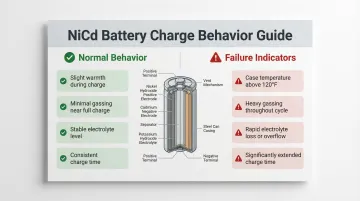
If you observe excessive heat or gassing, remove the battery from service immediately and perform a capacity test before returning it to the aircraft.
Voltage Irregularities and Cell Reversal
Individual cell voltage monitoring during discharge can reveal reversed cells — a common NiCd failure mode. Cell reversal happens when one or more cells discharge fully while others retain charge. The depleted cell's polarity flips, dragging down overall pack voltage and triggering avionics undervoltage faults during engine start.
This failure mode is directly traceable to maintenance gaps.
Indicators of cell reversal:
- Battery voltage drops rapidly under load
- Voltage recovers slowly after load is removed
- Measured voltage significantly below rated value (e.g., 22V instead of 24V)
- Uneven cell voltages during discharge testing
Most cases trace back to skipped or inadequate deep-cycle maintenance. Restoring a proper deep-cycle schedule — per the CMM interval — prevents the cell imbalances that lead here.
Physical Inspection Indicators
These visual findings mandate immediate removal from service:
- Corrosion around terminals — indicates electrolyte leakage or poor connection
- Case swelling — suggests internal pressure buildup from cell failure
- Electrolyte leakage — visible wetness or white crystalline deposits
- Cracked cell vents — compromises pressure relief and allows contamination
These findings also require inspection of the battery tray and aircraft wiring. Electrolyte (potassium hydroxide) is highly corrosive and can damage surrounding structure if not addressed promptly.
Maintenance Schedules and Service Intervals by Battery Type
Service Interval Comparison
The maintenance burden differs dramatically between NiCd and SLA batteries:
| Maintenance Task | OEM/PMA NiCd | SLA (via STC) |
|---|---|---|
| Electrolyte check | Every 3 months | None required |
| Deep cycle / balancing | Every 6 months | None required |
| Capacity test | Every 6-12 months | 18 months or 5,500 flight hours |
| Expected service life | 3-5 years | 5-7 years |
| Hazmat shipping | Yes (UN2795) | No (UN2800 non-spillable) |
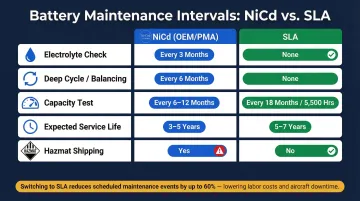
NiCd Maintenance Profile
Saft Operating and Maintenance Manuals typically require three recurring tasks:
- Every 3 months: Adjust electrolyte levels and replace water consumed by overcharging
- Every 6 months: Deep discharge balancing and capacity verification
- Every 12 months: Complete inspection, capacity test, and full reconditioning
SLA Maintenance Profile
Securaplane SLA batteries require no maintenance or capacity checks for up to 18 months or 5,500 flight hours from installation. If remaining capacity exceeds 90% at the first check, the next interval is deferred for another 5,500 flight hours.
Implications for MRO Planning
Those interval differences translate directly into labor hours, tooling requirements, and administrative overhead — so the right choice depends on your facility's existing setup.
PMA NiCd second-source lets MROs continue using existing tooling, procedures, and trained staff with zero process change. This path makes sense when:
- Your Part 145 facility already has NiCd capability
- Technicians are experienced with NiCd maintenance
- You want to avoid the administrative overhead of STC execution
- You need immediate availability without aircraft modification
Ni-Cad Systems offers FAA-PMA approved NiCd replacements for the SAAB 340 (P/N 3340D) that install directly in the existing tray with no modifications required.
SLA conversion reduces scheduled maintenance events but requires upfront planning:
- Verify technicians understand the different charge profile
- Confirm the aircraft's charging system is compatible (may require temperature sensor installation)
- Update maintenance program to reflect 18-month intervals
- File Form 337 and update aircraft records
For high-utilization fleets, eliminating quarterly electrolyte checks and semi-annual deep cycles can free dozens of technician-hours per year — time better spent on avionics and airframe work.
Rental Battery Programs for AOG Scenarios
When a battery is pulled for service or replacement, having a certified spare or rental unit available prevents aircraft-on-ground delays. Ni-Cad Systems offers rental battery programs specifically designed to keep regional operators flying during service turnarounds. Each rental unit carries FAA-PMA approval, arrives certified serviceable, and is available 24/7 for AOG support.
Rental programs provide:
- Immediate return to service while your battery is being serviced
- No need to stock multiple spare batteries
- Less capital tied up in backup inventory
- Same-day or next-day availability in most AOG scenarios
For SAAB 340 operators, this means capacity testing and deep cycling can be scheduled during planned maintenance windows without impacting dispatch reliability.
Frequently Asked Questions
Are AGM batteries FAA approved?
AGM (Absorbent Glass Mat) batteries are a type of sealed lead-acid battery and can be FAA approved when installed under an approved STC or manufactured under FAA-PMA. Approval is part-specific and aircraft-specific, not blanket by chemistry type.
What is the difference between a PMA battery and an STC battery replacement for the SAAB 340?
A PMA battery is a direct replacement part requiring no aircraft modification—only a standard logbook entry. An STC-based replacement (such as an SLA conversion) constitutes an alteration requiring logbook entry, Form 337, and all supporting STC documentation.
Can NiCd second-source batteries be used as a direct drop-in replacement for the 3340D?
Yes. FAA-PMA approved NiCd second-source batteries meet or exceed OEM specifications and install in the same tray with the same connectors. No STC or logbook alteration entry is needed.
How often should SAAB 340 NiCd batteries be serviced or replaced?
NiCd batteries require scheduled capacity testing and deep cycling per the battery CMM—every 6 months as a general interval. Replacement is triggered when capacity falls below approximately 80% of rated value or when physical damage is found.
What certifications should an MRO look for when sourcing an alternative SAAB 340 battery?
MROs should verify FAA-PMA approval documentation for NiCd second-source units, or a valid STC with FAA (and EASA/TCCA if applicable) approval for SLA conversions. The supplying facility should also hold Part 145 approval.
Does switching to an SLA battery on the SAAB 340 require updating the aircraft's maintenance program?
Yes. An SLA conversion under STC typically requires revising the aircraft's approved maintenance program to reflect the new battery type, service intervals, and any charger compatibility requirements specified in the STC data package.
Need immediate assistance with SAAB 340 battery replacement? Ni-Cad Systems offers FAA-PMA approved second-source batteries, capacity testing, and 24/7 AOG support. Contact their technical team at +1 510 785 9391 or emergency support at +1 510 501 9391.