NTSB Report CEN23LA014 documents a Diamond DA62 that suffered complete engine power loss due to incorrectly wired ECU backup batteries, resulting in a forced landing. FAA Unapproved Parts Notification 96-186 highlights improperly repaired NiCd battery cells that created conditions leading to uncontrollable thermal runaway. These aren't theoretical risks—they're documented failures with real consequences.
This article walks through the exact cross-referencing process step by step, covers what compatibility factors to verify, and explains the documentation required to stay compliant under FAA regulations.
Key Takeaways
- Cross-referencing requires verified form, fit, and function equivalency, not just matching voltage or capacity
- The FAA's PMA framework (14 CFR Part 21, §21.303) governs which replacement parts are legally installable on type-certificated aircraft
- Confirm aircraft-specific eligibility for any PMA replacement, not just general approval status
- Documentation requirements differ by alteration type — minor changes require a logbook entry; major alterations require FAA Form 337
- Contact the PMA holder directly to confirm cross-reference accuracy for your specific aircraft and serial number
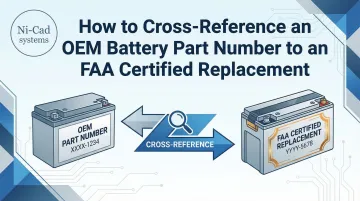
How to Cross-Reference an OEM Battery Part Number to an FAA Certified Replacement
Step 1: Locate and Record the Complete OEM Battery Part Number
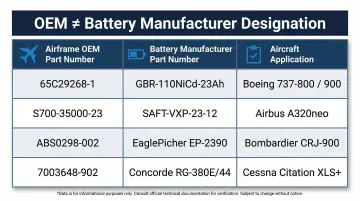
The FAA doesn't mandate universal battery part number syntax—formats vary by manufacturer, and airframe OEM part numbers frequently differ from battery manufacturer designations. This creates traceability gaps that mechanics must resolve before proceeding.
Where to find the part number:
- Aircraft's Illustrated Parts Catalog (IPC)
- Battery placard or label
- Component Maintenance Manual (CMM)
- Type Certificate Data Sheet (TCDS)
Critical data to record:
- Manufacturer name (both airframe OEM and battery manufacturer)
- Battery chemistry (NiCd or lead-acid)
- Voltage and capacity (Ah)
- All dash numbers and suffix codes
- Configuration variants
FAA Advisory Circular 21-29D emphasizes that positive identification is mandatory. Acceptable forms include FAA Form 8130-3, FAA-PMA markings per 14 CFR §45.15, or shipping documentation from the Production Approval Holder.
Common part number discrepancies:
| Airframe OEM Part Number | Battery Manufacturer Part Number | Aircraft Application |
|---|---|---|
| Cessna P/N 0511319-1 | Concorde RG-25 or RG-25XC | Multiple Cessna models |
| Cessna P/N C614001-0106 | Concorde RG24-16 | Cessna Citation series |
| Legacy Gill 2442 | Teledyne Gill LT 7242-14/7242-16 | General aviation aircraft |
For discontinued or superseded part numbers, PMA holders typically maintain proprietary cross-reference databases that map legacy OEM designations to currently approved replacements.
Step 2: Gather the Aircraft Identification and Eligibility Data
Battery eligibility is aircraft-model specific. A PMA part approved for dozens of aircraft models may not be eligible for yours—and installing it anyway makes it an unapproved part regardless of physical equivalency.
Required aircraft information:
- Aircraft make and model
- Serial number
- Type Certificate Data Sheet (TCDS) reference
- Current maintenance manual revision
- Any applicable Service Bulletins
Check for Airworthiness Directives (ADs):
Under 14 CFR Part 39, ADs are legally enforceable regulations that can restrict battery substitutions. Recent examples include:
- AD 2024-11-01: Requires replacing certain PMA Ni-Cd batteries on Airbus models due to reduced capacity during storage
- AD 2021-10-20: Mandates operational testing of battery systems on ATR aircraft following display unit failures
Access the FAA AD database and the Dynamic Regulatory System to verify current requirements before proceeding with any substitution.
Step 3: Search FAA-Approved PMA Cross-Reference Sources
The official FAA PMA database is maintained within the Dynamic Regulatory System. This is your primary verification source—third-party catalogs can contain outdated eligibility data that creates compliance risk.
PMA approval methods:
FAA AC 21.303-4 distinguishes two approval pathways:
- Identicality: Design is identical in every respect to the type-certificated article
- Tests and Computations: Engineering analysis demonstrates the replacement is "at least equal to" the original
Both ensure airworthiness equivalency, but identicality-based PMAs are the more conservative choice for direct substitution.
Cross-reference verification process:
- Search the FAA PMA database by OEM part number or article description
- Review the PMA holder's published eligibility list
- Verify your specific aircraft make, model, and serial number range appears
- Confirm the PMA covers your aircraft's certification basis
Reputable PMA holders maintain detailed cross-reference guides. For example, Ni-Cad Systems provides direct mapping of their NCS804750 to SAFT part numbers 20 VRED and 804750 for Falcon 900, 900EX, 2000, and 2000EX aircraft—the kind of model-specific traceability documentation that simplifies the verification process.
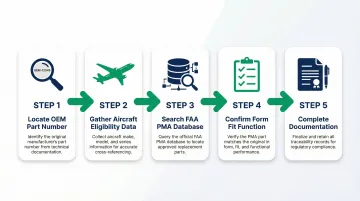
Step 4: Confirm Form, Fit, and Function Equivalency
Matching part numbers alone doesn't confirm compatibility. FAA Advisory Circular AC 23-27 provides specific guidance for battery substitutions, particularly for vintage general aviation aircraft.
Form (physical characteristics):
- Exact dimensions (length, width, height)
- Connector type and orientation
- Terminal configuration (threaded stud vs. quick-disconnect)
- Mounting hole pattern and spacing
Fit (installation compatibility):
- Weight within ±1 pound tolerance (per AC 23-27)
- Battery box or tray compatibility
- Securing device and retention hardware compatibility
- Clearance for ventilation and thermal management
Function (electrical performance):
- Voltage rating (must match exactly)
- Capacity (Ah) meeting minimum requirements
- Chemistry compatibility with charging system
- Discharge characteristics and cold cranking performance
- Temperature certification range
AC 23-27 states explicitly: "This part substitution is permissible only as long as the batteries are the same weight, within plus or minus one pound, and have such similar physical characteristics as to enable the use of the same securing or attaching devices."
Exceeding the ±1 lb tolerance or requiring modification to securing mechanisms elevates the substitution from minor to major alteration status. That distinction directly determines what documentation Step 5 requires.
Step 5: Verify Documentation and Complete the Installation Record
Proper documentation establishes traceability and legal compliance. Three elements are required:
1. PMA Marking
14 CFR §45.15 requires permanent, legible marking with "FAA-PMA," the manufacturer's name or trademark, and the part number.
2. Authorized Release Certificate
While FAA Order 8130.21H makes FAA Form 8130-3 optional for domestic new parts, it remains the FAA's highly recommended method for establishing traceability. Without it, mechanics must rely on alternative documentation (invoices, direct ship letters), which increases receiving inspection burden.
3. Maintenance Record Entry
14 CFR §43.9 requires entries to include:
- Description of work performed
- Date of completion
- Installer's name, signature, and certificate number
- Original OEM part number and replacement PMA part number
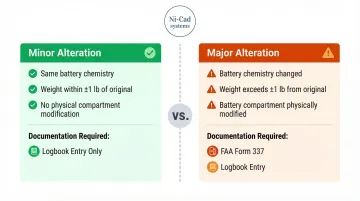
Minor vs. Major Alteration:
| Alteration Type | Conditions | Documentation Required |
|---|---|---|
| Minor | Same chemistry, weight within ±1 lb, no physical modification | Logbook entry only |
| Major | Chemistry change, weight exceeds ±1 lb, or battery compartment modification | FAA Form 337 plus logbook entry |
Key Compatibility Factors That Determine a Valid Cross-Reference
A matching part number doesn't confirm compatibility. Each of these factors must be independently verified to ensure airworthiness isn't compromised.
Battery Chemistry (NiCd vs. Lead-Acid)
NiCd and lead-acid batteries have fundamentally different charge/discharge profiles. FAA AC 00-33A identifies NiCd batteries as temperature-sensitive and susceptible to thermal runaway—an uncontrollable temperature rise that destroys the battery. As temperature increases, internal resistance drops, drawing higher current from constant voltage charging sources.
Lead-acid batteries don't share this profile, which is why chemistry substitution carries direct regulatory consequences. FAA AC 43.13-1B states explicitly: "Any change of battery type may be considered a major alteration." Chemistry changes affect:
- Charging system compatibility
- Emergency bus hold time calculations
- Temperature monitoring requirements
- Thermal management systems
Check whether your aircraft's battery charger, temperature sensor system, and any associated STCs or ADs specify chemistry type. A chemistry change typically requires FAA Form 337.
Voltage and Capacity (Ah) Ratings
Voltage must match the aircraft's electrical system requirement exactly. Capacity affects cold cranking performance, emergency power endurance, and APU start capability — and both are tied to specific airworthiness minimums:
- Transport category (14 CFR §25.1351(d)): Aircraft must operate safely for at least five minutes with normal electrical power inoperative
- General aviation (14 CFR §23.2525(c)): System must have enough capacity to supply essential loads for continued safe flight and landing
Installing a lower-capacity battery won't meet emergency power endurance requirements, creating a certification non-compliance.
Physical Dimensions, Weight, and Mounting Hardware
The battery must fit the battery box without modification, and weight tolerance is a regulatory requirement — AC 23-27 specifies ±1 lb to avoid affecting aircraft weight and balance. Before approving a cross-reference, confirm each of the following:
- Connector polarity and pin configuration
- Terminal type (threaded stud vs. quick-disconnect)
- Locking or retention hardware compatibility
- Ventilation tube routing and clearances
- Cable length and strain relief requirements
For aircraft where multiple battery manufacturers are eligible — such as SAFT, Marathon, or Varta for NiCd, or Concorde and Gill for lead-acid — specialized low-impedance receptacles may be required to maintain proper electrical connections across different terminal configurations.
Aircraft-Specific Eligibility Listing
A PMA part may be approved for dozens of aircraft models — but not necessarily yours. Eligibility is aircraft-model specific. Installing a PMA part on a non-listed aircraft makes it an unapproved part regardless of physical equivalency.
Verify the PMA holder's eligibility list covers your exact aircraft model and serial number range. 14 CFR §21.9 explicitly prohibits representing a replacement article as suitable for installation unless it's produced under an FAA approval covering that specific aircraft.
What You Need Before Starting the Cross-Reference Process
Having the right reference documents eliminates the most common dead ends. Missing a dash number or referencing the wrong TCDS revision can pull eligibility data for an inapplicable aircraft configuration.
Required Documents and References
Airworthiness documentation:
- Illustrated Parts Catalog (IPC) for the aircraft
- Component Maintenance Manual (CMM) for the battery system
- Type Certificate Data Sheet (TCDS)
- Current Airworthiness Directives affecting the battery or electrical system
- Aircraft maintenance manual with electrical system specifications
Cross-reference resources:
- Access to the FAA Dynamic Regulatory System for PMA verification
- PMA holder cross-reference guides and eligibility lists
- Battery manufacturer technical specifications
- OEM service bulletins related to battery systems
For NiCd aircraft batteries specifically, established PMA holders often maintain proprietary cross-reference databases that go beyond what's publicly searchable on the FAA DRS. Ni-Cad Systems, which holds 30+ FAA-PMA approvals, offers technical cross-reference support — including 24/7 AOG assistance at +1 510 501-9391 — for situations where public records don't resolve the eligibility question.
Compliance Readiness
The person performing the installation must hold the appropriate certificate—A&P mechanic or repair station authorization—and be familiar with documentation requirements under 14 CFR Part 43.
Identifying a valid PMA replacement is only part of the process. The installation record — including the part number used, the basis for eligibility, and the certifying signature — is what closes the loop and demonstrates airworthiness was maintained.
Common Mistakes When Cross-Referencing OEM Battery Part Numbers
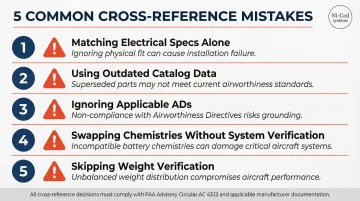
Most cross-referencing errors fall into predictable categories — and each one carries a distinct regulatory consequence. These are the five most common:
Matching electrical specs alone. Voltage and Ah ratings are the starting point, not the finish line. A battery that's electrically equivalent but physically incompatible or not listed for your aircraft model fails airworthiness requirements, regardless of how close the numbers look.
Using outdated catalog data. Third-party supplier listings and online catalogs frequently contain superseded eligibility information. PMA eligibility lists are revised periodically — always verify current approval status against the FAA PMA database or directly with the PMA holder before purchase.
Ignoring applicable ADs. An AD may mandate a specific part number, chemistry, or configuration that restricts substitution. Proceeding without checking creates a regulatory violation that may require an Alternate Means of Compliance (AMOC) to resolve.
Swapping battery chemistries without system verification. FAA AC 00-33A warns against servicing flooded lead-acid and NiCd batteries in the same shop area, where cross-contamination of acid and alkaline electrolytes destroys batteries. Installing a different chemistry without verifying charging system compatibility can damage equipment or create undetected low-state-of-charge conditions.
Skipping weight verification. Assuming a battery is "close enough" without physically weighing it and documenting ±1 lb compliance risks misclassifying the alteration. Exceeding that tolerance turns a simple logbook entry into a Form 337 requirement.
When Should You Cross-Reference vs. When to Consult a PMA Specialist?
For straightforward same-series battery substitutions—where the battery series is already PMA-approved on similar aircraft models—mechanics can typically complete the cross-reference independently using the FAA database and manufacturer documentation.
Cross-referencing becomes complex when:
- The OEM part number is obsolete with no clear successor
- Multiple PMA options exist with slight specification differences
- An Airworthiness Directive restricts or conditions the substitution
- The aircraft operates under Part 121/135 certificate with additional operator approval requirements
- Chemistry change is being considered
- Physical modifications to the battery compartment may be required
When any of those conditions apply, working directly with a Part 145 FAA-approved repair facility gives you access to engineering-level expertise. Ni-Cad Systems' Vice President Stephen Andrues holds 30+ FAA-PMA approvals and serves as an FAA Designated Engineering Representative with 40 years of NiCd battery experience. Rental batteries are available to keep aircraft flying during complex evaluations, and 24/7 AOG support is reachable at +1 510 501-9391.
Part 121 and 135 operators face additional requirements:
Under 14 CFR §121.369 and §135.427, air carriers must follow their specific Continuous Airworthiness Maintenance Programs (CAMP). A PMA battery approved for Part 91 operations requires explicit listing in the carrier's approved maintenance manual before it qualifies for Part 121/135 use—approval on one certificate does not transfer automatically.
Frequently Asked Questions
What are the FAA battery restrictions?
Per 14 CFR §21.9, aircraft battery installations must use parts produced under a Type Certificate, PMA, or TSO authorization — unapproved or non-traceable parts cannot be legally installed on type-certificated aircraft. Applicable Airworthiness Directives may further restrict battery type, chemistry, or configuration on specific models.
What are the two types of batteries used in the aviation industry?
The two primary types are nickel-cadmium (NiCd) and lead-acid batteries. NiCd batteries are common on jet and turboprop aircraft due to high discharge rates and reliability in extreme temperatures. Lead-acid batteries are widely used in piston-engine general aviation aircraft. The two types are not interchangeable without verifying charging system and electrical system compatibility.
What is FAA-PMA and how does it apply to aircraft battery replacements?
FAA-PMA (Parts Manufacturer Approval) is an authorization under 14 CFR §21.303 that permits manufacturers to produce approved replacement parts for type-certificated aircraft. A PMA battery is a legal second-source alternative to the OEM part, provided it appears on the PMA holder's eligibility list for your specific aircraft model.
Can I install a PMA battery without additional FAA field approval?
In most cases, installing a PMA-approved battery listed as eligible for the aircraft is classified as a minor alteration, requiring only a logbook entry per 14 CFR §43.9. However, if the substitution involves a chemistry change or requires physical modification to the battery compartment, it becomes a major alteration requiring FAA Form 337.
How do I verify a PMA battery's eligibility for my specific aircraft?
Search the FAA's online PMA database by part number or article description, then cross-check against the PMA holder's eligibility list, which specifies covered aircraft make, model, and serial number ranges. Contact the PMA holder directly if your specific aircraft's eligibility is unclear.
What documentation must accompany a PMA replacement battery at the time of installation?
The battery must ship with an FAA Form 8130-3 (Airworthiness Approval Tag) from the PMA holder confirming traceability and conformity. The installer must then record a maintenance entry per 14 CFR §43.9 citing both the original OEM part number and the PMA replacement's part number and manufacturer identification.