Introduction
A replacement aviation battery arrives on the flight line or in the shop—what's in the box matters beyond the battery itself. Missing or incomplete documentation can ground an aircraft, trigger a compliance finding, or worse, introduce an unapproved part into service. The FAA Form 8130-3 is the cornerstone of that documentation package, but it's rarely sufficient on its own.
This guide walks maintenance professionals, operators, and procurement teams through exactly what 8130-3 documentation should accompany an aviation battery replacement and what to scrutinize when it does. Whether you're receiving a new FAA-PMA battery or a serviced NiCd unit, getting the paperwork right protects your operation from compliance risk before the battery ever goes into service.
Key Takeaways
- FAA Form 8130-3 certifies your replacement battery's airworthiness and must come from an FAA-authorized source
- Block 11 should reflect the actual work performed (e.g., "Overhauled," "Tested") for serviced batteries or "New" for production releases
- A complete documentation package includes the 8130-3, capacity test report, work order, and traceability records
- Documentation requirements differ between FAA-PMA approved second-source batteries, overhauled units, and other release categories
- Missing, vague, or unverifiable documentation is a red flag — verify the issuing facility's certificate before installation
What Is FAA Form 8130-3 and Why Does It Matter for Aviation Battery Replacements
FAA Form 8130-3 is the "Authorized Release Certificate, Airworthiness Approval Tag," the official document certifying that a part meets applicable airworthiness standards and is eligible for installation or return to service. For aviation batteries, it serves two functions: confirming a new or PMA-approved battery conforms to its approved design data, and approving a serviced or overhauled battery for return to service after maintenance.
Only specific entities may issue an 8130-3 for a battery. These include FAA Aviation Safety Inspectors, Production Approval Holders (PAHs, including PMA holders), and FAA Part 145 certificated repair stations with appropriate quality systems. The issuing organization and signatory's authorization number must be visible on the tag. According to FAA Order 8130.21, independent A&P mechanics are not authorized to issue this form.
Why This Matters for Batteries
Aircraft batteries are safety-critical components subject to:
- Mandatory capacity checks per manufacturer Instructions for Continued Airworthiness (ICA)
- Service life limits and time-between-overhaul requirements
- Airworthiness Directives addressing unsafe conditions
The 8130-3 is documented proof that all applicable requirements were met before the battery left the repair or manufacturing facility. That said, the form has one critical limitation worth understanding: it "does not constitute approval to install" the article on a particular aircraft. The receiving A&P or inspector must still confirm the battery suits the specific aircraft and properly log the installation.
This is why the issuing organization's credentials matter. Ni-Cad Systems holds both Part 145 FAA repair station certification and 30+ FAA-PMA approvals, covering over 47,000 units serviced since 1974 — which means the 8130-3 documentation issued for both serviced and PMA replacement batteries reflects a fully traceable, compliant release.
The Key Blocks to Review on a Battery's 8130-3
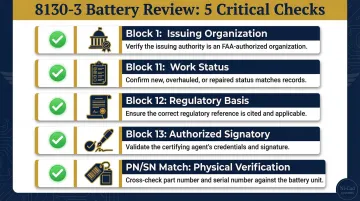
When you receive a battery with an 8130-3, three blocks demand immediate scrutiny — each one must align with the physical unit and your installation requirements to confirm airworthiness status.
Block 1 / Applicant Organization
Verify the name and address of the issuing repair station or manufacturer match a known, FAA-certificated entity. If the organization is unfamiliar, cross-reference it with the FAA's repair station database. The certificate number must match an active facility with a rating that covers battery work.
Block 11 (Status/Work)
For a serviced or overhauled battery, this block should describe the maintenance performed. Look for specific language such as:
- "Overhauled"
- "Repaired and Inspected"
- "Capacity Tested and Returned to Service"
FAA Order 8130.21 permits only one status term per form. Vague or generic entries like "serviceable" without supporting detail fail to meet regulatory standards and warrants rejection.
Block 12 (Remarks)
This block contains the critical regulatory basis for the release. For batteries returned to service under Part 145, confirm it references:
- The specific Component Maintenance Manual (CMM) and revision used
- Airworthiness Directive (AD) compliance status
- Life-limited parts status (if applicable)
- Description of repairs or modifications performed
For a new or PMA battery, Block 12 should reference the applicable design approval data (Type Certificate, PMA approval number) and confirm the part conforms to its approved design. 14 CFR 43.9 requires this level of detail for maintenance records.
Block 13 (Certification)
Check that the authorized signatory's name, certificate number or authorization number, and signature are all present. The approval number must match the correct FAA certificate type — a Repair Station Certificate for maintenance releases, a Production Approval for new parts. If you need to verify designee authority, the FAA Designee Management System is the authoritative source.
Part Description Fields (PN/SN Matching)
Before accepting the battery, verify:
- Part number and serial number on the 8130-3 exactly match the physical unit and all accompanying paperwork
- Physical markings conform to 14 CFR 45.15, which requires PMA and TSO articles to be permanently and legibly marked with the manufacturer ID and part number
Any discrepancy between the tag and the physical part is a compliance hold. Contact the supplier or issuing organization to correct it before the battery is accepted for installation.
What Else Should Come With Your Aviation Battery Documentation Package
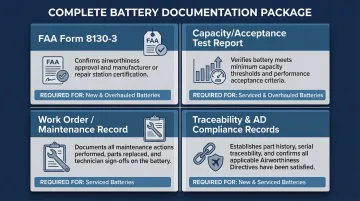
The 8130-3 is necessary, but it doesn't stand alone. A complete battery replacement package should include traceability records, test evidence, and maintenance history — each supporting the airworthiness approval on the form itself.
Capacity/Acceptance Test Report
A properly serviced aviation battery—particularly NiCd types—should come with a capacity test report documenting:
- The battery's tested capacity as a percentage of rated capacity
- Individual cell voltages
- Test date and equipment used
- Pass/fail determination based on manufacturer criteria
AC 43.13-2B states that lead-acid batteries are generally considered airworthy if they meet 80% of their C1 (1 hour) capacity rating, though returning them to service at 85% is recommended. This report confirms the battery meets airworthiness standards and the manufacturer's maintenance manual requirements.
Work Order or Maintenance Record
A detailed work order from the repair facility should accompany the 8130-3, listing:
- All tasks performed (capacity test, cell replacement, connector replacement)
- Parts replaced (cells, connectors, temperature sensors if applicable)
- Reference to the maintenance manual and revision used
- Technician who performed and inspected the work
- Date of completion
This forms the audit trail behind the 8130-3 release statement and satisfies 14 CFR 43.9 maintenance record requirements. Together, the test report and work order establish what was done and whether it met the required standard — the next step is confirming where the parts came from.
Traceability/Source Documentation
For new or PMA batteries and components, look for documentation tracing the battery back to its FAA-approved source:
- For PMA parts: The PMA holder's name and approval number
- For new cells or sub-components: Manufacturer certificates or supplier documentation establishing origin
- A Certificate of Compliance (C of C) alone is not sufficient for airworthiness certification
AC 20-62E clarifies that a C of C merely provides evidence that a part was produced under an approved manufacturing process, whereas an 8130-3 is an official airworthiness approval. The C of C should supplement, not replace, the 8130-3.
AD Compliance and Life-Limit Status
Confirm whether any Airworthiness Directives apply to your battery type and that the documentation package includes evidence of compliance. For life-limited components (such as certain battery cases or temperature sensors), verify that life status records are included and accurate. Block 12 should explicitly reference AD compliance when applicable.
New Battery vs. Overhauled/Serviced Battery: How Documentation Differs
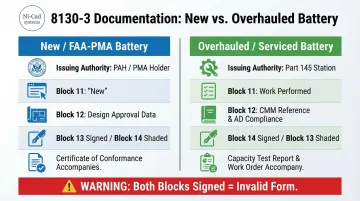
The FAA strictly separates production approvals from maintenance releases. FAA Order 8130.21 explicitly prohibits "a mixture of production- and maintenance-released products and articles on the same FAA Form 8130-3." Accepting invalid documentation puts the battery's airworthiness status in question — and can ground an aircraft during a records audit.
New or FAA-PMA Approved Battery
When receiving a new OEM or FAA-PMA approved replacement battery:
- Issuing authority: Production Approval Holder (manufacturer or PMA holder)
- Block 11 status: Should state "New"
- Block 12 content: References the applicable design approval data (Type Certificate, PMA approval number)
- Signatory block: Block 13 is signed by authorized PAH personnel; Block 14 is shaded/darkened
- Accompanying documents: Certificate of Conformance from the manufacturer typically accompanies but does not replace the tag
For example, when Ni-Cad Systems ships a FAA-PMA approved second-source replacement battery pack, the 8130-3 reflects "New" status and references their PMA approval number in Block 12.
Overhauled or Serviced Battery from a Part 145 Repair Station
When a battery has been returned to service following overhaul or maintenance:
- Issuing authority: Part 145 repair station
- Block 11 status: Reflects actual work performed ("Overhauled," "Repaired," "Inspected," "Tested")
- Block 12 content: References the specific maintenance manual and revision, capacity test results, AD compliance
- Signatory block: Block 14 is signed by authorized repair station personnel; Block 13 is shaded/darkened
- Accompanying documents: Capacity test report and detailed work order
The repair station's certificate number should be clearly visible in Block 14c and verifiable through the FAA repair station database.
Why This Distinction Matters for Records
These aren't interchangeable document types — each reflects a different regulatory authority and a different compliance chain.
Mixing documentation on a single 8130-3 is not permitted. If you receive a form with both Block 13 and Block 14 signed, or a mix of "New" and "Overhauled" parts listed, the form violates FAA Order 8130.21 and is invalid. Reject the form and contact the supplier directly — do not accept the battery into inventory or place it in service until corrected documentation is issued.
Red Flags That Should Raise Concerns About Battery Documentation
Counterfeit parts and fraudulent documentation are real risks in the aviation parts market. Knowing what to look for during receiving inspection can prevent an unapproved component from entering your maintenance records.
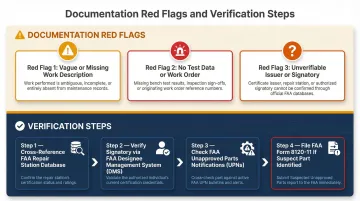
Vague or Missing Work Description
If Block 11 or Block 12 contains only generic language (e.g., "serviceable" with no supporting detail), fails to reference a specific maintenance manual, or is blank, the documentation does not meet the standard required by FAA Order 8130.21 and 14 CFR 43.9. Request a corrected form or complete supporting records before proceeding.
No Accompanying Test Data or Work Order
An 8130-3 tag without a capacity test report or any supporting work order for a battery that was supposedly serviced or overhauled is a documentation failure. Legitimate Part 145 facilities maintain and provide this data as standard practice. Absence of test data may indicate the work was not actually performed or was performed by an uncertificated entity.
Unverifiable Issuing Organization or Signatory
If the repair station name is unfamiliar, the certificate number cannot be located in the FAA's repair station database, or the signatory's authorization number does not correspond to a valid approval, treat the documentation as suspect.
The open, downloadable nature of the 8130-3 form means counterfeit tags are a known risk in the aviation parts market. SAFO 20010 alerts operators to fraudulent documentation. Traceability verification is your primary defense.
When any of these conditions appear, take these verification steps:
- Cross-reference certificate numbers in the FAA repair station database
- Verify signatory authority through the Designee Management System
- Check the FAA Unapproved Parts Notifications database for unapproved or counterfeit battery components
- Report suspected unapproved parts using FAA Form 8120-11
Frequently Asked Questions
Frequently Asked Questions
Does every aviation battery replacement require an FAA Form 8130-3?
Not strictly — a logbook entry meeting all 14 CFR 43.9 requirements is legally sufficient for domestic maintenance releases. However, operators under Parts 121 and 135 should consult their approved procedures and ops specs, which typically require the 8130-3 as the industry standard.
What should Block 12 say on an 8130-3 for a serviced aircraft battery?
Block 12 must reference the specific work performed, the maintenance manual used (with revision), capacity test results, and AD compliance status. It should also include a return-to-service statement under the applicable regulatory authority. Vague entries like "serviceable" do not satisfy 14 CFR 43.9 requirements.
Can a Certificate of Compliance replace an 8130-3 for an aviation battery?
No. A Certificate of Compliance is a supplemental traceability document and is not a substitute for the 8130-3. The 8130-3 is the airworthiness release document, while the C of C supports it by establishing manufacturer compliance and source traceability. Both may accompany a battery, but the C of C cannot replace the 8130-3.
Who is authorized to sign an 8130-3 for an aviation battery replacement?
Authorized signatories include FAA Aviation Safety Inspectors, Production Approval Holders (for new or PMA parts), and certificated Part 145 repair station personnel. The signatory's name, title, and certificate number must appear on the form. Independent A&P mechanics are not authorized to issue 8130-3 forms.
What is the difference in documentation for an OEM battery versus an FAA-PMA approved battery?
Both require an 8130-3, but the issuing authority differs. An OEM battery is released under the Type Certificate or TSO by the original manufacturer; a PMA battery is released under the PMA holder's production approval. Both are acceptable for installation when documentation is complete and physical markings comply with 14 CFR 45.15.
How long should I retain the 8130-3 and supporting documents from a battery replacement?
Retention requirements vary by regulation. Under 14 CFR 91.417, 121.380, and 135.439, operators must keep maintenance records — including 8130-3s — until the work is repeated or superseded, or for a minimum of one year. Best practice is to retain the 8130-3 for the life of the component and keep it available for inspection.